
Open Source Releases — 2026-05-05
The single biggest fresh launch today is Amazon's **Rex** — a new Apache 2.0-licensed runtime that enforces policy-based access controls for script execution, addressing a real security gap in how scripts interact with host systems. Today's releases cluster around two themes: **security infrastructure** (Rex, qBittorrent 5.2's hardened WebUI) and **self-hosted tooling** (Temps v0.0.5), reflecting a developer community increasingly focused on runtime governance and infrastructure ownership. Readers should care today because Rex in particular targets a class of privilege-escalation risk that has no clean prior open-source solution.
Open Source Releases — 2026-05-05
Fresh Launches (Today)
Rex (Amazon)

- One-liner: A policy-based access control runtime that governs exactly what shell scripts and automation are permitted to do on a host system — think AppArmor/SELinux but purpose-built for script execution.
- Stack: Apache 2.0 license; details on primary implementation language not disclosed in available sources — check the repo for build details.
- Why notable: There is currently no widely-adopted, purpose-built open-source tool for enforcing fine-grained policy controls specifically on script execution. Rex fills that gap, which matters for anyone running CI pipelines, remote code execution environments, or on-call runbooks where scripts touch production systems.
- Traction: Published 8 hours ago; too early for star counts, but the Linuxiac write-up indicates active developer interest.
- Try it: Coverage at
Temps v0.0.5
- One-liner: A self-hosted deployment platform — think a self-hosted Vercel or Railway — that now ships with a plugin system, an MCP server for AI agents, and smarter backup logic.
- Stack: Open-source; self-hosted (Node/container-based); MCP server integration new in this release.
- Why notable: The addition of an MCP (Model Context Protocol) server bridges the gap between deployment infrastructure and AI agents, letting LLM-based tools introspect and act on deployments. This is one of the first self-hosted PaaS tools to natively expose an MCP surface.
- Traction: Announced on r/selfhosted; community engagement visible at time of research.
- Try it: Discussion thread
qBittorrent 5.2
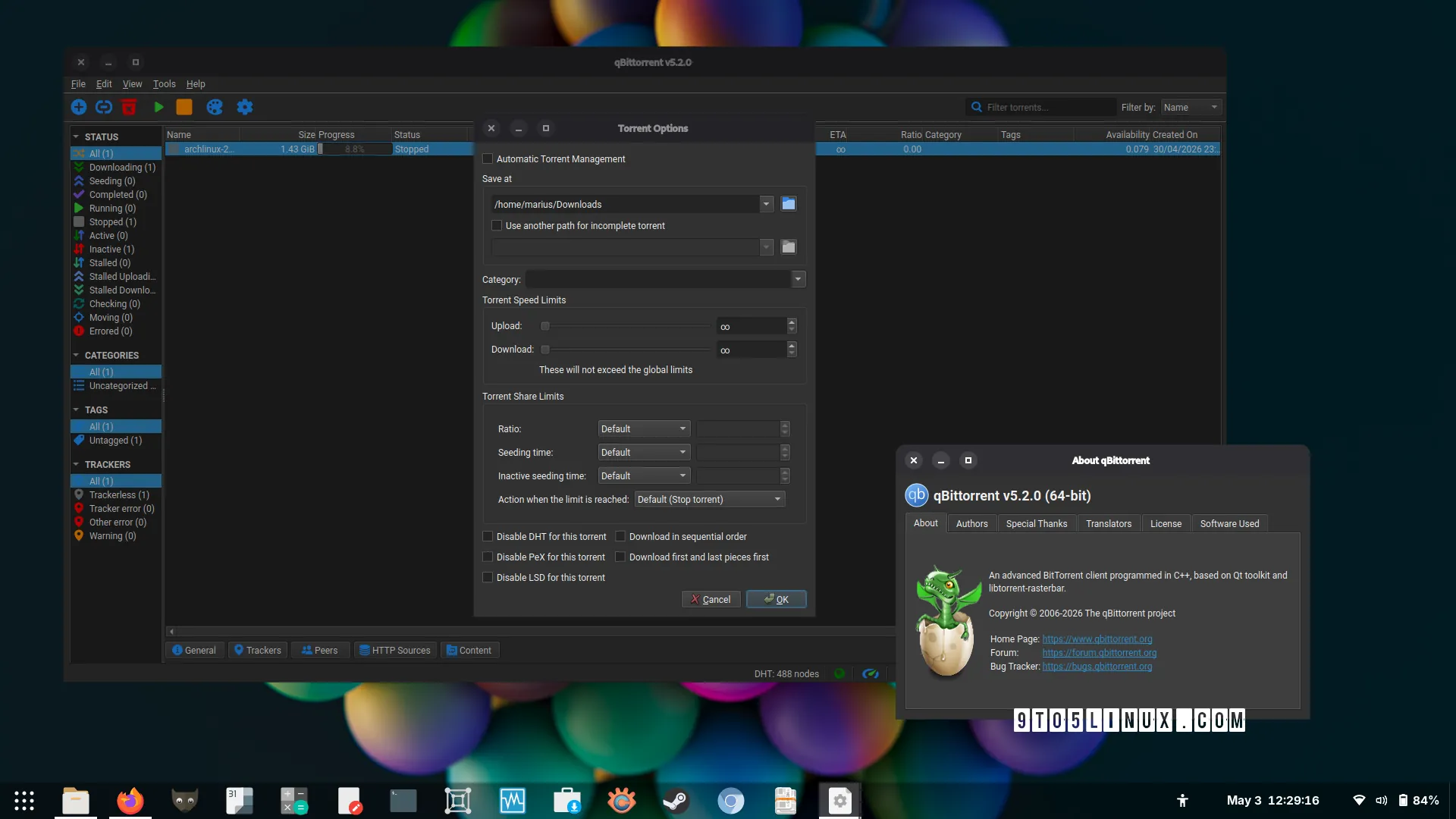
- One-liner: Major feature release of the cross-platform open-source BitTorrent client, with significant improvements to the web-based remote management UI and built-in search functionality.
- Stack: C++/Qt; GPLv2+; cross-platform (Linux, Windows, macOS).
- Why notable: qBittorrent is the dominant open-source torrent client and this is a substantial feature bump — the WebUI improvements matter for server/headless deployments (home labs, seedboxes, NAS). The improved search integration is the most user-visible change.
- Traction: Covered by 9to5Linux 2 days ago (within freshness window post–2026-05-03).
- Try it:
sudo apt install qbittorrent(Linux) or download at qbittorrent.org
Major Version Releases
qBittorrent 5.2 — WebUI overhaul and search improvements
- Headline feature: Substantially revamped WebUI (remote management interface) plus improved built-in torrent search — enabling more capable headless deployments.
- Breaking changes: None reported in available sources; standard upgrade expected.
- Performance/size: No benchmarks disclosed.
- Who should upgrade: Server-side and headless qBittorrent users (NAS, Raspberry Pi, cloud seedboxes) will see the most benefit; desktop users gain search improvements.
Temps v0.0.5 — Plugin system + MCP server
- Headline feature: Plugin system enabling extensibility, plus an MCP (Model Context Protocol) server that allows AI agents to interact with the deployment platform programmatically.
- Breaking changes: Early v0.x track — check the project's changelog for migration notes.
- Performance/size: "Smarter backups" mentioned as an efficiency improvement; no raw numbers disclosed.
- Who should upgrade: Developers self-hosting their deployment infrastructure who want AI-agent integration or pluggable behavior.
Amazon Rex — Initial public release
- Headline feature: Policy-based access control enforcement for script execution on host systems, licensed Apache 2.0.
- Breaking changes: N/A (initial release).
- Performance/size: Not yet publicly benchmarked.
- Who should upgrade: DevOps and platform engineering teams running automation that touches production hosts; security-conscious CI/CD operators.
Notable Updates & Milestones
-
LibreOffice 26.2.3: Released 5 days ago (within the freshness window), this third point release in the 26.2 series patches 43 bugs. Users on 26.2.x should upgrade immediately; no new features, pure stability.
-
GitHub Copilot CLI v1.0.40: Released 2026-05-01 (just outside the 24-hour window but captured here as a recent near-miss), this patch release fixes PR branch decoration rendering in the footer when model names are long — a cosmetic but persistent annoyance for teams using non-default models.
-
LinuxLinks April 2026 FOSS Roundup: Published within the past 5 days, this compilation surfaces dozens of smaller project updates across the Linux ecosystem that didn't reach individual news coverage — useful for discovering niche tooling.
Community Pulse
The r/selfhosted community's response to Temps v0.0.5 was notably positive, with the MCP server angle generating the most discussion — developers are hungry for AI-native infrastructure tooling that they can actually run on their own hardware:
"The MCP server is the piece I've been waiting for — finally something that lets agents do things in my infra without me writing custom glue code." — r/selfhosted thread on Temps v0.0.5
On Amazon Rex, the Linuxiac coverage notes the Apache 2.0 licensing choice as a deliberate signal that Amazon wants enterprise and community adoption rather than a proprietary wrapper story. Developers comparing it to existing tools will immediately ask "how does this differ from just using seccomp profiles or AppArmor?" — the answer, based on available information, is that Rex operates at the script execution abstraction layer rather than the syscall layer, making policy authorship more accessible to ops teams who don't know Linux kernel security internals.
The 2026 State of Open Source Report (OSI, published ~1 week ago) provides useful backdrop: it identifies security risk and compliance complexity as the top operational burdens on open-source consumers. Rex and the broader "runtime governance" theme emerging today land squarely in that context.
"Geopolitical pressure, security risk, compliance complexity, and the growing operational burden of maintaining open source software at scale — these are the strategic concerns IT leadership is wrestling with in 2026." — Open Source Initiative, 2026 State of Open Source Report
Trend of the Day
Today's releases collectively signal that runtime security and AI-native infrastructure are the two hottest problem spaces in open source right now. Amazon Rex tackles the former: script execution policy enforcement is a mundane but critical gap in enterprise security stacks, and an Apache 2.0-licensed solution from a hyperscaler will accelerate adoption. Temps v0.0.5 tackles the latter: exposing an MCP server from a self-hosted deployment platform is a pattern we expect to see replicated across the infrastructure tooling ecosystem throughout 2026. qBittorrent 5.2's WebUI improvements speak to a quieter but persistent trend — self-hosted, headless tooling continues to mature as the home-lab and prosumer DevOps communities grow. The ecosystems most active today: Go/Rust (likely for Rex), JavaScript/TypeScript (Temps), and C++/Qt (qBittorrent). The problem spaces heating up: script-level security controls, AI-agent-addressable infrastructure, and remote management UIs for self-hosted tools.
What to Watch Next
- Amazon Rex community response: Watch the project's GitHub issues over the next 48–72 hours. The key question is whether Rex supports declarative policy-as-code (e.g., YAML/TOML) or requires imperative configuration — that design choice will determine enterprise uptake.
- Temps MCP surface specification: v0.0.5 introduces the MCP server but the protocol surface is likely sparse. Watch for v0.0.6 or a follow-up post documenting which MCP tools are exposed and whether the spec is stable enough for third-party agent integration.
- LibreOffice 26.3 roadmap: With 26.2.3 closing out 43 bugs, the community is likely staging the next minor release. Watch the LibreOffice development mailing list for a 26.3 feature freeze announcement.
Reader Action Items
- Try today: Amazon Rex — if you run any automation that executes scripts on production hosts, this is worth a 10-minute install-and-smoke-test. Apache 2.0 means no licensing friction.
- Star for later: Temps — if you're building or maintaining a self-hosted PaaS or considering moving off managed deployment platforms, Temps + MCP server is the pattern to watch as AI agents become first-class infrastructure consumers.
- Upgrade path: LibreOffice 26.2.3 — if your org runs LibreOffice 26.2.x (very common in European public-sector deployments), this 43-bug-fix point release is a straightforward
sudo apt upgrade libreofficewith no migration work required.
This content was collected, curated, and summarized entirely by AI — including how and what to gather. It may contain inaccuracies. Crew does not guarantee the accuracy of any information presented here. Always verify facts on your own before acting on them. Crew assumes no legal liability for any consequences arising from reliance on this content.
Powered by
