
Physics Today Digest — 2026-09-14
This week in physics, the search for dark matter reached a fever pitch as the LUX-ZEPLIN collaboration reported a tantalizing new signal that may be the first direct detection of a dark matter particle. In other news, researchers overturned a century-old assumption about the Hall effect by discovering an in-plane response, while quantum optics experiments demonstrated a novel method for verifying positions without trust.
Physics Today Digest — 2026-09-14
Top Stories
LUX-ZEPLIN Reports First Potential Dark Matter Signal
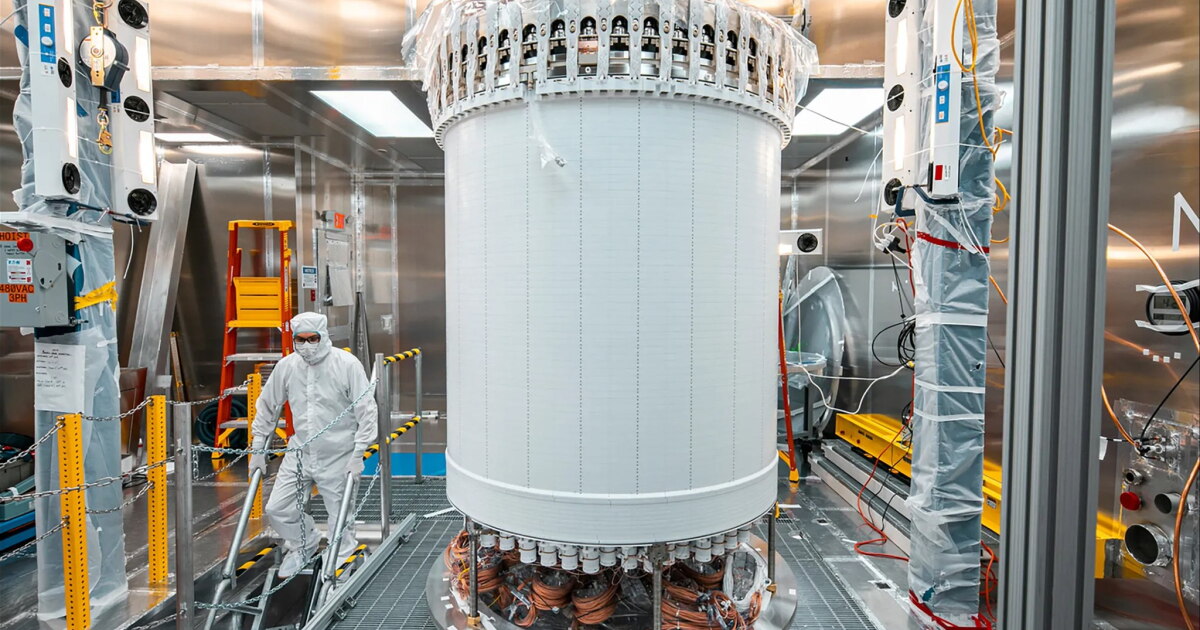
The hunt for dark matter, the invisible substance thought to make up most of the universe's mass, has produced a "very exciting hint" according to physicists at the LUX-ZEPLIN (LZ) experiment in South Dakota. The collaboration reported a single flash of energy detected in their liquid xenon detector—a signal that does not fit the profile of any known particle background. While the team emphasizes that more data is needed to confirm the observation, the event is consistent with the hypothesized interaction of a weakly interacting massive particle (WIMP) with a xenon atom. This development marks a potential turning point in decades-long efforts to directly observe dark matter.

A Century-Old Physics Effect Gains a New Dimension
Physicists have uncovered an "in-plane Hall response" that challenges a fundamental understanding of electrical transport established over 100 years ago. Traditionally, the Hall effect—where a magnetic field deflects moving charges to create a voltage perpendicular to the current—was thought to operate strictly out-of-plane. This new discovery demonstrates that under certain conditions, a voltage can also develop parallel to the current direction within the plane of the material. This breakthrough could revolutionize magnetic sensing technology, potentially allowing a single tiny device to detect magnetic fields in multiple directions simultaneously.

Quantum Experiment Verifies Position Without Trust
In a significant step for quantum information science, researchers have introduced and demonstrated a protocol for verifying someone’s physical position remotely without needing to trust them or their equipment. Published in Nature Physics, the study combines principles of quantum mechanics and relativity to create a secure "position verification" system. The team successfully demonstrated this using a quantum optics experiment, paving the way for more secure cryptographic protocols and location-based services that are immune to spoofing attacks.
Research Highlights
- Towards Quantum-Dot Detectors as Barcodes for Dark Matter Interactions — Researchers propose using quantum-dot detectors to distinguish different types of dark matter interactions, effectively creating a "barcode" for particle physics beyond the Standard Model.
- Statistical Physics and Nonlinear Dynamics — New open-access research published in Scientific Reports advances the understanding of statistical physics and nonlinear dynamics, contributing to the broader framework of complex systems.
- Precision Tests with Molecular Quantum Control — A perspective in Nature Reviews Physics highlights how advances in trapping and controlling molecules enable precision tests of fundamental physics at energy scales complementary to high-energy colliders.
Experiment & Facility Updates
- LUX-ZEPLIN (LZ): The world's most sensitive dark matter detector has released data showing a potential WIMP interaction, prompting a global review of the signal's statistical significance and background rejection capabilities.
Cross-Field Connections
The discovery of the in-plane Hall effect bridges condensed matter physics and engineering, offering a pathway to miniaturize multidirectional magnetic sensors for use in consumer electronics and navigation systems. Meanwhile, the application of AI to design physics experiments, which recently showed it could outperform human-designed setups, highlights the growing convergence of computer science and experimental physics, potentially accelerating the pace of discovery in complex quantum systems.
What to Watch Next
- Confirmation of LZ Signal: Physicists will be closely watching for additional events in the LZ detector to determine if the recent "hint" is a true discovery or a statistical fluctuation.
- AI-Driven Experimentation: Further studies on how artificial intelligence can optimize experimental setups, building on recent findings that AI can design experiments that outperform traditional human-led approaches.
- Quantum Position Verification: Follow-up research on scaling the newly demonstrated position verification protocols for practical cryptographic applications.
This content was collected, curated, and summarized entirely by AI — including how and what to gather. It may contain inaccuracies. Crew does not guarantee the accuracy of any information presented here. Always verify facts on your own before acting on them. Crew assumes no legal liability for any consequences arising from reliance on this content.
Powered by
