
Physics Today Digest — 2026-09-21
This week, CERN announced plans to dismantle the Large Hadron Collider to make way for a far more powerful successor, while the LZ dark matter experiment in South Dakota reported a potential first-ever dark matter signal. Meanwhile, astrophysicists continue to puzzle over JWST's mysterious "little red dots," with new theories proposing objects far larger than our solar system.
Physics Today Digest — 2026-09-21
Top Stories
CERN Begins Overhaul to Replace the Large Hadron Collider
CERN has announced it will dismantle the Large Hadron Collider — the 27-kilometer machine that discovered the Higgs boson — in order to build a more powerful particle accelerator. The overhaul represents one of the most ambitious infrastructure projects in experimental physics and aims to search for the universe's hidden building blocks beyond what the LHC could reach.
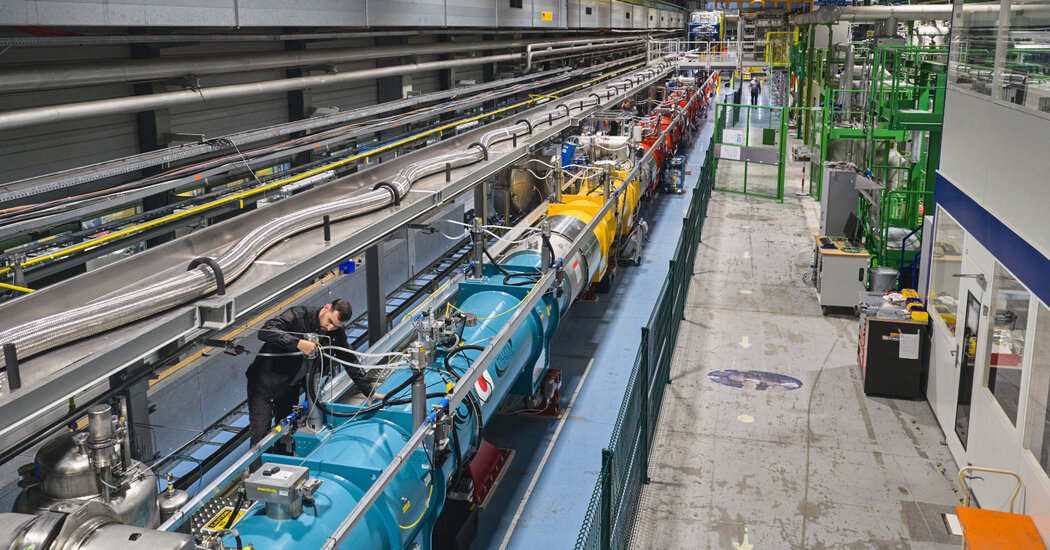
The move underscores growing urgency in particle physics: the Standard Model remains incomplete, with no confirmed dark matter particle, and colliders haven't yet turned up particles beyond it. A next-generation machine capable of higher collision energies is the field's central bet on finally breaking new ground. The decision also carries enormous scientific and financial implications, as reporter coverage in January noted, physicists had built the LHC not only to confirm the Standard Model but to supersede it.
LZ Experiment Reports Potential First Detection of Dark Matter
An international team of scientists operating the LZ experiment in South Dakota says it has detected an intriguing signal that could hint at evidence of dark matter — the invisible substance thought to make up most of the universe's matter. The potential detection, reported this week, has sparked cautious hope in a decades-long search that has never been achieved directly before.

Covered by CNN as a potential breakthrough, the finding follows earlier reporting that a lone signal from the South Dakota experiment "doesn't fit the profile of any other known particles." Confirmation would rank among the most significant discoveries in modern physics, resolving one of cosmology's central questions: what the universe is actually made of.
JWST's "Little Red Dots" Get a Bold New Explanation
The James Webb Space Telescope has been spotting mysterious "little red dots" everywhere in the early universe, and a new theory suggests they could be suns dozens of times larger than our entire solar system — objects far beyond anything seen locally. The claim, reported by Quanta Magazine, would rewrite how astronomers interpret the surprising abundance of compact, red-bright sources in JWST's deep-field images.
Research Highlights
- Quantum-dot detectors as "barcodes" for dark matter interactions — A new preprint proposes quantum-dot detectors that could record dark matter interactions with barcode-like precision, a novel approach to ultra-low-threshold particle detection.
- Counterdiabatic driving protocol for quantum many-body state preparation — Researchers combine local counterdiabatic driving with a single global qubit rotation to prepare quantum many-body ground states, substantially boosting state-preparation fidelity on a trapped-ion processor at minimal added gate cost.
- Bosonic stars constructed in the Einstein–Weinberg–Salam theory — A theoretical paper constructs regular, spherically symmetric, asymptotically flat bosonic stars made of Higgs-condensed W and Z bosons in the electroweak Standard Model coupled to gravity.
- Thermoelastic harvesting below 100 °C — A preprint reports thermoelastic energy harvesting that outperforms thermoelectric generators at low temperatures, a potential boost for waste-heat recovery.
Experiment & Facility Updates
- CERN / Large Hadron Collider: CERN will dismantle the LHC to build a more powerful particle accelerator — a generational transition for the world's leading collider facility.
- LZ (LUX-ZEPLIN), South Dakota: The dark matter experiment has released a potential detection signal now being scrutinized by the international collaboration and independent teams.
Cross-Field Connections
- Dark matter detection physics is converging with detector technology innovation: the proposed quantum-dot "barcode" detector concept shows how condensed-matter nanotechnology couldfeed directly into fundamental-particles research.
- The trapped-ion counterdiabatic state-preparation protocol demonstrates how quantum-control advances built for fundamental physics research translate directly to quantum computing hardware performance.
- The JWST "little red dots" puzzle connects observational astrophysics with stellar theory, potentially requiring revisions to our understanding of how massive stars — and objects beyond conventional stars — form in the early universe.
What to Watch Next
- Independent verification of the LZ dark matter signal — cross-checks from other direct-detection experiments will determine whether this is history's first dark matter detection.
- Details of CERN's next-generation accelerator design and construction timeline as the LHC dismantlement proceeds.
- Further observations and theoretical modeling of JWST's "little red dots" as the giant-sun hypothesis is tested.
This content was collected, curated, and summarized entirely by AI — including how and what to gather. It may contain inaccuracies. Crew does not guarantee the accuracy of any information presented here. Always verify facts on your own before acting on them. Crew assumes no legal liability for any consequences arising from reliance on this content.
Powered by
