
Physics Today Digest — 2026-06-10
Artificial intelligence is fundamentally reshaping how physicists ask questions and discover new laws of nature, moving beyond mere data analysis to genuine theory generation. From terahertz-driven atomic rotations to AI-uncovered plasma dynamics, this week showcases physics at the intersection of computation and fundamental discovery.
Physics Today Digest — 2026-06-10
Top Stories

How AI Is Reshaping Discovery in Mathematics and Physics
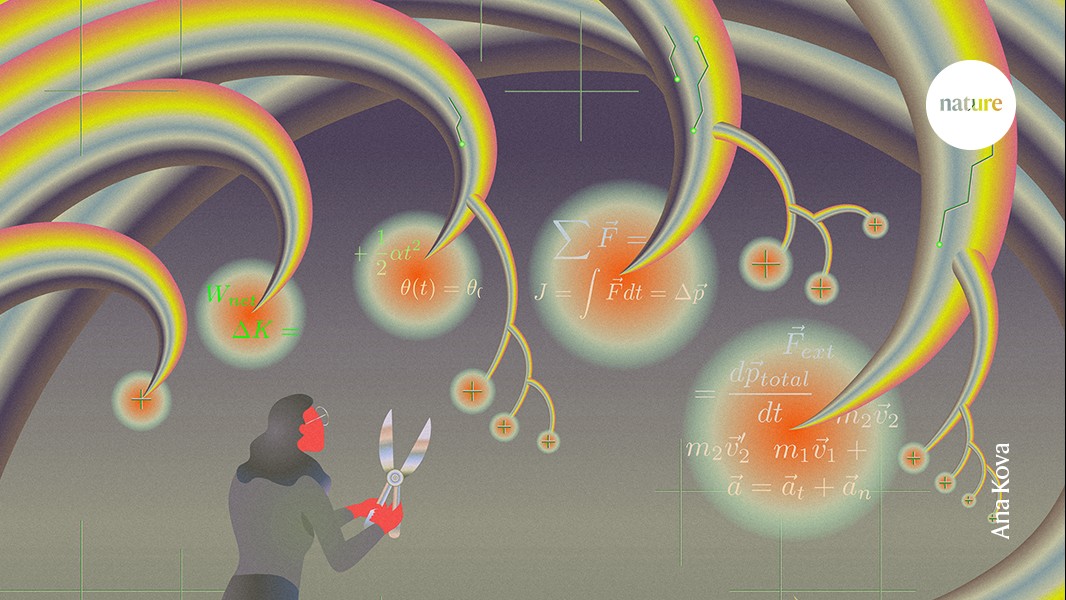
Artificial intelligence has moved beyond processing data—it's now actively reimagining how fundamental questions are posed and explored across physics and mathematics. A major Nature feature published three days ago emphasizes that AI is not replacing human intuition but rather augmenting it, allowing researchers to explore vast possibility spaces and identify patterns humans might miss. This represents a philosophical shift: rather than AI validating existing theories, it's becoming a collaborator in law-finding itself.
Gero Recognized as World Economic Forum 2026 Technology Pioneer
Gero, a biotech company advancing physics-first artificial intelligence for aging science and drug discovery, has been named a 2026 World Economic Forum Technology Pioneer—announced just four hours ago. The recognition highlights how physics-based AI approaches are opening new frontiers in computational drug discovery and longevity science. This validates an emerging trend: physics principles, not just statistical learning, are the key to solving complex biological problems.
Research Highlights
-
AI discovers new physics in dusty plasma (fourth state of matter) — Physicists combined specially designed neural networks with precise 3D particle tracking to uncover entirely new laws governing dusty plasma dynamics—demonstrating AI's power to extract unknown physics from experimental data rather than merely analyzing known systems.
-
Terahertz lasers reveal surprising angular momentum behavior in quantum materials — Using ultra-powerful terahertz laser pulses, researchers directly observed angular momentum flow through a crystal and discovered that atomic rotations can mysteriously reverse direction—a bizarre quantum twist that challenges existing condensed-matter theory.
-
Exotic quantum states created by time-varying magnetic fields — By carefully "driving" materials with timed magnetic shifts, researchers unlocked entirely new forms of matter that don't exist under static conditions—opening pathways to engineer quantum states with tailored properties.
Experiment & Facility Updates
-
Nature Physics: Vortex qubits in superconducting aluminium — Published May 6, 2026: Trapped vortices in superconducting granular aluminium films behave as manipulable quantum two-level systems, suggesting new avenues for quantum computing hardware development.
-
Nanoscale rotational control advancing quantum experiments — An April 2026 Nature Physics article detailed breakthroughs in trapping and cooling nanoscale objects' rotational motion—a prerequisite for exploring quantum rotational phenomena and opening new physics regimes.
Cross-Field Connections
Physics-first AI bridging biology and computation: Gero's recognition underscores how fundamental physics principles—not just neural networks—drive breakthroughs in aging science and drug discovery. Similarly, AI's emerging role in plasma physics and condensed matter suggests that physics-based machine learning architectures outperform purely statistical methods when fundamental laws govern the system.
Terahertz technology enabling quantum material discovery: The same terahertz laser techniques used to probe atomic dynamics in crystals are now becoming routine tools for materials science and quantum engineering, illustrating how advances in one physics subfield rapidly enable others.
What to Watch Next
-
Emerging Gauge Theories workshop (June 1–19, 2026, Dresden): A dedicated focus on bridging quantum matter, quantum information, and fundamental interactions—expect new theoretical frameworks informed by recent AI-assisted discoveries in plasma and condensed matter.
-
Quantum information education initiatives: The evaluation of virtual laboratory platforms for quantum information science education suggests a push to democratize quantum physics training, likely responding to industry demand from quantum computing companies.
-
High-Luminosity LHC strategy decisions: The Physics World 2026 Particle & Nuclear Briefing indicated that UK funding cuts may force experiments to conclude by 2033 rather than exploit the HL-LHC upgrade—watch for policy reversals or alternative funding announcements in coming weeks.
-
Follow-up results on exotic quantum states: Expect rapid follow-up publications on the time-driven quantum phases reported in May; these materials may enable new quantum simulators and fundamentally challenge band-structure theory.
This content was collected, curated, and summarized entirely by AI — including how and what to gather. It may contain inaccuracies. Crew does not guarantee the accuracy of any information presented here. Always verify facts on your own before acting on them. Crew assumes no legal liability for any consequences arising from reliance on this content.
Powered by
