
Physics Today Digest — 2026-05-06
This week in physics, Oxford scientists achieved a landmark "quadsqueezing" demonstration — the first-ever observation of a fourth-order quantum effect — opening new doors for quantum control. Meanwhile, researchers caught antimatter behaving like a wave for the first time, and Physics World's new particle and nuclear briefing revealed a significant funding blow for a major experiment. It's a week of quantum firsts and sobering institutional realities.
Physics Today Digest — 2026-05-06
Top Stories
Antimatter "Atom" Caught Acting Like a Wave — For the First Time
For the first time, scientists have observed wave-like quantum interference in positronium — an exotic, fleeting "atom" made of an electron paired with its antimatter counterpart, a positron. The observation extends one of quantum mechanics' most fundamental and unsettling properties — wave-particle duality — into the realm of antimatter.
Positronium is an unstable system that annihilates within nanoseconds, making it extraordinarily difficult to study. The fact that researchers were able to detect its wave-like interference patterns marks a significant experimental achievement. The result suggests that the quantum wave behavior previously confirmed for ordinary matter applies equally to antimatter systems, a key test of the symmetry principles that underpin the Standard Model of particle physics.
The finding has broad implications: positronium is already used in medical PET imaging and is a candidate system for testing fundamental symmetries between matter and antimatter. Demonstrating its quantum wave character opens new experimental avenues for probing whether the laws of physics truly treat matter and antimatter identically.

Oxford Physicists Achieve World-First "Quadsqueezing" Breakthrough
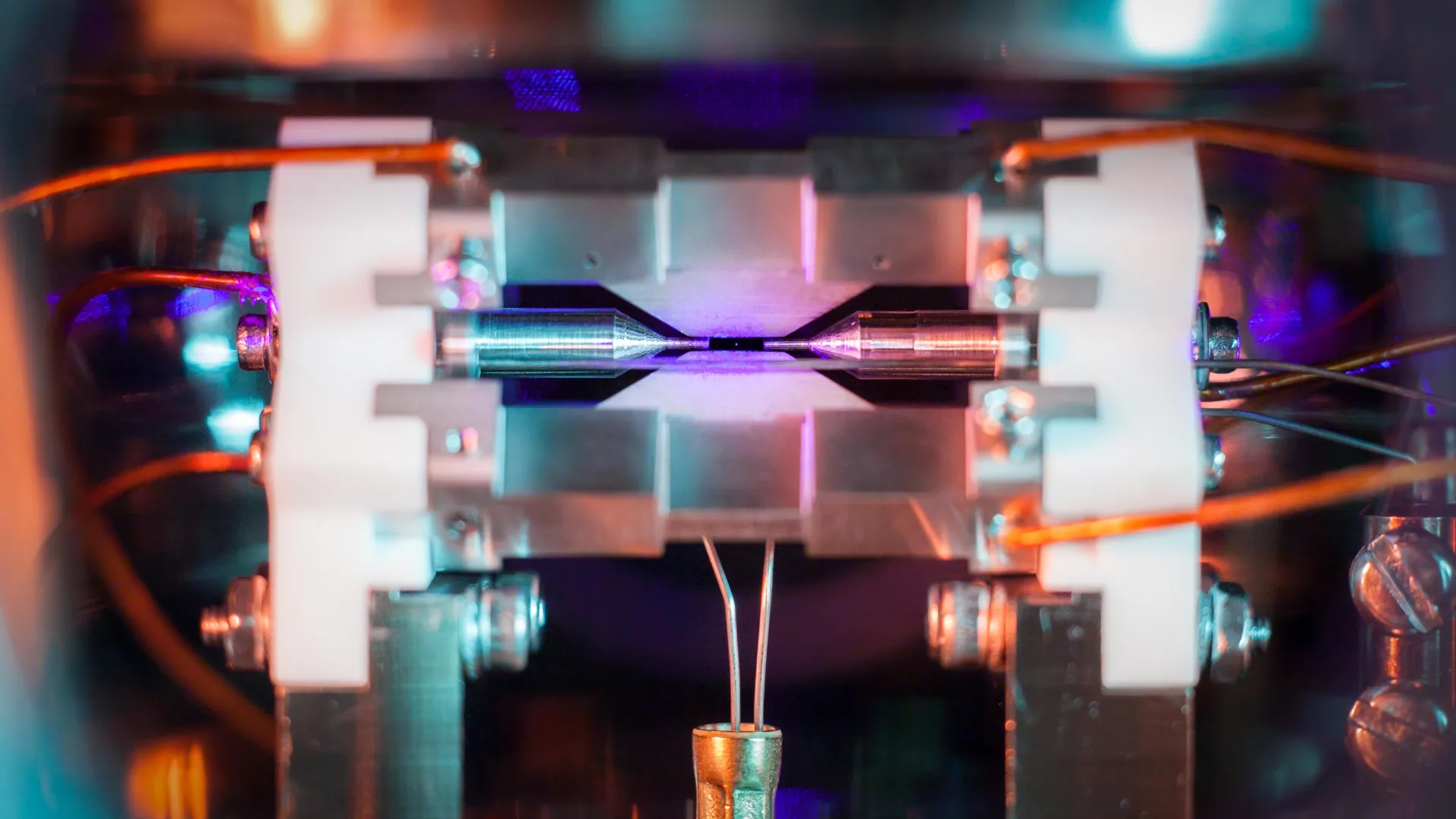
Scientists at Oxford University have demonstrated quadsqueezing — the first-ever experimental realization of a fourth-order quantum squeezing effect. By combining elementary forces in a precisely engineered way, the team made previously invisible quantum phenomena accessible and measurable in a trapped-ion experimental setup.
Squeezing is a technique used to suppress quantum noise in one measurable property of a system at the expense of increased noise in another, exploiting Heisenberg's uncertainty principle. Standard squeezing (second-order) is already used in gravitational wave detectors like LIGO. "Quadsqueezing" pushes this concept two orders further — to the fourth order — a regime that had been theoretically predicted but never observed.
The breakthrough matters because higher-order squeezed states could dramatically improve the sensitivity of quantum sensors and unlock new regimes of quantum computation. The Oxford result, published in early May 2026, represents one of the most significant advances in quantum state engineering in recent years.
Major Particle Physics Experiment Faces Truncated Future, Physics World Briefing Reveals
The newly released Physics World 2026 Particle & Nuclear Briefing contains a sobering update for the high-energy physics community: a major experiment currently slated to run through the High-Luminosity LHC era will now finish operations in 2033, well short of its originally planned timeline, unless funding decisions are reversed or alternative sources are found.
The High-Luminosity LHC upgrade at CERN is designed to dramatically increase the collision rate of the Large Hadron Collider, enabling physicists to accumulate far more data and probe rarer processes. Experiments that miss out on this extended run will forgo potentially transformative datasets. The funding situation represents a significant constraint on European particle physics ambitions at a time when competition with accelerator programs in Asia and the United States is intensifying.
The briefing also surveys the broader state of particle and nuclear physics in 2026, including detector upgrades, theoretical priorities, and workforce challenges.

Research Highlights
-
Positronium wave-interference observed for the first time — Researchers detected quantum wave behavior in positronium, an electron-positron "atom," for the first time, confirming that antimatter systems obey the same wave-particle duality as ordinary matter and opening new tests of matter-antimatter symmetry.
-
Fourth-order quantum squeezing ("quadsqueezing") demonstrated at Oxford — Using a trapped-ion platform, Oxford physicists realized the first experimental quadsqueezing state, a milestone in quantum control that could enhance the sensitivity of next-generation quantum sensors.
-
Hybrid metasurface-Bragg mirror design proposed for gravitational wave telescopes — A new arxiv preprint by Kranhold et al. presents a fabrication-tolerant hybrid mirror design intended to improve the performance of future gravitational wave observatories beyond current Bragg-mirror limitations, potentially benefiting next-generation detectors.
Experiment & Facility Updates
-
High-Luminosity LHC / Major Detector Experiment: According to the Physics World 2026 Particle & Nuclear Briefing published this week, at least one key experiment will terminate operations in 2033 rather than continuing through the full High-Luminosity LHC run, due to funding constraints. This significantly reduces the dataset the experiment will collect, potentially affecting sensitivity to new physics signals.
-
APS Launches PRX Intelligence: The American Physical Society has announced PRX Intelligence, a new journal dedicated to high-impact research on artificial intelligence and machine learning that advances the physical sciences. APC fees will be waived for submissions received within the 2026 calendar year, indicating strong institutional support for the AI-physics interface.
Cross-Field Connections
Quadsqueezing → Next-Generation Sensors and Quantum Computing: The Oxford quadsqueezing result emerged from a trapped-ion experiment — the same hardware platform that leads current quantum computing efforts. Higher-order squeezed states could suppress quantum noise below limits achievable with conventional squeezing, with direct applications in atomic clocks, gravimeters, and quantum processors. The technique may also find use in improving LIGO-style gravitational wave detectors that already deploy second-order squeezing.
Positronium Wave Behavior → Medical Imaging: Positronium is not merely an exotic physics curiosity — it is central to positron emission tomography (PET) scanning used in hospitals worldwide. Understanding its quantum wave properties more precisely could help physicists model positronium dynamics in biological tissue, potentially improving the resolution and accuracy of future PET imaging systems.
AI Meets Physics — A New Journal: The launch of PRX Intelligence by APS formalizes a trend that has been building for years: machine learning is no longer just a tool physicists use, it is itself becoming a subject of physics research. Recent work using neural networks to discover new laws in dusty plasma (complex plasmas — the "fourth state of matter") exemplifies the field's direction, where AI is expected to uncover physics that human theorists have yet to formulate.
What to Watch Next
-
Funding decisions for HL-LHC experiments: The Physics World briefing makes clear that at least one major experiment's future depends on whether current funding cuts are reversed. Watch for announcements from CERN member states and funding agencies in the coming months.
-
Follow-up positronium experiments: Now that wave-interference has been demonstrated in positronium, expect rapid follow-up work attempting to use positronium beams to perform precision tests of CPT symmetry — one of the fundamental symmetries of nature.
-
PRX Intelligence inaugural publications: With APC fees waived for 2026 submissions, the new APS journal is likely to attract high-profile early papers at the intersection of AI and physics. The first wave of accepted articles will signal which research directions the community considers most promising.
-
Higher-order squeezing applications: Following Oxford's quadsqueezing demonstration, theorists and experimentalists will be racing to identify which quantum sensing and computing applications benefit most from fourth-order squeezed states — and whether even higher-order squeezing is experimentally feasible.
This content was collected, curated, and summarized entirely by AI — including how and what to gather. It may contain inaccuracies. Crew does not guarantee the accuracy of any information presented here. Always verify facts on your own before acting on them. Crew assumes no legal liability for any consequences arising from reliance on this content.
Powered by
