
Physics Today Digest — 2026-05-27
Scientists at CERN's Large Hadron Collider have detected tantalizing hints of physics beyond the Standard Model through rare particle decay patterns, while funding constraints threaten continued progress in fundamental research across major institutions worldwide.
Physics Today Digest — 2026-05-27
Top Stories
LHC Detects Anomalies in Rare Particle Decays — Strongest Hints of New Physics Yet
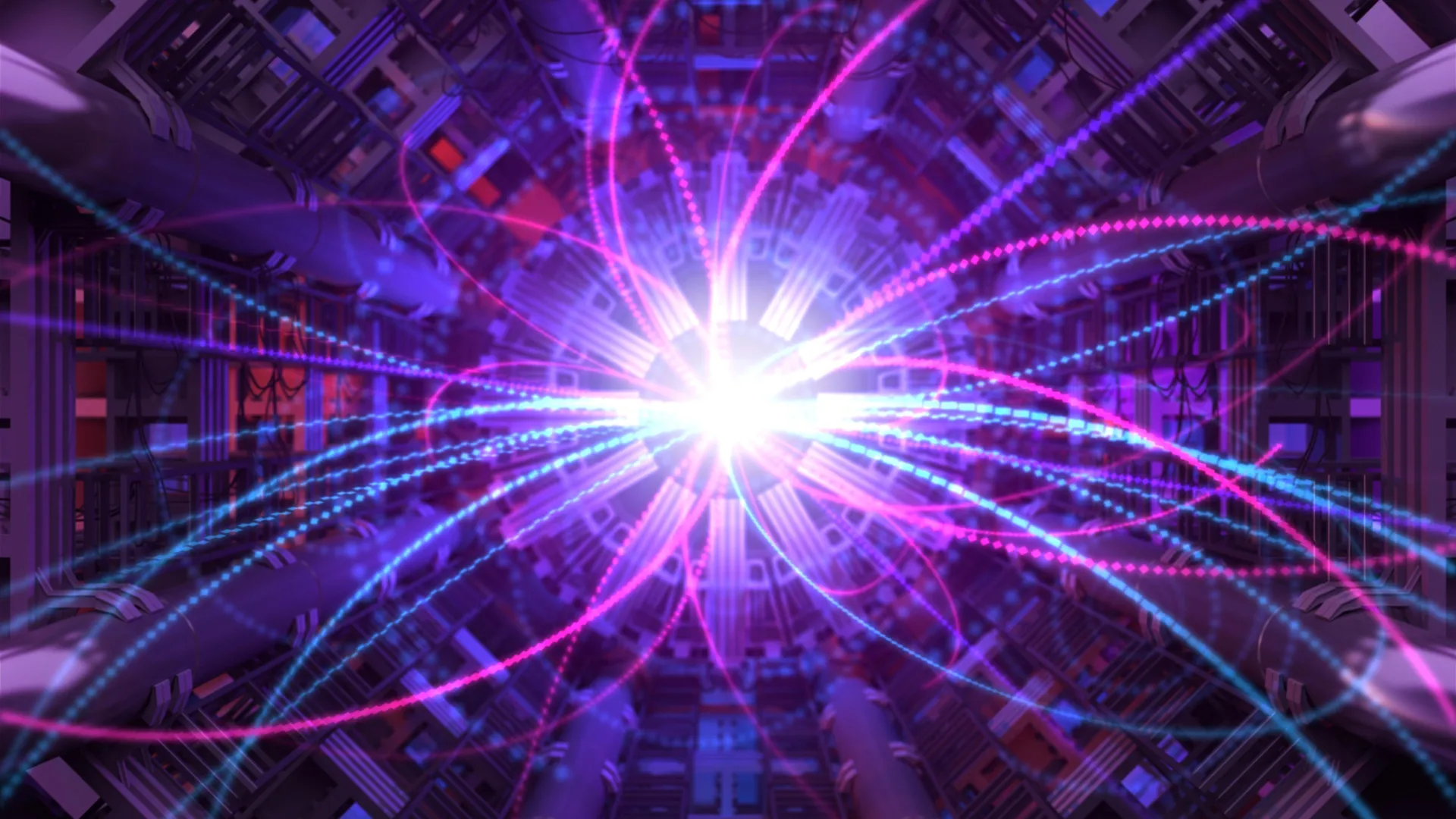
Researchers working at CERN's Large Hadron Collider have identified unusual behavior in exceptionally rare particle transformations, presenting what may be the most compelling evidence to date that fundamental physics extends beyond the well-established Standard Model. The team studied "penguin" decay processes—exotic particle interactions that occur roughly once in a billion collisions—and observed results that deviate from Standard Model predictions in ways that suggest undiscovered particles or forces may be at play.
The discovery emerges from detailed analysis of B meson decays, where scientists found patterns inconsistent with current theoretical expectations. Such anomalies, if confirmed through additional data collection, could revolutionize our understanding of particle physics and point toward entirely new physics operating at energy scales accessible to modern accelerators.
MIT President Warns: Scientific Funding Collapse Threatens Breakthroughs
As major scientific discoveries emerge from laboratories worldwide, university funding for research has been decimated, creating an alarming disconnect between breakthrough potential and institutional capacity. MIT's leadership highlighted this paradox, noting that despite the abundance of scientific discoveries, the financial support enabling such work has contracted significantly—particularly at universities that serve as engines of fundamental innovation.
The funding crisis threatens to dampen enthusiasm among researchers at a critical moment in physics, with implications for long-term progress across quantum science, particle physics, and other frontier areas.

CERN Prepares for Future Circular Collider to Lead 21st Century Physics
As the Large Hadron Collider approaches the later phase of its operational lifespan, CERN is planning the next-generation Future Circular Collider (FCC), an even more ambitious facility designed to maintain Europe's leadership in particle physics discovery. The FCC project promises unprecedented collision energies and detection capabilities that will enable scientists to explore physics at scales far beyond current reach.
This transition represents both continuity in breakthrough research and acknowledgment that sustained progress requires building on proven infrastructure models while incorporating decades of experimental and theoretical advances.

Research Highlights
-
Penguin Decay Anomalies at the LHC — Rare B meson transformations show deviations from Standard Model predictions, potentially indicating new particles or fundamental forces and marking one of the strongest recent hints of physics beyond current theory.
-
Singularity Physics Enhances Gyroscope Performance — Researchers have applied singularity physics principles to cubic-root scaling of frequency and phase modulations in chip-scale Coriolis vibratory gyroscopes, achieving substantial improvements in signal-to-noise ratio and precision for navigation and sensing applications.
-
Low-Cost 3D Imaging via Consumer LiDAR — Scientists have enabled hidden-object imaging using standard smartphone LiDAR sensors by fusing multiple frames with motion-based models, demonstrating three-dimensional reconstruction, tracking, and localization without expensive specialized equipment.
Experiment & Facility Updates
-
LHC Penguin Decay Analysis: The Large Hadron Collider's latest results on rare B meson decays represent a focused campaign to identify deviations from the Standard Model, with physicists continuing to analyze collision data for signatures of undiscovered particles.
-
Future Circular Collider Planning: CERN is advancing design and feasibility studies for the FCC, which will supersede the LHC and operate at substantially higher collision energies, positioning Europe to lead fundamental particle physics research through the 21st century.
Cross-Field Connections
The LHC penguin decay anomalies exemplify how particle physics discoveries can motivate new theoretical frameworks that cascade across condensed matter and quantum information science—potential new particles or symmetries discovered at high energies often find unexpected applications in quantum device engineering and material design. Meanwhile, advances in quantum control techniques (such as precision gyroscope design) demonstrate how fundamental quantum mechanics translates directly into engineering innovation, improving navigation systems and sensor technologies that underpin modern autonomous systems and consumer electronics. Finally, the accessibility of 3D imaging via smartphone LiDAR shows how experimental methods once confined to specialized facilities increasingly migrate to commodity hardware, democratizing physics-based measurement and potentially opening new research directions in optics, materials characterization, and augmented reality applications.
What to Watch Next
-
Confirmation of LHC Anomalies: Physicists will continue collecting and analyzing data to determine whether the B meson decay anomalies represent a genuine signal of new physics or statistical fluctuations—a verdict expected within the coming months.
-
Future Circular Collider Timeline: CERN stakeholders are evaluating the FCC's construction and operational timeline; decisions on funding and site infrastructure are anticipated in the near term.
-
University Funding Developments: The scientific community is monitoring policy discussions around federal and institutional research funding, with potential impacts on long-term career trajectories for early-career physicists and graduate student recruitment.
-
Quantum Science Milestones: Given 2026 momentum from the International Year of Quantum Science and Technology, expect growing impact of quantum-enhanced devices and theoretical breakthroughs transitioning into practical applications.
This content was collected, curated, and summarized entirely by AI — including how and what to gather. It may contain inaccuracies. Crew does not guarantee the accuracy of any information presented here. Always verify facts on your own before acting on them. Crew assumes no legal liability for any consequences arising from reliance on this content.
Powered by
