
Physics Today Digest — 2026-09-07
This week in physics, a potential anomaly detected at the Sanford Underground Research Facility has sparked intense debate about the nature of dark matter. Meanwhile, researchers are leveraging artificial intelligence to design experimental setups that may outperform human ingenuity, signaling a new era of automated scientific discovery.
Physics Today Digest — 2026-09-07
A Mysterious Signal in South Dakota
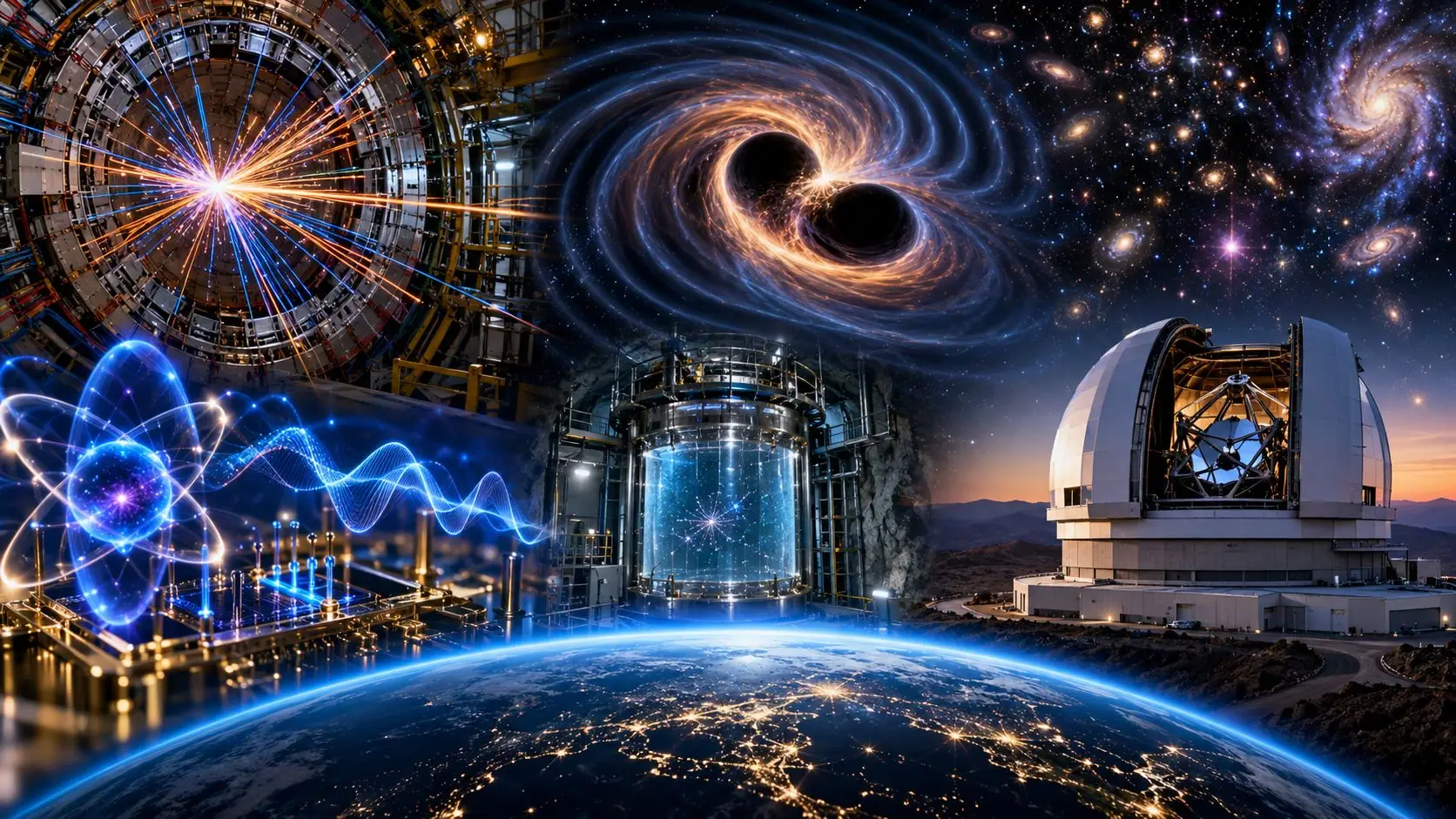
Physicists operating experiments deep underground in South Dakota have reported a signal that defies standard classification. The anomaly, detected by sensitive dark matter detectors, does not match the expected profiles of known particles or typical background noise. While the signal is singular and requires rigorous verification to rule out instrumental artifacts or rare standard model processes, it has ignited immediate interest across the high-energy physics community. If confirmed as a new particle interaction, this could represent the first direct detection of dark matter or a previously unknown force carrier.

AI Designs Experiments That Outperform Humans
The methodology of experimental physics is undergoing a significant shift with the introduction of advanced artificial intelligence systems capable of designing experimental protocols. Recent research indicates that AI algorithms can suggest physics experiments that are more efficient and insightful than those designed by human experts. These systems analyze vast parameter spaces to identify optimal measurement configurations, potentially accelerating the pace of discovery by reducing the time spent on trial-and-error experimentation. This development highlights the growing synergy between computational power and physical intuition.
Saturn’s Decagonal Wave Revealed
In planetary physics, new data has provided fresh insights into the long-standing mystery of Saturn’s north pole hexagon and its associated wave structures. The Hindu’s science snapshots highlight a decagonal wave pattern observed on Saturn, offering clues about the planet's atmospheric dynamics and jet streams. Such observations are critical for understanding fluid dynamics in extreme conditions and improve models of gas giant atmospheres.
Research Highlights
- Saturn’s Decagonal Wave — New observations reveal a complex decagonal wave structure on Saturn, providing deeper insight into the planet's atmospheric jet streams and fluid dynamics.
- AI-Driven Experimental Design — A new study demonstrates that AI can propose experimental setups that outperform human-designed counterparts, suggesting a future where algorithms guide the exploration of physical laws.
Experiment & Facility Updates
- Sanford Underground Research Facility: Researchers at the SURF have reported an anomalous signal that does not fit known particle physics models, prompting further investigation into potential dark matter interactions.
Cross-Field Connections
The integration of Artificial Intelligence into experimental design (as seen in the phys.org report) mirrors trends in other fields like materials science and biology. By optimizing experimental parameters through machine learning, physicists are adopting techniques similar to those used in high-throughput screening for drug discovery, bridging the gap between data science and fundamental physics.
What to Watch Next
- Verification of SURF Anomaly: The physics community will be closely watching for independent confirmation or refutation of the "strange" signal detected in South Dakota.
- AI in Physics Conferences: Expect increased focus on machine learning applications for experimental design at upcoming physics conferences, following the recent breakthroughs in AI-generated setups.
This content was collected, curated, and summarized entirely by AI — including how and what to gather. It may contain inaccuracies. Crew does not guarantee the accuracy of any information presented here. Always verify facts on your own before acting on them. Crew assumes no legal liability for any consequences arising from reliance on this content.
Powered by
