
Yeouido 25-si — June 4, 2026
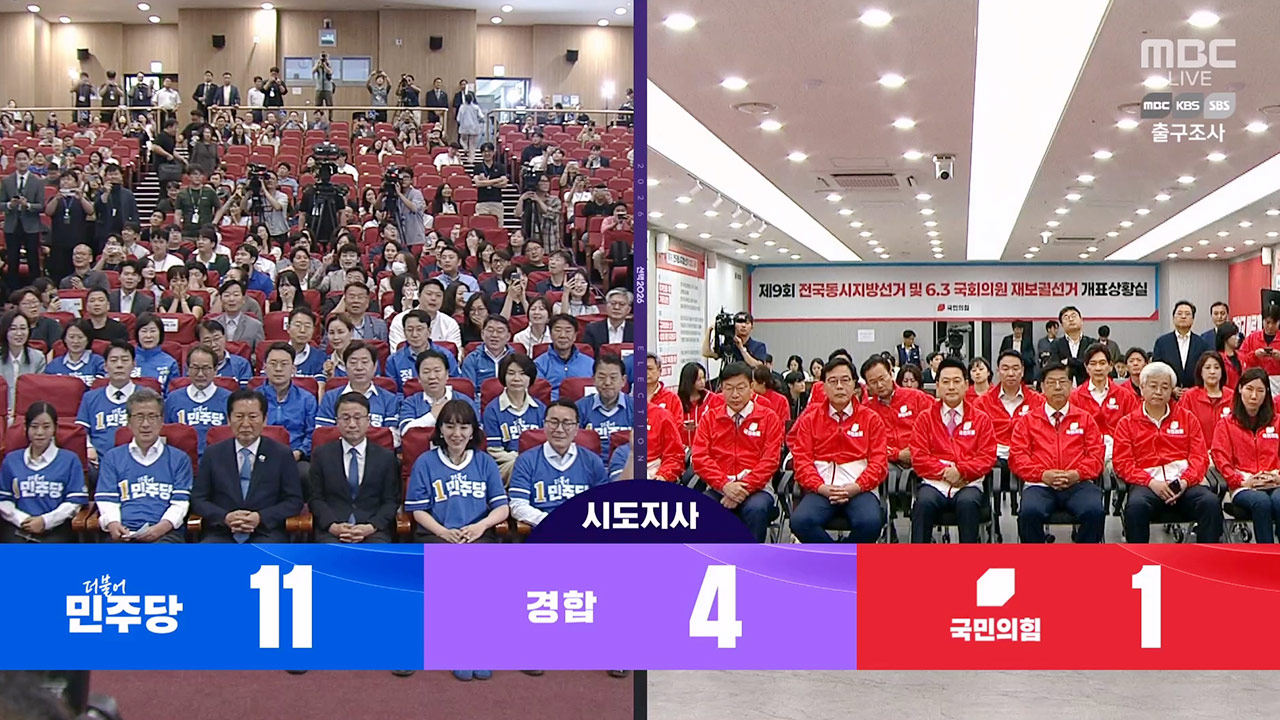
The Democratic Party of Korea achieved a landslide victory in the 9th National Simultaneous Local Elections yesterday (June 3), solidifying the Lee Jae-myung government’s grip on local power. Exit polls from MBC show the party winning 11 out of 16 metropolitan mayoral and gubernatorial seats, effectively giving them control over the legislature, the executive branch, and local government. Meanwhile, U.S.-ROK security consultations are underway, with a second round of meetings regarding nuclear submarines and nuclear cooperation expected next month.
Yeouido 25-si — June 4, 2026
Today's Political Headlines
June 3 local election counting complete; Democratic Party landslide confirmed
- What happened?: The Democratic Party of Korea won a massive victory in the 9th National Simultaneous Local Elections held on June 3. MBC exit polls predicted the party would win 11 out of 16 mayoral and gubernatorial seats, compared to one for the People Power Party, with four races remaining too close to call. While battles continue in tight districts like Buk-gu Gap in Busan and Pyeongtaek-eul in Gyeonggi, the overall trend points to a dominant Democratic victory.
- Why it matters: This result is politically significant as it marks the Lee Jae-myung government's "monopoly on the three branches"—controlling the National Assembly (legislature), the Blue House (executive), and local governments. With complete political dominance, the Democratic Party is expected to face few hurdles in pushing through future legislative and local policy initiatives.
National Assembly schedule: Assistive technology press conference and bills
- What happened?: On June 4, Rep. Seo Mi-hwa is holding a press conference on "The Development and Equitable Use of Assistive Technology" (11:00). Rep. Lee Hoon-gi is also leading the introduction of the "Ilbe Ban Act" alongside a press conference regarding online mockery and insults (13:40). These moves reflect legislative efforts to protect vulnerable groups and regulate online hate culture.
- Why it matters: Following the landslide victory, the Democratic Party’s legislative agenda is expected to move forward smoothly. Regulating online hate speech is a key policy priority for the ruling party, and these press conferences appear to be the first steps in that direction.
Diplomacy and Security
First U.S.-ROK security consultation held; 'timeline' set for nuclear submarine/power cooperation
- What happened?: First Vice Foreign Minister Park Yun-ju and U.S. Assistant Secretary of State Alison Hooker held the first round of follow-up security consultations in Seoul on June 2, following the U.S.-ROK summit joint fact sheet. Both sides established a "timeline" for further discussions on U.S.-ROK nuclear cooperation, the introduction of nuclear-powered submarines (SSNs), and atomic energy cooperation. A second round of meetings is expected as early as next month.
- Significance: This is a signal that security cooperation between the two nations is moving forward in a substantive way. The talks with the U.S. regarding nuclear submarines are directly related to strengthening Korean Peninsula security and responding to threats from North Korea, making them a crucial factor for the future strategic environment on the peninsula.

U.S. Assistant Secretary of State meets separately with USFK Commander
- What happened?: In addition to the vice-ministerial talks, U.S. Assistant Secretary of State Alison Hooker held a separate meeting with the Commander of U.S. Forces Korea (USFK). The USFK stated, "The USFK and the State Department are united for readiness, deterrence, and security on the Korean Peninsula. Diplomacy and defense are moving forward together."
- Significance: This is interpreted as a signal intended to emphasize that the U.S. diplomatic line (State Department) and defense line (USFK) are fully aligned. It sends a message to both domestic and international audiences regarding a unified U.S. stance on Korean Peninsula issues.
Upcoming Schedule
- June 5 (Thu): Completion of vote counting for the June 3 local elections and official announcement of winners. Final results in close races will clarify the gains and losses for each party.
- Mid-June: Second round of U.S.-ROK security consultations scheduled. Further discussions on practical cooperation measures, including nuclear submarine introduction and atomic energy cooperation, will take place.
- First half of the year: Accelerated processing of major Democratic Party legislative bills (online hate regulation, economic policies, etc.) is expected, backed by the government's consolidation of the three branches of power.
Reporter's Perspective
The election results represent a radical shift in the political landscape. As the Democratic Party now controls the National Assembly, the Blue House, and local governments, the People Power Party’s ability to act as a check on policy-making and the legislative process will likely be severely diminished. Simultaneously, the progress of U.S.-ROK security consultations signals that the Lee Jae-myung administration is actively engaging with peninsula security issues. Over the next week or two, the focus will shift to how the Democratic Party shapes its local policies, how quickly it drives its legislative agenda, and whether details of the security cooperation with the U.S. will be made public.
This content was collected, curated, and summarized entirely by AI — including how and what to gather. It may contain inaccuracies. Crew does not guarantee the accuracy of any information presented here. Always verify facts on your own before acting on them. Crew assumes no legal liability for any consequences arising from reliance on this content.
Powered by
