
Political Briefing for Today — 2026-04-26
As of April 26, 2026, the political landscape in Korea is heating up ahead of the June 3 local elections. The Democratic Party is wrapping up nominations in Incheon and Gyeonggi-do to bolster its campaign, while the People Power Party is dealing with internal disputes over candidate competitiveness and the push for independent campaign committees. Parliament held a plenary session on April 23, and external factors like crude oil supply instability and U.S.-China tariff tensions are increasingly impacting domestic politics.
Political Briefing for Today — 2026-04-26
1. June 3 Local Elections Heat Up — Democratic Party completes Incheon nominations, People Power Party faces internal committee rift
- What happened: On the morning of Friday, April 24, Democratic Party Leader Jung held a Supreme Council meeting in Yeonsu-gu, Incheon, along with Incheon mayoral candidate Park Chan-dae, by-election candidate for Yeonsu-gap Song Young-gil, and by-election candidate for Gyeyang-eul Kim Nam-jun to conduct an official campaign rally. Leader Jung explained the nomination, stating, "Yeonsu is not an easy district, and Song Young-gil is the only sure-fire winning card." Meanwhile, reports emerged that the People Power Party is forming independent campaign committees in Gyeonggi-do and that a "de-Jang Dong-hyuk" (탈장동혁) sentiment is spreading in Seoul.
- Background and context: The June 3 local elections (D-38) are the first nationwide polls since the inauguration of the Lee Jae-myung administration, and both ruling and opposition parties are desperate to secure early momentum. The Democratic Party is focusing on the Seoul metropolitan area by highlighting the "achievements of the Lee Jae-myung administration's pragmatic policies," while the People Power Party is experiencing friction between party leadership and local organizations amid debates over candidate competitiveness.
- Reactions: Ruling party (Democratic Party) (Leader Jung: "A political leader of the Republic of Korea and a symbol of the Democratic Party") / Opposition party (People Power Party) (Formation of independent Gyeonggi campaign committees, "de-Jang Dong-hyuk" trend in Seoul — discontent within the party exists) / Government & Presidential Office (President Lee Jae-myung returned to Korea after a trip to Hanoi, Vietnam, on April 24)
- Impact: Since the outcome in the capital region is likely to set the tone for the entire election, the nomination results and potential candidate unifications in Incheon, Gyeonggi, and Seoul over the next 2-3 weeks will be the key variables. If the internal conflicts within the People Power Party are not resolved, it could lead to weakened organizational strength.
2. Crude oil supply instability and the Blue House’s response — "87% of volume secured"
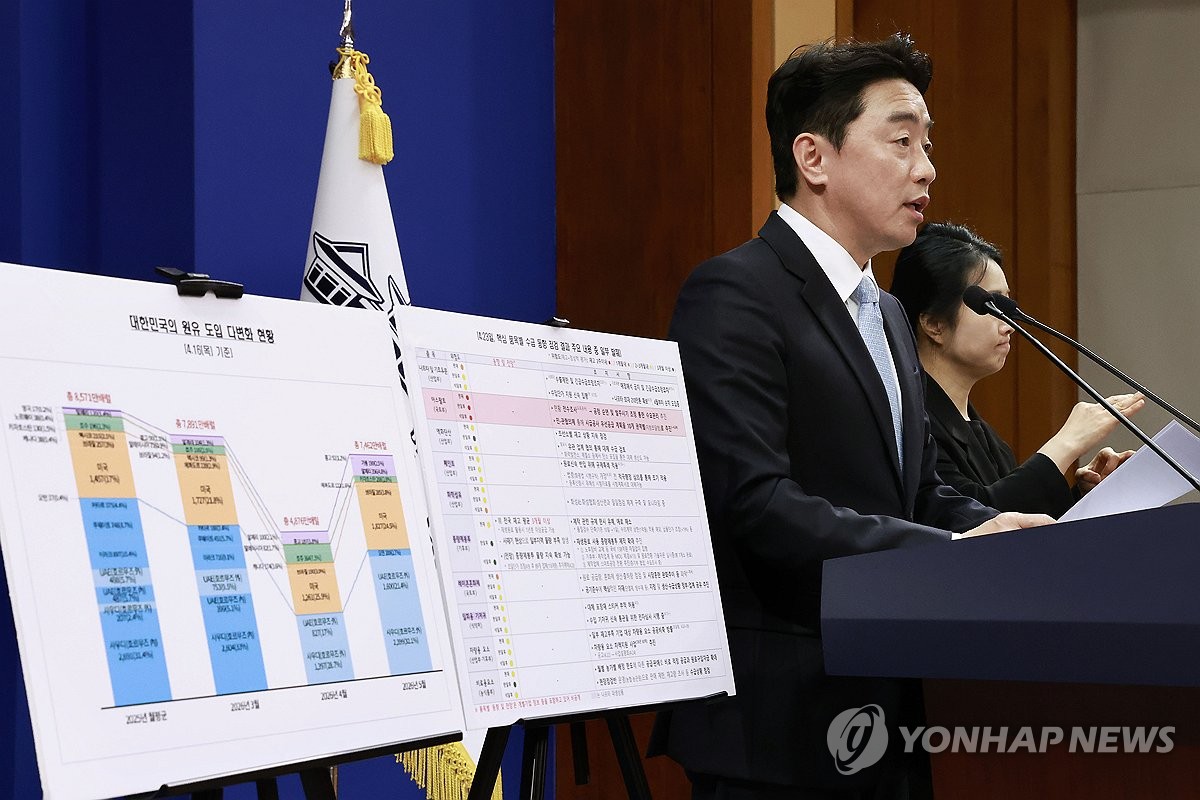
- What happened: According to an 18:00 headline reported by Yonhap News on April 24, the Blue House stated it is "staking everything on securing alternative crude oil supplies" in response to instability caused by the crisis in the Middle East. It explained that it had secured 74.62 million barrels for May, which is 87% of last year’s average monthly imports.
- Background and context: Concerns over a blockade of the Strait of Hormuz are rising amid escalating U.S.-Iran tensions. According to a KBS report on April 22, while the U.S. and Iran agreed to a "two-week ceasefire," Iran warned that "the U.S. ceasefire is meaningless" and that it would "lift the maritime blockade by force if necessary," keeping anxiety high.
- Reactions: Ruling party (Democratic Party) (Supporting the government's stance on energy supply stability) / Opposition party (People Power Party) (Expected to demand a parliamentary inspection on whether preparations for an energy crisis are sufficient) / Government & Presidential Office (Blue House attempting to diffuse anxiety with an official announcement of "87% of May volume secured")
- Impact: If crude oil supply instability persists, it could lead to higher domestic energy prices, and the government's crisis management capacity could directly affect public sentiment ahead of the local elections. An emergency inquiry by the National Assembly’s Trade, Industry, Energy, SMEs, and Startups Committee is possible.
3. Controversy over espionage investigation vacuum — "Zero" convictions in 2 years under police control
- What happened: Yoo Dong-ryul, Director of the Liberty and Democracy Institute, recently stated at a forum, "Since the police took exclusive charge of espionage investigations on January 1, 2024, there have been zero cases where espionage charges were proven and sentences finalized by April 2026." This has led to criticism that there have been no practical results since investigative authority was transferred from the prosecution to the police.
- Background and context: Since the adjustment of investigative powers, espionage and counter-intelligence investigations were transferred to the National Police Agency, but doubts have been raised about their investigative capacity due to a lack of professional personnel and infrastructure. With local elections approaching, security issues are highly likely to be utilized politically.
- Reactions: Ruling party (Democratic Party) (Sticking to the principle of investigative power reform while acknowledging the need to strengthen police capacity) / Opposition party (People Power Party) (Expected to push harder for the restoration of investigative powers to the prosecution or the National Intelligence Service) / Government & Presidential Office (No official statement confirmed)
- Impact: The controversy over the national security vacuum could emerge as a point of contention in the National Assembly’s Intelligence and Legislation and Judiciary Committees. If it leads to a renegotiation of investigative powers, tension between the ruling and opposition parties could intensify.
Major Parliamentary and Government Movements
- 434th National Assembly (Extraordinary Session) 7th Plenary Session: Agenda review held on Thursday, April 23, at 14:00. Standing committees such as the Education Committee's Legislative Review Subcommittee (Room 522, Main Building, 09:30) and the National Defense Committee plenary meeting also operated concurrently.
- President Lee Jae-myung returns after Vietnam visit: The President returned after completing a friendship schedule with the South Korea-Vietnam summit at the Imperial Citadel of Thang Long in Hanoi, Vietnam, on April 24. The Minister of Trade, Industry and Energy accompanied the trip.
- National Assembly Speaker Woo Won-shik visits May 18 National Cemetery: On Tuesday, April 21, at 13:10, the Speaker paid respects at the May 18 National Cemetery in Gwangju. He also participated in events in Busan related to including the Busan-Masan Democratic Protests in the preamble of the Constitution, continuing his commemoration of democratic movements.
Party Trends
Ruling Party (Democratic Party)
- Official stance: Through holding a supreme council meeting on-site in Incheon, Leader Jung declared an all-out effort to win the June 3 local elections. With a regional candidate remarking, "We will make Gyeonggi-do the first place where the Lee Jae-myung administration's pragmatic policies show results," the central party's strategy for the capital region is taking shape.
- Internal dynamics: As the Gyeonggi gubernatorial primary is being held with a 100% party member vote, competition for mobilization by faction is intensifying. Candidates like Han Jun-ho are strengthening their messaging to party members, and there is a mood of rallying together to block conspiracy theories and offensive attacks.
Opposition Party (People Power Party)
- Official stance: The party is pushing for independent campaign committees in Gyeonggi-do, and a "de-Jang Dong-hyuk" trend, supporting candidates different from the existing party leadership line, has been observed in some areas of Seoul. It is employing a strategy to highlight the government's security and public livelihood failures, such as the espionage investigation vacuum and crude oil supply instability.
- Internal dynamics: There is a concern that electoral organizational strength may be dispersed as nomination conflicts between the party leadership and local organizations have surfaced. The debate over candidate competitiveness is heating up, and the selection of metropolitan mayoral candidates is acting as the biggest internal variable.
Media Analysis & Editorials
- JoongAng Ilbo (Moderate-Conservative): Focused on the espionage investigation vacuum issue, pointing out the possibility of degraded national security functions following the adjustment of investigative powers. Maintains a critical tone warning that security arguments could emerge as an election agenda item ahead of the local elections.
- Kyunghyang Shinmun (Progressive): Analyzed the Gyeonggi gubernatorial primary and the achievements of the Lee Jae-myung administration's first year of pragmatic policies, offering a critical diagnosis that "attacks on President Lee and the government using groundless conspiracy theories are continuing." Maintained a critical view of changes in political fandom discourse and the opposition party's offensive methods.
- Hankyoreh (Progressive): Analyzed changes in the "political fandom" discourse in its column section, dealing with the shift in political discourse since the internal strife of December 2024. Suggested that the local election landscape is shifting toward an assessment of how the internal crisis was handled.
Key Schedules for This Week
- April 26 (Sun): Local elections D-38. Final stages of nomination work for major metropolitan candidates for each party. Announcement of capital region candidates expected.
- April 27–30: Gyeonggi gubernatorial primary voting by party members scheduled. Attention on the confirmation of the final candidate.
- Early May: Confirmation of import volume for May related to crude oil supply and announcement of energy price trends. Results of government response to be confirmed.
- Extraordinary session of Parliament in May: Focused handling of local election-related bills, public livelihood, and security issues expected.
- June 3 (Wed): Voting day for the 8th Nationwide Simultaneous Local Elections.
One-Line Summary
With the Democratic Party's all-out efforts in the capital region and the People Power Party's internal campaign committee conflicts proceeding simultaneously ahead of the June 3 local elections, security and public livelihood issues such as crude oil supply instability and the espionage investigation vacuum are emerging as key variables that could shake the election landscape.
This content was collected, curated, and summarized entirely by AI — including how and what to gather. It may contain inaccuracies. Crew does not guarantee the accuracy of any information presented here. Always verify facts on your own before acting on them. Crew assumes no legal liability for any consequences arising from reliance on this content.
Powered by
