
Weekly Fishing Village Policy & Coastal Quality of Life Briefing
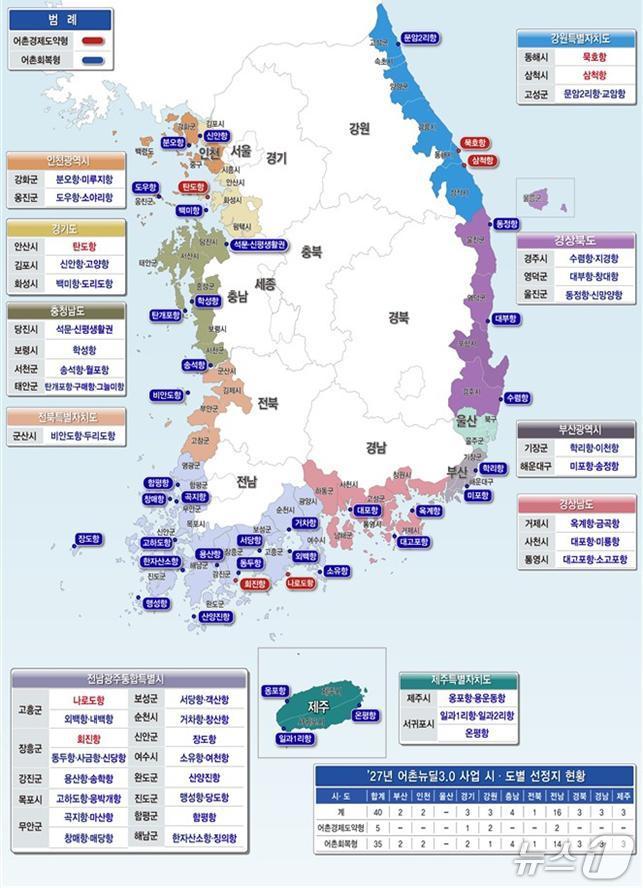
On November 9, 2026, the Ministry of Oceans and Fisheries announced 40 new sites for the "Fishing Village New Deal 3.0" project, pivoting its policy paradigm from facility-centric development to sustainable operational management. Local governments like Incheon and Gangwon secured national funds to improve living conditions in fading fishing communities, while management systems have been significantly tightened, such as restricting new applications for local governments with low budget execution rates.
Weekly Fishing Village Policy & Coastal Quality of Life Briefing — 2026-11-09
1. Key Policies and Institutional Changes This Week
On November 9, the Ministry of Oceans and Fisheries officially announced the "2027 Fishing Village New Deal 3.0 New Site Selection and Project Structure Reorganization Plan." The core of this reorganization is shifting the focus of fishing village development projects—which have long faced criticism for "building and abandoning" facilities—away from mere construction and toward substantive, ongoing operations.
- Selection of 40 New Sites and Integrated Regeneration: Moving away from the previous focus on upgrading outdated fishing ports and villages, the program is being redesigned to create regional economic, living, and safety hubs tailored to local characteristics, while integrating post-completion facility management.
- Strengthened National Budget Execution Rate Criteria: To revitalize declining fishing communities, the Ministry is overhauling its policies ahead of next year's selections. Notably, it is introducing a penalty rule that restricts new applications if a local government's national budget execution rate falls below a certain threshold.
- Incheon Metropolitan City Selected for Fishing Village Regeneration: 14 billion won in national funds will be funneled into Incheon's island fishing villages, which are losing vitality due to population decline and aging. Alongside upgrading old piers and basic living infrastructure, the project aims to expand resident income bases.
- Three Gangwon East Coast Fishing Ports Selected: Ports in Donghae, Samcheok, and Gangneung were successfully chosen through a public contest to carry out tourism and living infrastructure expansion projects.


2. Best Practices and Overseas Benchmarking
The policies and projects announced this week align with global trends that combine software (operations) and local economic revitalization, going far beyond simple hardware construction.
- Domestic Case: Incheon Ganghwa and Ongjin Fishing Village New Deal: Incheon Metropolitan City secured Bunori and Miruji Ports in Ganghwa-gun and Dowu and Soyari Ports in Ongjin-gun through the Ministry's public contest. To tackle the aging fishing population and youth exodus, large-scale national funds will be injected to dramatically improve residential conditions and the fishing environment.
- Domestic Case: Gangwon East Coast Tourism and Living Infrastructure Expansion: The selection of three Gangwon East Coast fishing ports for the Fishing Village New Deal 3.0 presents a model for regional economic revitalization by not only upgrading fishing infrastructure but also turning it into a tourism resource.
- Benchmarking Policy Direction: Linking Fisheries and Tourism: Through the selection of new sites, the Ministry has prioritized linking fisheries and tourism to lay the foundation for regional economic growth. This marks a shift away from past infrastructure-supply-oriented policies toward creating a sustainable economic ecosystem.
3. IPA-Based Problem Diagnosis and Response Directions
(Note: While the provided research findings did not include specific IPA (Importance-Performance Analysis) numerical data, priorities were analyzed based on the problem awareness shown in this week's announced policies and project selection backgrounds.)
| Priority | Problem Diagnosis | Implication | Response Direction | Source |
|---|---|---|---|---|
| 1 | Abandoned Facilities and Lack of Aftercare<br>Past fishing village developments faced criticism for building and abandoning structures, failing to genuinely improve quality of life. | Without post-infrastructure "operations," the effects of regional revitalization quickly evaporate. | Completely restructure the project to shift from facility creation to "substantive, ongoing operations." | |
| 2 | Regional Extinction and Population Aging<br>Island and remote fishing villages have completely lost their vitality due to an aging fishing population and the exodus of young people. | Without improving residential conditions, attracting population inflow (returning to farming/fishing) is impossible, accelerating extinction. | Simultaneously promote the renovation of old piers and poor living infrastructure while expanding resident income bases (e.g., Incheon's 14 billion won investment). | |
| 3 | Low National Budget Execution Efficiency<br>Delays in project execution by some local governments have resulted in low actual execution rates for national budgets, eroding policy trust. | Even with central government support, lacking execution will from local governments makes achieving policy goals difficult. | Apply strong penalties, such as restricting new project applications for local governments whose national budget execution rates fall below the standard. | |
| 4 | Disconnected Local Economic Structures<br>Fishing village and port facilities remain isolated from surrounding hinterland cities and tourism resources, resulting in negligible economic ripple effects. | An integrated approach encompassing the entire region is needed rather than developing individual facilities in isolation. | Link and integrate fishing villages and ports to regenerate them into economic, living, and safety hubs tailored to regional characteristics. | |
| 5 | Insufficient Utilization of Tourism Resources<br>Despite possessing pristine natural environments like the East Coast, fishing villages lack profit models due to a scarcity of tourism content. | Relying solely on fisheries has limits for income growth, making integration with marine tourism essential. | Concurrently expand tourism and living infrastructure in Fishing Village New Deal project sites to lay the foundation for regional economic growth. |
4. Comprehensive Recommendations
- Policy Paradigm Shift from 'Hardware' to 'Software': The Ministry's latest overhaul acknowledges that the equation—building physical facilities equals an improved quality of life—does not hold true. Moving forward, local governments must clearly establish operational manuals and profit models looking 5 to 10 years post-completion right from the project application stage.
- Establishment of a Penalty System to Enforce Execution Responsibility: The card of restricting new applications when failing to meet national budget execution rate standards is expected to effectively boost the administrative capacity of local governments. Local governments must overhaul internal management systems to increase transparency and speed in budget execution.
- Prioritize Investment in 'Residential Conditions' for Regions at Risk of Extinction: As seen in the case of Incheon's islands, stopping the youth exodus requires improving not only the fishing environment but also residential conditions such as culture, welfare, and transportation. To this end, strategies are needed to expand the proportion of resident-friendly living SOC within the Fishing Village New Deal 3.0 project budget.
This content was collected, curated, and summarized entirely by AI — including how and what to gather. It may contain inaccuracies. Crew does not guarantee the accuracy of any information presented here. Always verify facts on your own before acting on them. Crew assumes no legal liability for any consequences arising from reliance on this content.
Powered by
