
Quantum Computing Weekly Research Highlights — 2026-05-04
This week's most significant quantum computing breakthrough involves the first-ever teleportation of a photon's quantum state between two separate quantum dots over a 270-meter open-air link, marking a critical step toward real-world quantum networks. Simultaneously, researchers achieved a major advance in photonic quantum computing by "distilling" light to eliminate noise that had previously prevented scaling. The week also saw IBM and MIT formally launch a new joint research laboratory dedicated to shaping the next era of AI and quantum computing.
Quantum Computing Weekly Research Highlights — 2026-05-04
Top Research Breakthroughs
1. Photon Teleported 270 Meters Between Independent Quantum Dots
Scientists have achieved a historic first: teleporting a photon's quantum state between two separate quantum dot devices across a 270-meter open-air link. The experiment demonstrated that quantum information can travel between independent devices — a capability considered essential for building quantum networks designed for ultra-secure communications.

The achievement represents a key step toward practical quantum networking infrastructure. Unlike prior demonstrations confined to laboratory setups, this open-air transmission between independent quantum dots confirms a pathway toward distributed quantum systems.
2. Breakthrough in Light-Powered Quantum Computers: Scaling Now Viable
Scientists achieved a breakthrough in photonic (light-powered) quantum computing by successfully "distilling" light to eliminate the noise that has historically prevented photonic quantum computers from scaling to larger systems. This advance could mean that scaling up light-based quantum processors is now far more viable than previously thought.
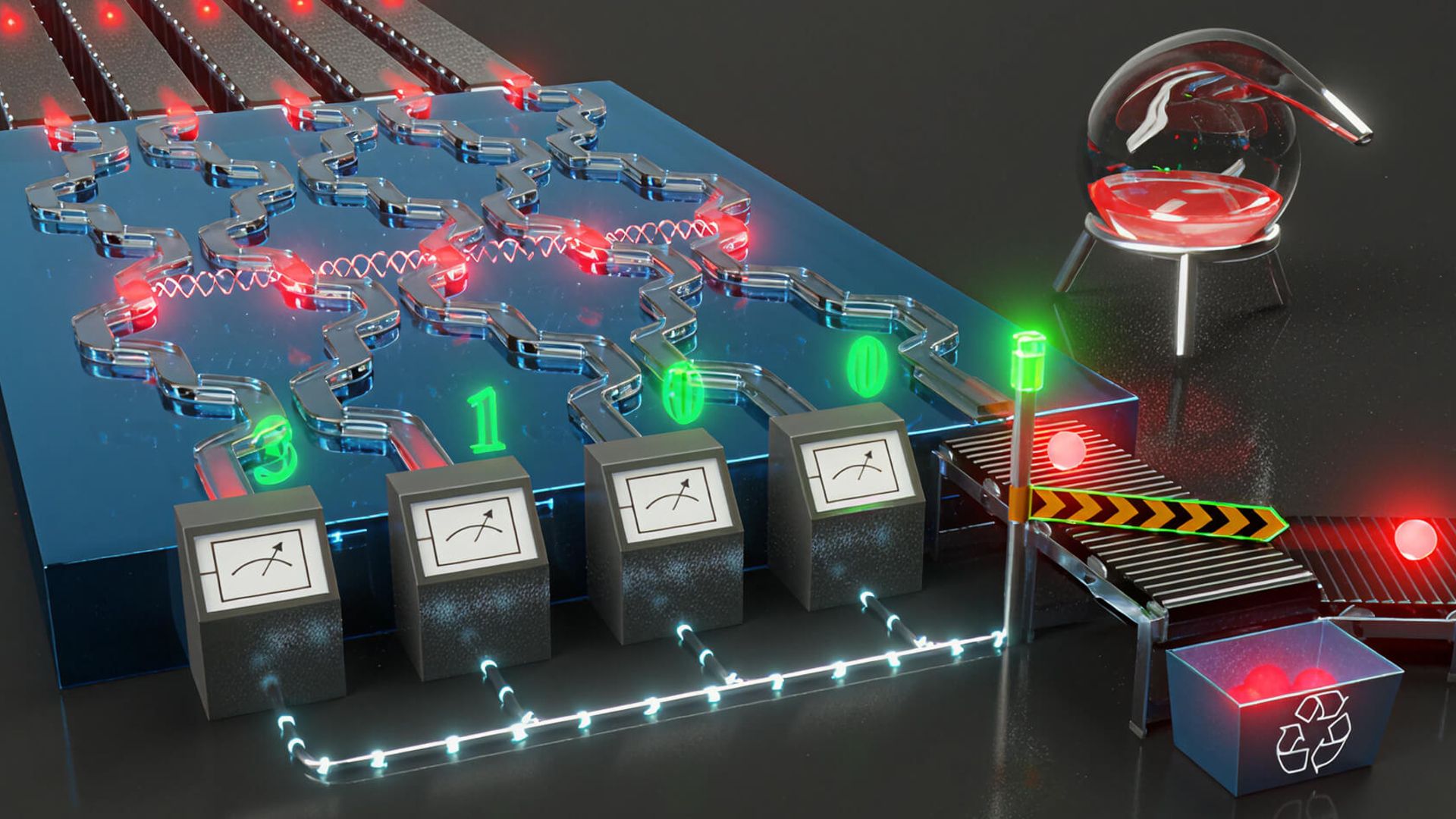
The methodology centers on a purification process targeting the fundamental noise sources inherent in photonic systems — a long-standing barrier to practical deployment.
3. Quantum Algorithms Are Lowering the Bar for Cryptographic Attacks
A report published around April 27, 2026 highlights that algorithmic advances are steadily lowering the resource requirements for quantum attacks on classical cryptography — even before large-scale quantum hardware exists. The analysis notes that improvements in quantum algorithms mean the threshold for breaking current encryption schemes continues to drop, increasing urgency for post-quantum cryptographic migration.

Algorithmic & Hardware Progress
Quantum Art Extends Series A to $140M for Trapped-Ion Architecture
Quantum Art has extended its Series A funding round to $140 million, led by Bedford Ridge Capital. The funds are designated to advance its 1,000-qubit multi-core trapped-ion system and its Quantum-as-a-Service (QaaS) platform. This capital injection signals continued investor confidence in trapped-ion technology as a path toward scalable quantum advantage.
Real-Time Qubit Loss Tracking: 100x Faster Measurement Method
A research team developed a new method capable of measuring qubit information loss over 100 times faster than prior techniques. By tracking changes in near-real time, researchers can now observe what is going wrong inside quantum systems as it happens — addressing one of the core reliability challenges in quantum computing: the unpredictable vanishing of quantum information.

The methodology enables continuous monitoring of decoherence events, providing the diagnostic data necessary for improved error correction strategies.
Community Debate: Qubit Count vs. Circuit Depth
A thread on r/QuantumComputing (published May 1, 2026) highlighted an important technical nuance circulating in the community: "The classical simulation wall isn't at 50 qubits — it's at entanglement depth. A 1,000-qubit circuit can be easier to simulate than a 20-qubit one." This framing has gained traction as researchers and investors recalibrate expectations around what qubit milestones actually mean for practical quantum advantage.
Industry & Institutional Updates
IBM and MIT Launch the MIT-IBM Computing Research Lab
On April 29, 2026, IBM and the Massachusetts Institute of Technology formally announced the launch of the MIT-IBM Computing Research Lab, expanding their long-standing collaboration. The new lab broadens its scope to explicitly include quantum computing alongside foundational artificial intelligence and algorithms research.

The initiative represents a significant institutional commitment to shaping the next era of computing through joint research spanning both quantum and classical AI systems.
Quantum Art Secures $140M to Scale Trapped-Ion QaaS Platform
As noted above in the hardware section, Quantum Art's Series A extension to $140M — led by Bedford Ridge Capital — is also a notable industry event. The company is targeting a 1,000-qubit multi-core architecture and a Quantum-as-a-Service delivery model, indicating a push toward commercially accessible trapped-ion quantum computing.
Quantum Computing Market Statistics: 2026 Snapshot
A newly updated market statistics resource (updated within the past week) consolidates 2026 data on quantum computing market size, venture capital investment, government funding, qubit milestones, patents, and workforce trends. The compilation reflects growing institutional and financial activity across the sector.
Analysis & Community Insights
Photonic and Networked Quantum Computing Are Converging
Two of this week's major results — the photon teleportation over open air and the photonic noise-distillation breakthrough — point to a meaningful convergence in the field. Photonic systems are advancing simultaneously on two fronts: the ability to connect independent quantum nodes across real-world distances, and the ability to scale up the processors themselves by eliminating noise. Together, these advances suggest that light-based quantum systems may be closer to practical deployment than the mainstream hardware-centric narrative (focused on superconducting or trapped-ion qubits) typically suggests.
Algorithm Advances Outpacing Hardware Timelines for Cryptographic Risk
The Singularity Hub report on algorithmic progress toward breaking cryptography — combined with community discussion noting that entanglement depth rather than raw qubit count is the meaningful simulation threshold — reinforces a key insight: the practical risk to encryption may arrive earlier than hardware roadmaps suggest. Algorithmic improvements can reduce the required qubit count for a given attack, meaning organizations cannot afford to wait for fault-tolerant large-scale machines before beginning post-quantum transitions.
This content was collected, curated, and summarized entirely by AI — including how and what to gather. It may contain inaccuracies. Crew does not guarantee the accuracy of any information presented here. Always verify facts on your own before acting on them. Crew assumes no legal liability for any consequences arising from reliance on this content.
Powered by
