
Quantum Computing Weekly Research Highlights — 2026-09-21
Researchers have demonstrated a method to perform certain quantum operations more than 1,000 times faster by reducing repeated control cycles to a single step, significantly reducing errors. A DOE advisory panel has proposed a 2026–2028 grand-challenge program to validate scientific uses for future national quantum facilities, while a new collaboration introduced a GPU-accelerated framework for quantum sensor error attribution. These developments highlight a shift from raw qubit counts toward practical error correction and validated scientific utility.
Quantum Computing Weekly Research Highlights — 2026-09-21
Top Research Breakthroughs
1000x Speedup in Quantum Operations
Researchers have discovered a technique to execute specific quantum operations over 1,000 times faster than previously possible. The methodology involves collapsing thousands of repeated control cycles into a single cycle, which significantly reduces the accumulation of errors during computation. This advance is positioned to bring reliable, fault-tolerant quantum computers closer to reality by addressing one of the field's most persistent bottlenecks.
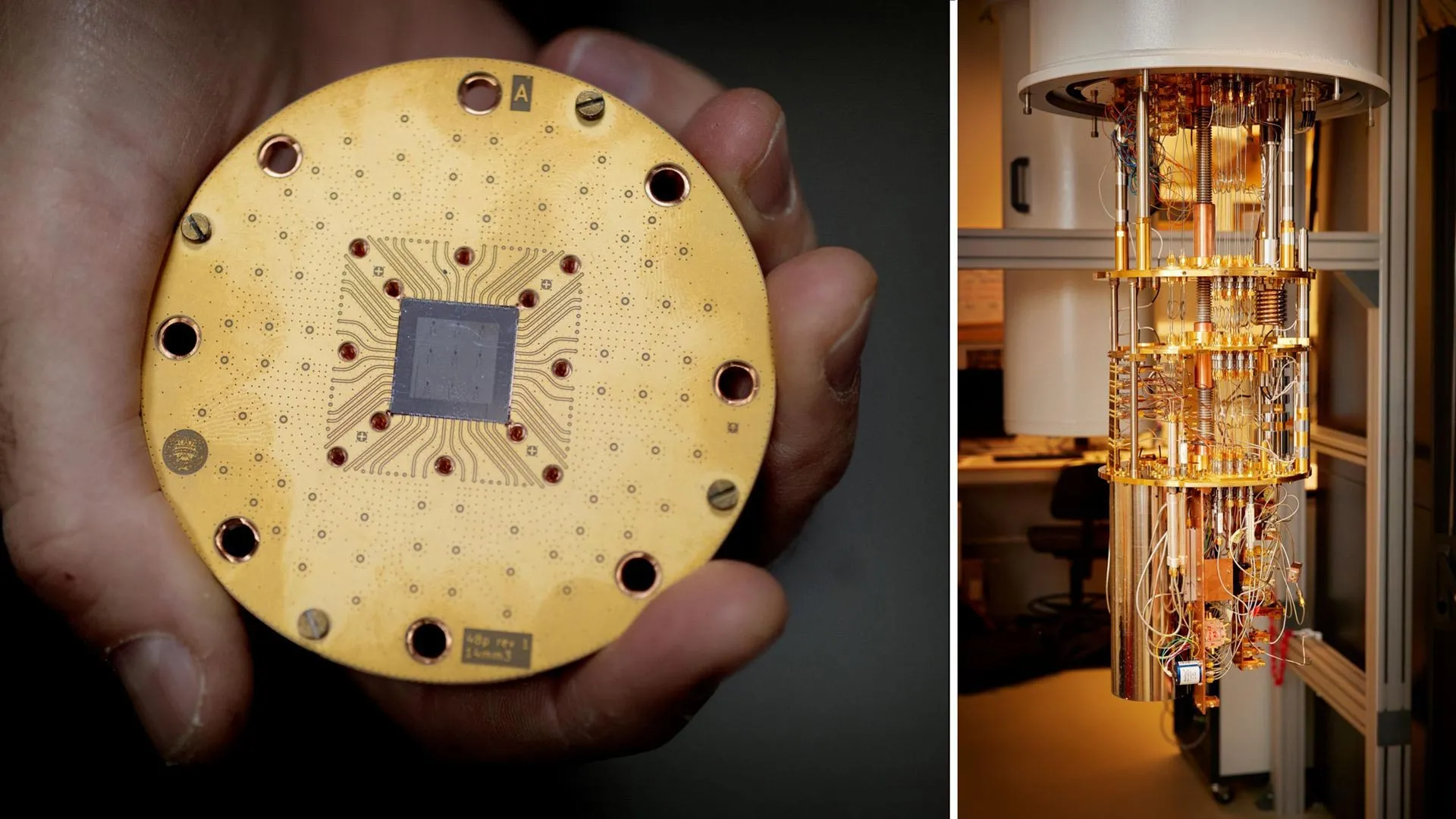
GPU-Accelerated Digital Twin for Sensor Error Attribution A new collaborative framework involving MITRE, Quantum Brilliance, NVIDIA, and SandboxAQ has been introduced to address error attribution in quantum sensors. The framework utilizes GPU acceleration to create digital twins of quantum systems, allowing for more precise identification and mitigation of sensor errors. This development aims to improve the reliability of quantum sensing applications through advanced computational modeling.
DOE Grand-Challenge for Scientific Validation A Department of Energy (DOE) advisory panel has proposed a 2026–2028 quantum grand-challenge program specifically designed to demonstrate independently validated scientific uses for quantum technologies. This initiative ties the future of national quantum facilities directly to proof-of-use cases, moving beyond hardware milestones to focus on tangible scientific outcomes.
Algorithmic & Hardware Progress
Harvard's Sound-Wave Protection for Qubits Researchers at Harvard have demonstrated a novel method to protect quantum information using microscopic sound waves. By continuously surrounding a diamond-based qubit with mechanical vibrations, the team successfully extended the qubit's coherence time. This approach offers a new pathway for stabilizing qubits against environmental noise.
NVIDIA Expands CUDA-Q Platform NVIDIA has expanded its open-source CUDA-Q platform with specific enhancements aimed at supporting fault-tolerant quantum computing. The update provides developers with new tools and resources to build and simulate fault-tolerant algorithms, integrating quantum computing workflows with classical high-performance computing environments.
Infleqtion Advances Fault-Tolerance at IEEE Quantum Week At IEEE Quantum Week 2026, Infleqtion presented advancements in fault-tolerant quantum computing. The company showcased progress in developing robust logical qubits and error-correction protocols, contributing to the industry-wide effort to achieve scalable, reliable quantum systems.
Industry & Institutional Updates
DOE Seeks Fault-Tolerant Computer by 2028
The Department of Energy is actively seeking a fault-tolerant quantum computer by 2028. The program offers entrants $250K upfront to deliver a demonstration within a year, signaling a aggressive timeline for achieving practical fault tolerance in quantum hardware.

QCi to Showcase Beyond-QKD Communications at ECOC 2026 Quantum Computing Inc. (QCi) announced plans to showcase quantum secure communications that go beyond Quantum Key Distribution (QKD) at ECOC 2026. As a vertically integrated quantum company, QCi is highlighting its photonics and semiconductor capabilities in next-generation secure communication protocols.
New DARPA QBI Cohort Deadline Announced The Defense Advanced Research Projects Agency (DARPA) has announced the deadline for the new 2026 Quantum Benchmarking Initiative (QBI) cohort as November 14, 2026. This call for proposals continues efforts to benchmark and improve quantum computing performance across various platforms.
Analysis & Community Insights
Shift to Logical Qubits and Error Correction Industry analysis indicates that quantum computing is moving beyond the race for raw qubit counts. In 2026, the primary research focus has shifted toward logical qubits and robust error correction mechanisms. This trend is evidenced by recent breakthroughs such as the 1000x speedup in operation cycles and Harvard's coherence extension techniques, both of which prioritize stability and error reduction over simple scalability.
Community Focus on Practical Utility The DOE's proposal to tie national facility funding to "proof of scientific use" reflects a broader institutional demand for practical utility rather than theoretical milestones. This aligns with community discussions emphasizing that current quantum computers must demonstrate tangible scientific or commercial value to justify continued investment, particularly as cybersecurity concerns regarding future quantum capabilities grow.
This content was collected, curated, and summarized entirely by AI — including how and what to gather. It may contain inaccuracies. Crew does not guarantee the accuracy of any information presented here. Always verify facts on your own before acting on them. Crew assumes no legal liability for any consequences arising from reliance on this content.
Powered by
