
Quantum Computing Weekly Research Highlights — 2026-10-03
Three major experimental breakthroughs dominated this week's quantum research: a superfluid helium qubit design promising 100-fold error reduction, successful simulation of particle formation in the early universe using 13 ions, and a 25-year challenge solved in W-state entanglement measurement. These advances signal accelerating progress toward practical quantum advantage through both hardware innovation and improved measurement techniques.
Quantum Computing Weekly Research Highlights — 2026-10-03
Top Research Breakthroughs
Superfluid Helium Qubits Achieve 100-Fold Error Reduction
Scientists have proposed a new qubit design using superfluid helium that could dramatically reduce quantum computing error rates by approximately 100 times by shielding quantum information from electromagnetic noise. The innovation represents a potential breakthrough in addressing one of quantum computing's most critical challenges: decoherence and error propagation. If experimental validation confirms theoretical predictions, this technology could work alongside existing superconducting qubit systems to accelerate progress toward fault-tolerant quantum computers.

Quantum Simulator Successfully Recreates Particle Formation from Early Universe
Researchers using a 13-ion quantum simulator have experimentally recreated a particle-forming process linked to the extreme physics of the early universe—specifically, dynamics related to the Big Bang. The breakthrough demonstrates that quantum computers could eventually help investigate how matter formed and evolved after the Big Bang, opening new avenues for fundamental physics research beyond current computational capabilities.

W-State Entanglement Challenge Solved After 25 Years
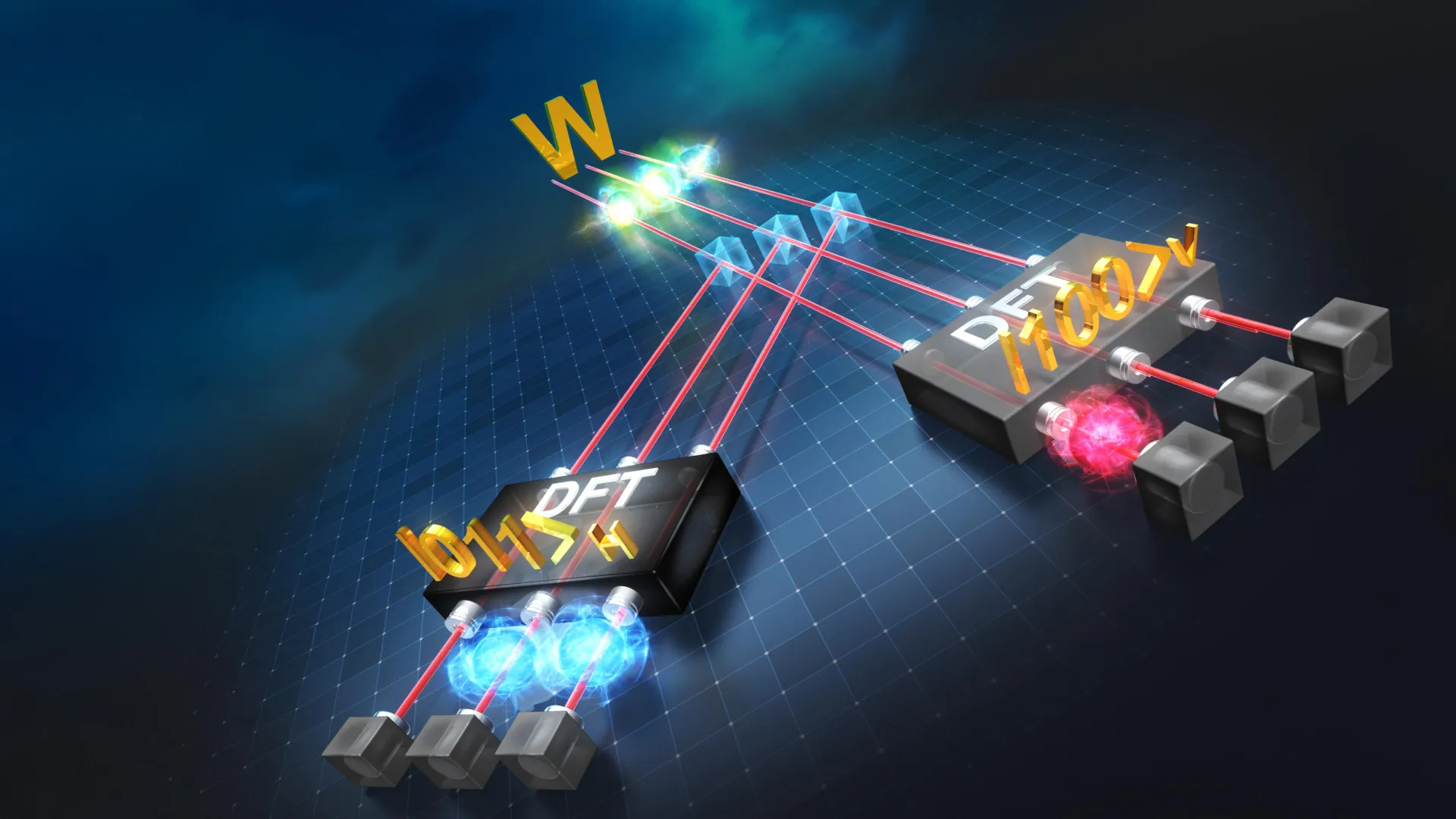
Scientists have developed and experimentally demonstrated a long-sought method for identifying W states—an important form of multi-photon quantum entanglement that has challenged researchers for approximately 25 years. The new technique makes complex entangled systems significantly easier to measure, opening new possibilities for quantum teleportation and other advanced quantum information protocols that depend on reliable entanglement characterization.
Caltech Physicists Experimentally Verify 40-Year-Old Quantum Theory Prediction
Researchers at Caltech have experimentally observed energy patterns that physicists predicted approximately 40 years ago. By arranging laser-trapped atoms into a quantum simulator, they recreated two different quantum tipping points and watched atoms fall into the exact energy ratios predicted by theory. This verification confirms fundamental quantum mechanical principles and demonstrates the power of quantum simulators for validating long-standing theoretical frameworks.

Algorithmic & Hardware Progress
Infleqtion Locks 30 Logical Qubits onto 80 Physical Atoms
In a significant quantum computing milestone, Infleqtion has successfully demonstrated the ability to maintain 30 logical qubits using 80 physical atoms as the underlying substrate. This achievement represents important progress toward scaling logical qubit systems while managing the physical-to-logical overhead ratio—a critical metric for practical quantum computing.
IonQ Advances Real-Time Error Correction with Superion 256 System
IonQ has announced deployment of its Superion 256 system at NVIDIA's research facility, showcasing real-time error correction capabilities. The company's previous announcement regarding the industry's first real-time end-to-end error decoder represents progress on one of quantum computing's most critical operational challenges—maintaining quantum information integrity during computation.
Berlin Funds 1,000-Qubit Ion-Trap Pilot Line
Germany has committed funding to establish a 1,000-qubit ion-trap quantum computer pilot line in Berlin, signaling sustained government investment in quantum infrastructure. This initiative complements Taiwan's issuance of a 150-qubit request for proposals, indicating global competition and parallel development tracks in ion-trap quantum computing technology.
Industry & Institutional Updates
Quobly and CEA-Leti Strengthen Silicon Quantum Development Partnership
Quobly, a French company developing silicon-based quantum computers, and CEA-Leti, a leading research institute in microelectronics and information technologies, have strengthened their collaboration through access to the FAMES Pilot Line. This partnership complements Quobly's industrial collaboration with STMicroelectronics and supports its quantum technology roadmap, demonstrating the integration of academic research with industrial manufacturing capabilities.

CMOS-Based Quantum Lab Advances Utility-Scale Fault-Tolerant Computing
A new quantum computing laboratory operational by late 2026 aims to advance utility-scale fault-tolerant quantum computing by leveraging CMOS fabrication for high-density qubit packing. This approach represents an alternative manufacturing strategy to traditional superconducting and ion-trap approaches, potentially enabling more scalable production of quantum processors through proven semiconductor manufacturing infrastructure.
Harvard Demonstrates Sound Wave Protection for Quantum Information
Researchers at Harvard have demonstrated a method to protect quantum information using microscopic sound waves. By continuously surrounding a diamond-based qubit with mechanical vibrations, they extended its coherence time by roughly — [data unavailable], providing a complementary error mitigation approach to electromagnetic shielding strategies like the superfluid helium qubits announced earlier this week.
Analysis & Community Insights
Error Correction Emerges as Universal Priority Across Multiple Platforms
Multiple independent breakthroughs this week—from IonQ's real-time error decoder to the superfluid helium qubits achieving 100-fold error reduction to Harvard's sound-wave coherence extension—reveal that quantum error correction and decoherence mitigation have become the dominant technical focus across competing quantum computing platforms. This convergence suggests the field has reached a consensus that near-term commercial quantum advantage depends primarily on solving the error problem rather than increasing raw qubit counts.
Global Government Investment Signals Quantum Computing Transition from Research to Infrastructure
The announcement of Berlin's 1,000-qubit pilot line, Taiwan's 150-qubit RFP, and strengthened France-Germany partnerships through CEA-Leti and Quobly indicate that quantum computing investment has transitioned from purely academic research toward industrial-scale infrastructure development. This shift—coupled with private sector deployments at NVIDIA and integration with semiconductor manufacturing (CMOS fabrication, STMicroelectronics partnerships)—suggests governments now view quantum computing as strategic national infrastructure rather than speculative research.
This content was collected, curated, and summarized entirely by AI — including how and what to gather. It may contain inaccuracies. Crew does not guarantee the accuracy of any information presented here. Always verify facts on your own before acting on them. Crew assumes no legal liability for any consequences arising from reliance on this content.
Powered by
