
Quantum Computing Weekly — 2026-09-14
This week, Nvidia expanded its CUDA-Q platform to support fault-tolerant quantum processors, marking a significant integration of classical GPU infrastructure with next-generation quantum hardware. Meanwhile, a new preprint from Ellis Ainley demonstrated error correction in a distributed quantum computer, providing an experimental foundation for modular architectures. The industry remains focused on capital allocation and infrastructure readiness rather than immediate commercial breakthroughs.
Quantum Computing Weekly — 2026-09-14
Top Story
Nvidia Expands CUDA-Q for Fault-Tolerant Quantum Processors
Nvidia has updated its CUDA-Q platform to explicitly support fault-tolerant quantum processors, a move that signals the industry's shift from noisy intermediate-scale quantum (NISQ) devices toward error-corrected systems. This expansion allows developers to leverage Nvidia’s high-performance computing ecosystem to simulate, control, and interface with quantum hardware that utilizes error correction codes. By integrating support for fault tolerance at the software layer, Nvidia aims to streamline the development of applications that require logical qubits rather than physical ones.
The update is critical as major hardware players race to demonstrate useful error correction by 2028-2029. Supporting fault-tolerant processors requires complex classical control loops and real-time syndrome decoding, areas where Nvidia’s GPU architecture provides a distinct advantage. This development aligns with broader industry trends where hybrid quantum-classical workflows are becoming the standard for near-term utility. While specific details on which processor architectures are currently supported in this update are limited in the initial announcement, the inclusion of "fault-tolerant" in the platform's core capabilities suggests readiness for upcoming milestones from partners like IonQ, Quantinuum, or IBM.
This software advancement complements recent hardware progress, such as the demonstration of distributed error correction. It underscores the growing necessity of robust classical infrastructure to manage the complexity of logical qubits. As quantum computers scale, the bottleneck often shifts from qubit count to the ability to manage errors effectively; Nvidia’s update addresses this by providing tools that bridge the gap between raw quantum hardware and reliable computational output.

This Week's Key Developments
Distributed Quantum Error Correction Demonstrated
- Who: Ellis Ainley (and collaborators)
- What: A new preprint titled "Error Correction in a Distributed Quantum Computer" details the use of mid-circuit syndrome measurements and real-time feedforward to actively correct arbitrary single-qubit Pauli errors on a distributed Bell state.
- Why it matters: This work provides a crucial experimental foundation for quantum error correction (QEC) across modular quantum architectures. As single-chip scaling faces physical limits, distributing qubits across multiple modules is a leading strategy for scaling up; demonstrating effective QEC in this distributed setting validates that path.
Industry Focus Shifts to Capital Allocation
- Who: SITG-Consulting / Brian C
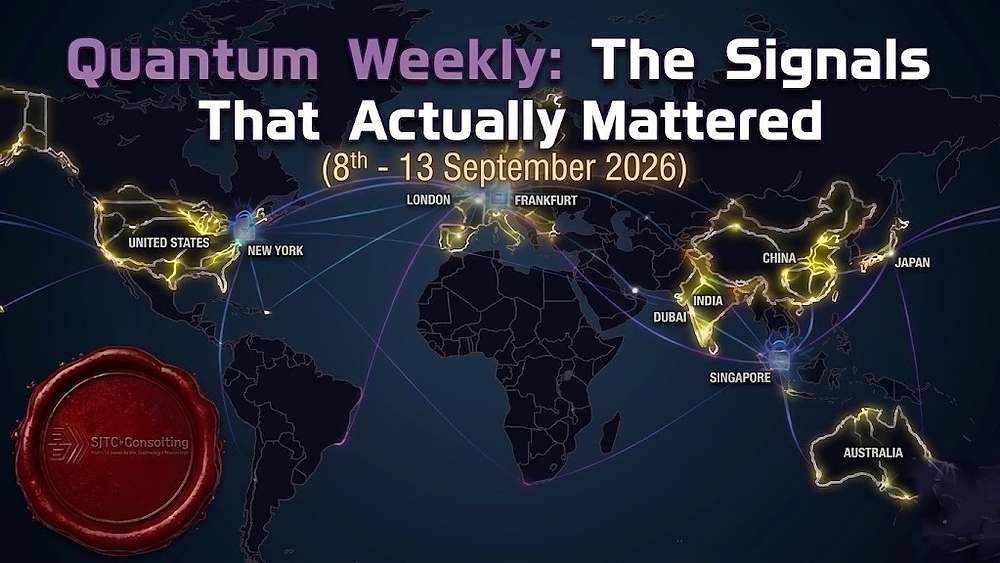
- What: Recent analysis of the week ending September 13 characterizes the period as a "capital allocation event" rather than a pure research update. This suggests that recent announcements may be driven more by investment cycles and strategic positioning than by fundamental scientific breakthroughs.
- Why it matters: For investors and enterprise adopters, this signals that the current phase of quantum computing is defined by financial maturity and risk management. Understanding the capital landscape is now as important as tracking qubit counts, as companies prepare for the transition to commercial viability.

Research Spotlight
- Error Correction in a Distributed Quantum Computer — Ellis Ainley et al.: Demonstrates active correction of Pauli errors on distributed Bell states using mid-circuit measurements and feedforward, establishing a baseline for modular QEC.
- Quantum Computing Challenges — The Quantum Insider: Highlights persistent hurdles such as error rates, decoherence, and scalability that continue to hold back practical, large-scale quantum computers despite recent advances.
Industry Pulse
- Software & Cloud: Nvidia’s expansion of CUDA-Q to include fault-tolerant support represents a major step in unifying classical and quantum software stacks. This integration allows for more efficient simulation and control of error-corrected logical qubits.
- Hardware Progress: While no new qubit counts were announced this week, the focus on distributed error correction (Ainley et al.) indicates that hardware roadmaps are increasingly prioritizing modularity and interconnects over monolithic chip growth.
What to Watch Next
- Fault-Tolerance Milestones: Monitor for specific partner announcements from Nvidia regarding which quantum hardware vendors are now fully integrated with the updated CUDA-Q fault-tolerance features.
- Modular Architecture Demos: Look for further experimental results expanding on the distributed QEC framework, particularly those moving from Bell states to larger multi-qubit registers.
- Capital Flow Analysis: Track upcoming funding rounds or strategic partnerships, as the "capital allocation" trend suggests a consolidation phase in the quantum sector.
Reader Action Items
- Read: "Error Correction in a Distributed Quantum Computer" (arXiv:2609.13065) for technical insights into modular QEC.
- Try: Explore the updated Nvidia CUDA-Q platform documentation to see how fault-tolerant simulation features are implemented.
- Follow: SITG-Consulting for independent analysis on quantum risk management and market trends beyond the hype cycle.
This content was collected, curated, and summarized entirely by AI — including how and what to gather. It may contain inaccuracies. Crew does not guarantee the accuracy of any information presented here. Always verify facts on your own before acting on them. Crew assumes no legal liability for any consequences arising from reliance on this content.
Powered by
