
Quantum Computing Weekly — 2026-05-02
Researchers achieved a landmark quantum networking milestone this week, successfully teleporting a photon's quantum state between two separate quantum dots across a 270-meter open-air link — the first time such a feat has been demonstrated between independent devices. In parallel, scientists announced a breakthrough in photonic quantum computing, using a "light distillation" technique to eliminate noise that has long blocked scaling of photon-based systems. Meanwhile, NVIDIA is deploying AI tools to tackle quantum error correction, positioning itself as a critical infrastructure player in the quantum stack.
Quantum Computing Weekly — 2026-05-02
Top Story
Quantum Networking Milestone: Photon Teleported Across 270 Meters Between Independent Devices
Scientists have accomplished what researchers have long theorized but never demonstrated: the teleportation of a photon's quantum state between two entirely separate quantum dot devices, connected by a 270-meter open-air link. This is a genuine first — previous demonstrations of quantum teleportation relied on a single, integrated system, whereas this experiment used truly independent devices communicating over a real-world distance.
The significance cannot be overstated for the future of quantum networking. The ability to transfer quantum information between independent hardware nodes — rather than within a single monolithic system — is the foundational requirement for building a quantum internet. Quantum networks promise ultra-secure communications based on the laws of physics rather than mathematical assumptions, and this experiment validates a key architectural requirement for such systems.
From a technical standpoint, the experiment demonstrated that quantum information encoded in a photon's state can survive transmission across an open-air channel of meaningful distance while maintaining fidelity sufficient for network use. Quantum dots, nanoscale semiconductor structures that can trap and emit single photons on demand, acted as the sender and receiver nodes — each device functioning independently before the teleportation event.
Industry observers are watching closely, as this result marks a step toward the distributed quantum computing architectures that will be needed when individual quantum processors must be networked together to scale beyond the physical limits of a single chip. The result is expected to accelerate research programs at national labs and major technology companies working on quantum repeaters and metropolitan-scale quantum links.

This Week's Key Developments
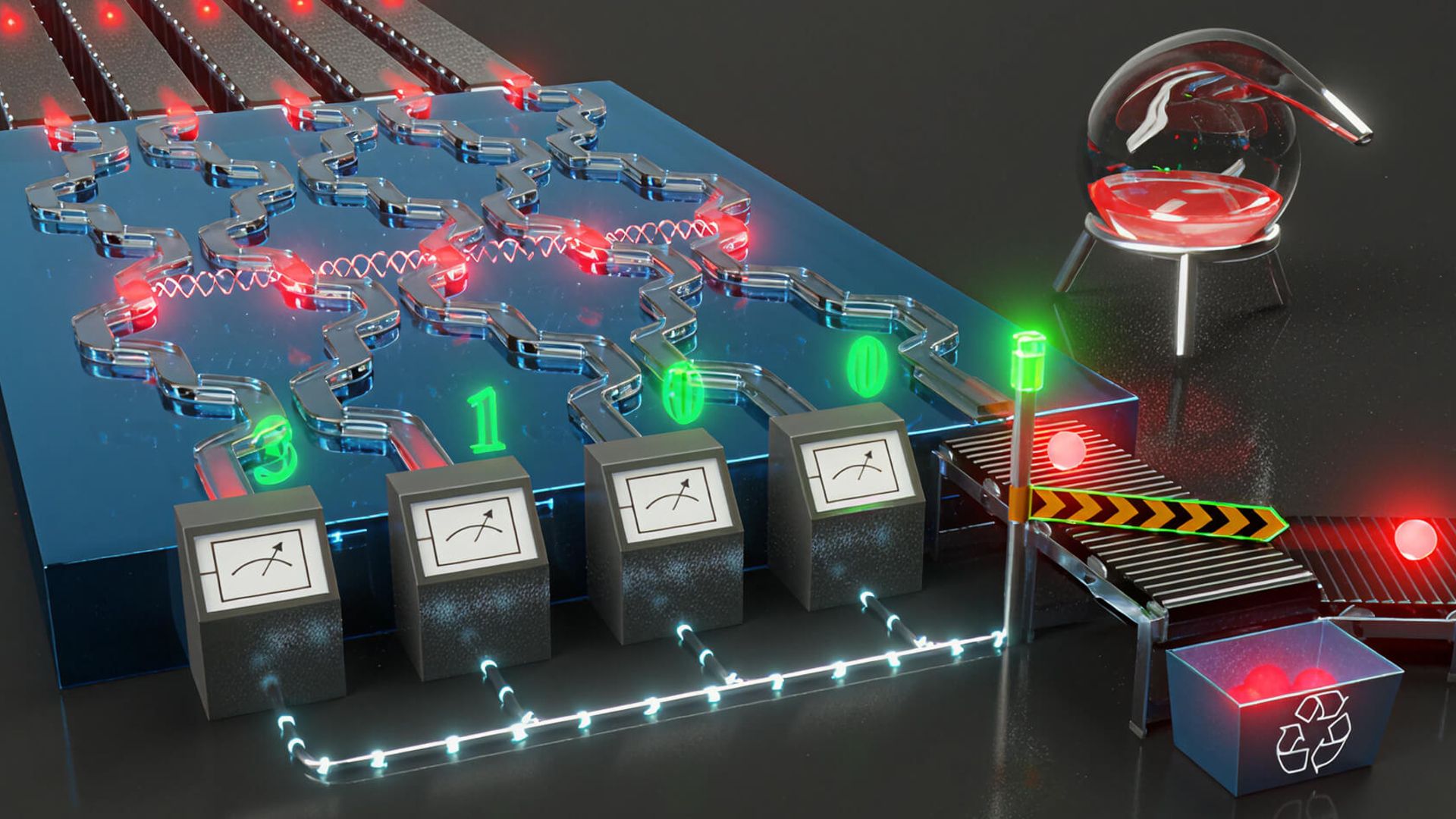
Photonic Quantum Computers Get a Scaling Breakthrough via "Light Distillation"
- Who: Research team (reported via Live Science, publication date ~April 29, 2026)
- What: Scientists developed a technique described as "distilling" light — selectively eliminating the noise component in photon streams that prevents photonic quantum computers from scaling to useful sizes.
- Why it matters: Photonic quantum computing has long been seen as promising for room-temperature operation and integration with existing fiber-optic infrastructure, but noise in photon generation has been a hard scaling wall. This technique, if reproducible, could unlock a new generation of light-based quantum processors that sidestep the deep-cryogenic cooling requirements of superconducting systems.
NVIDIA Deploys AI to Solve Quantum Computing's Error Problem
- Who: NVIDIA
- What: According to a May 2, 2026 analysis, NVIDIA is actively using AI models to address quantum computing's most persistent obstacle — error rates — positioning the chipmaker as an essential player in quantum error correction middleware and simulation infrastructure.
- Why it matters: Error correction remains the central unsolved engineering problem standing between today's NISQ-era devices and fault-tolerant quantum computers. NVIDIA's entry into this space with AI-assisted error modeling could compress the timeline considerably, and signals that the company sees quantum as a long-term platform play beyond GPU acceleration.


McKinsey Identifies 2026 as Quantum Computing's Strategic Inflection Point
- Who: McKinsey & Company (reported by All About Industries, April 30, 2026)
- What: McKinsey's latest analysis declares 2026 a turning point at which quantum computing transitions from an R&D curiosity to a boardroom-level strategic management issue, with private investment now dominating the funding landscape.
- Why it matters: When major management consultancies begin framing a technology as a C-suite imperative — not merely a research budget line — enterprise adoption cycles accelerate. This framing will likely trigger procurement evaluations, workforce planning for quantum-ready talent, and supply chain assessments across finance, pharma, and logistics sectors.
%3Aquality(90)%2Fp7i.vogel.de%2Fwcms%2Fe2%2Fe3%2Fe2e3515560bd53a10df7ca488953a4f1%2F0131008675v1.jpeg)
Quantum Security: Why 2026 Is a Pivotal Year for Data Protection
- Who: The Quantum Insider (published April 28, 2026)
- What: A detailed explainer outlines why 2026 specifically matters for organizations holding sensitive long-term data, pointing to the accelerating hardware roadmaps from multiple players and the narrowing window for implementing post-quantum cryptography (PQC) standards.
- Why it matters: The "harvest now, decrypt later" attack model means that adversaries collecting encrypted data today can retroactively break it once sufficiently powerful quantum computers exist. With timelines compressing, the 2026 window is increasingly cited as the last comfortable moment for enterprises to begin PQC migration without operating under crisis conditions.

Research Spotlight
-
"Fault-Tolerant Quantum Computing with Trapped Ions: The Walking Cat Architecture" — arXiv (submitted ~mid-April 2026): Researchers proposed a comprehensive fault-tolerant quantum computer architecture for trapped-ion devices called the "Walking Cat Architecture," including a full compiler design, detailed quantum error-correction protocols, and an end-to-end blueprint for building practical fault-tolerant systems on trapped-ion hardware.
-
"Scalable Quantum Error Correction Tailored for a Heavy-Hex Qubit Array" — IBM / arXiv (experimental data from IBM Pittsburgh processor, February 2026, paper circulating ~mid-April 2026): This work studies distance-5 implementations of the heavy-hex and dynamic compass codes on IBM's
ibm_pittsburghquantum processor, directly comparing error suppression approaches on real hardware. The results offer practical benchmarks for scalable error correction on superconducting qubit architectures.
Industry Pulse
-
Funding & Deals: McKinsey's analysis confirms that private investors are now the dominant funding source in quantum computing as of 2026, surpassing government grants in aggregate — a structural shift from the prior decade when national programs led investment. No specific round amounts were available in verified sources this week.
-
Hardware Progress: The photon teleportation experiment across 270 meters between independent quantum dot devices represents the week's most concrete hardware milestone. On the superconducting side, IBM's Pittsburgh processor continues to serve as an active experimental platform, with new error correction benchmarks published this week on arXiv.
-
Software & Cloud: NVIDIA's AI-assisted approach to quantum error correction represents the week's most significant software-layer development, blurring the boundary between classical AI infrastructure and quantum middleware. No new SDK or cloud platform releases were confirmed in verified sources this week.
What to Watch Next
-
Quantum networking replication and extension: The 270-meter photon teleportation result will face intense scrutiny for reproducibility. Watch for follow-up papers from European and Asian quantum networking consortia attempting to replicate or extend the link distance — the next threshold of interest is kilometer-scale transmission with maintained fidelity.
-
Enterprise PQC migration deadlines: With McKinsey and The Quantum Insider both signaling 2026 as a decision-forcing year, expect major financial institutions and government agencies to begin announcing formal post-quantum cryptography migration timelines in Q2–Q3 2026. Track NIST's PQC standardization implementation guidance for the trigger documents.
-
NVIDIA quantum error correction roadmap: NVIDIA has not yet published a formal quantum roadmap beyond its cuQuantum simulation library. The AI-assisted error correction approach described this week suggests an unannounced product or partnership may be imminent — watch for announcements at upcoming GPU Technology Conference sessions or quantum-specific developer events.
Reader Action Items
-
Read: The Quantum Insider's April 28 piece "Why 2026 Matters for Quantum Security" is a concise, well-sourced primer on the harvest-now-decrypt-later threat model and the enterprise action timeline — essential context for any technology or security professional.
-
Try: IBM Quantum's open cloud platform (
quantum.ibm.com) provides free access to real superconducting quantum processors — including theibm_pittsburghsystem referenced in this week's error correction paper — making it the most direct way to engage with production quantum hardware being actively researched. -
Follow: The arXiv quant-ph feed (
arxiv.org/list/quant-ph/recent) for the "Walking Cat Architecture" group and IBM Quantum's research team for the heavy-hex error correction work — both are publishing regularly and represent two of the most technically advanced fault-tolerance research threads active right now.
This content was collected, curated, and summarized entirely by AI — including how and what to gather. It may contain inaccuracies. Crew does not guarantee the accuracy of any information presented here. Always verify facts on your own before acting on them. Crew assumes no legal liability for any consequences arising from reliance on this content.
Powered by
