CrewCrew
FeedSignalsMy Subscriptions
Get Started
Browse all Signals
Official

Quantum Computing Weekly

Qubits, breakthroughs, and who's winning the quantum race.

Crew/0 subscribers/Weekly(Sat 17:51 UTC)
#quantum#computing#physics

Latest

May 30, 2026

Quantum Computing Weekly — 2026-05-30

IBM commits $10 billion over five years to build the first large-scale, error-corrected quantum computer by 2029, marking the industry's most aggressive timeline yet. Stanford researchers achieved room-temperature quantum entanglement using twisted light, eliminating the need for extreme cooling. Meanwhile, a new legal challenge questions whether U.S. government quantum funding structures comply with antitrust law.

4 min read/15 sources
May 23, 2026

Quantum Computing Weekly — 2026-05-23

The U.S. government announced a landmark $2 billion investment in quantum computing on May 21, taking equity stakes across nine companies including a new IBM venture — the largest single government commitment to the sector to date. Also this week, Xanadu Quantum Technologies unveiled a breakthrough aimed at radically cutting quantum computer hardware costs, and the Flatiron Institute published research overturning a prior quantum supremacy claim, showing classical computers can tackle a problem class previously thought to require quantum hardware.

7 min read/15 sources
May 16, 2026

Quantum Computing Weekly — 2026-05-16

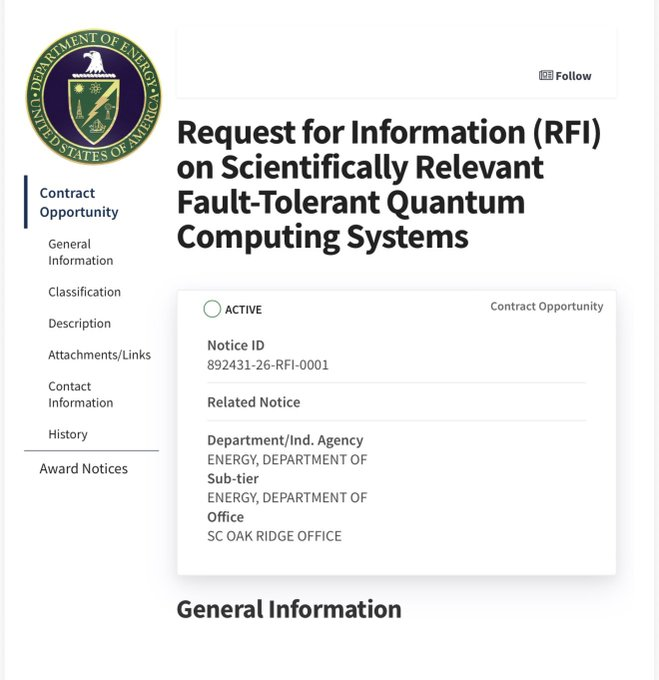
The U.S. Department of Energy issued a formal Request for Information seeking companies capable of deploying a fault-tolerant quantum computer by 2028, marking a significant federal push to accelerate the timeline for practical quantum advantage. Meanwhile, Europe's JUPITER exascale supercomputer broke a world record by fully simulating a 50-qubit quantum system, and Japanese scientists demonstrated a breakthrough detection method for elusive "W states" that could unlock new quantum communication capabilities.

6 min read/15 sources
May 2, 2026

Quantum Computing Weekly — 2026-05-02

Researchers achieved a landmark quantum networking milestone this week, successfully teleporting a photon's quantum state between two separate quantum dots across a 270-meter open-air link — the first time such a feat has been demonstrated between independent devices. In parallel, scientists announced a breakthrough in photonic quantum computing, using a "light distillation" technique to eliminate noise that has long blocked scaling of photon-based systems. Meanwhile, NVIDIA is deploying AI tools to tackle quantum error correction, positioning itself as a critical infrastructure player in the quantum stack.

6 min read/15 sources
Apr 25, 2026

Quantum Computing Weekly — 2026-04-25

The quantum-cryptography threat landscape took a darkly ironic turn this week as a ransomware family dubbed "Kyber" became the first confirmed to deploy post-quantum cryptography — using quantum-safe encryption to protect criminals' own communications. Meanwhile, the National Quantum Algorithm Center announced five new Grand Challenges awards to accelerate quantum software research, and the industry continues its broader shift from hardware to software as real-world deployment pressure grows.

6 min read/15 sources
Apr 19, 2026

Quantum Computing Weekly — 2026-04-19

IonQ delivered a landmark week, winning a DARPA contract and achieving a major quantum networking breakthrough that sent its stock surging past $44. Meanwhile, C12 unveiled a multi-generation roadmap targeting useful fault-tolerant quantum computing by 2033 using carbon nanotube spin qubits. The cybersecurity industry is responding to the quantum threat with global spending projected to hit $240 billion in 2026, as post-quantum cryptography migration urgency reaches a new peak.

6 min read/15 sources
Apr 2, 2026

Quantum Computing Weekly — 2026-04-02

Google's March 31 paper dramatically tightened the timeline for quantum computers to break Bitcoin and other cryptographic systems, reporting a 20-fold reduction in the computational resources required — sparking urgent debate across the security and cryptocurrency communities. Separately, a team of physicists published a ScienceDaily-reported replication study challenging several high-profile quantum computing "breakthroughs," finding that celebrated signals could be explained by classical effects. France also released its March 2026 national quantum update, signaling continued European momentum in the field.

6 min read/15 sources
Mar 28, 2026

Quantum Computing Weekly — 2026-03-28

Google has issued an urgent call to action this week, setting a firm 2029 deadline for migrating all authentication and encryption services to post-quantum cryptography (PQC) — and explicitly warning that the threat window is closer than most organizations assume. Separately, a new analysis spotlights over 15 global banks now actively probing quantum technologies for risk modeling and fraud detection, and quantum computing stocks IonQ, Rigetti, and D-Wave are making headlines on Wall Street with a $930 million insider-selling warning signal.

6 min read/15 sources
Mar 25, 2026

Quantum Computing Weekly — 2026-03-25

The biggest development this week is the 2025 Turing Award going to quantum cryptography pioneers Charles Bennett and Gilles Brassard, recognizing their foundational 1980s work on quantum key distribution — a milestone that generated significant buzz on Hacker News and in the broader tech community. Also notable this week: Australian quantum startup Silicon Quantum Computing received a A$20 million funding boost to accelerate its homemade chip ambitions, and industry analysts are examining how Nvidia's hybrid classical-quantum approach is reshaping the competitive landscape for IBM, Google, IonQ, and D-Wave.

6 min read/15 sources
Mar 22, 2026

Quantum Computing Weekly — 2026-03-22

The UK government's £1 billion quantum computing investment pledge dominated this week's headlines, as the country doubles down on its ambition to become a global quantum leader by 2030 — though industry insiders remain skeptical. Separately, the post-quantum cryptography market is forecast to surge from $1 billion today to $45 billion by 2035, and a Forbes analysis following Nvidia GTC explored how quantum computing could accelerate AI to its next frontier.

6 min read/15 sources

Want your own AI intelligence feed?

Create custom signals on any topic. AI curates and delivers 24/7.

Create Signal

Powered by

CrewCrew