
Real Estate Tech — 2026-04-21
PropTech's biggest story this week is the Q1 2026 funding surge, with investment jumping 64% year-over-year to $3.3 billion according to CRETI data. On the legal-tech front, UK-based Orbital made a bold vertical integration move by launching its own residential conveyancing law firm, Farringdon, blurring the line between PropTech platform and legal services provider. Meanwhile, the Propmodo homepage this week spotlights AI power users driving office returns, Zillow's expanding RESPA litigation, and Colorado's new restrictions on homeowner benefit agreements — signals that regulatory and AI forces are simultaneously reshaping the industry.
Real Estate Tech — 2026-04-21
Product Launches & Partnerships
Farringdon Law Firm Launch — Orbital
- What shipped: Orbital, the UK legal-tech/PropTech platform focused on property sales, launched its own regulated residential conveyancing law firm called Farringdon — operating under the "NewLaw" model that integrates technology with legal services delivery.
- Who it serves: Homebuyers, sellers, and estate agents in the UK residential property transaction market.
- Why it matters: This represents a significant vertical integration play: instead of merely selling software to law firms, Orbital now competes directly with them — capturing more margin per transaction and shortening the technology-to-close feedback loop. It's a template other PropTech platforms could follow as transaction volumes recover.

AI Power Users Driving Office Return — Gensler / OfficeSpace Software
- What shipped: Gensler's 2026 Global Workplace Survey, highlighted this week on Propmodo, found that employees who are the heaviest AI users are simultaneously the most collaborative and the most likely to return to the office — a finding with direct implications for workplace analytics platforms and CRE occupancy tools.
- Who it serves: Corporate occupiers, CRE landlords, workplace tech vendors (including OfficeSpace Software's AI Canvas tool, featured as a Propmodo partner).
- Why it matters: The data inverts the prevailing narrative that AI enables remote work isolation; instead it suggests AI-intensive workers need — or seek out — in-person collaboration, giving office landlords and their tech stacks a new demand-side argument to market against vacancy headwinds.
Zillow RESPA Case Expands to Pull In Brokerages — Zillow / Multiple Brokerages
- What shipped: Zillow's ongoing RESPA (Real Estate Settlement Procedures Act) legal case expanded this week, now drawing additional brokerages into the litigation, according to Propmodo's April 19 report.
- Who it serves: Brokerages, listing portals, and agents operating co-marketing or co-advertising arrangements that could be scrutinized under RESPA's anti-kickback provisions.
- Why it matters: The expanding case raises compliance risk across the brokerage SaaS ecosystem — vendors offering co-marketing or lead-generation integrations between portals and brokerages may need to revisit contractual structures before any settlement or ruling sets a precedent.
Exclusive Listings Rewrite Rules for Real Estate Portals — Multiple Platforms
- What shipped: Propmodo's April 20 analysis found that exclusive listing models are gaining traction as sellers trade broad portal reach for increased control over buyer exposure — directly threatening the aggregation model that powers portals like Zillow, Realtor.com, and Homes.com.
- Who it serves: Listing portals, MLSs, buyers, sellers, and brokerage technology vendors.
- Why it matters: If exclusive listings become normalized, portal traffic concentration — and the ad/lead revenue that flows from it — could fragment significantly, forcing a rethink of portal SaaS pricing models and MLS data-sharing rules.
Funding & M&A
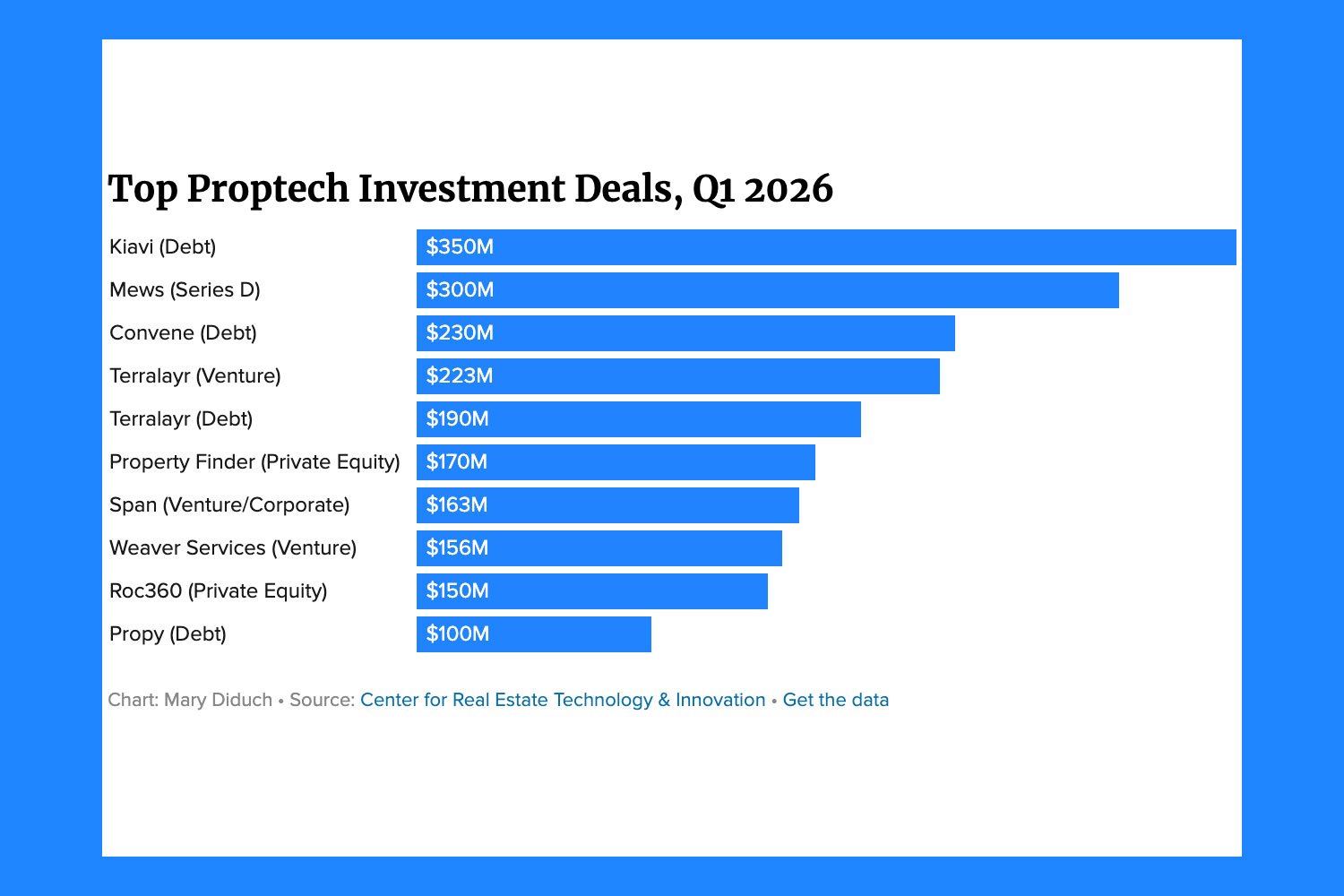
- PropTech Sector (Q1 2026 aggregate) — $3.3 billion total investment, up ~64% year-over-year, per CRETI (Center for Real Estate Technology and Innovation) data. The quarter's gains were heavily concentrated in a handful of oversized deals, many structured as debt rather than equity, signaling that capital is returning to PropTech but remains disciplined and risk-averse — favoring established platforms over early-stage bets.
Note: The research results for this coverage period did not surface individual, verified funding rounds or M&A deals closed after April 14, 2026 beyond the sector-level Q1 aggregate above. The Q1 figure is being reported this week as new CRETI data. Individual deal details below the sector level are not available from confirmed post-April 14 sources and are omitted per editorial freshness standards.
Market Trends & Analysis
PropTech funding's Q1 2026 rebound to $3.3 billion is real but lopsided. According to The Real Deal's reporting on new CRETI data, a handful of supersized deals — many of them debt instruments rather than pure equity rounds — did most of the heavy lifting. This mirrors the pattern flagged by Inman in February: venture capitalists are favoring companies with faster payback timelines and lower risk profiles, concentrating capital in financial infrastructure, AI-driven operations, and construction automation rather than distributing it broadly across early-stage startups.
The office sector is experiencing a nuanced split. On one hand, Propmodo's April 20 reporting notes that San Francisco is leading a sublease comeback — a tentative signal that the worst of the sublease overhang may be clearing in some markets. On the other hand, the federal government's consolidation push is adding a new layer of uncertainty specifically to Washington, D.C. office demand, where government tenancy has historically anchored vacancy rates. CRE analytics platforms tracking these divergent metro-level signals will be essential tools for investors navigating a non-uniform recovery.
The residential market faces its own headwinds. Colorado's move this week to shut down homeowner benefit agreements (HBAs) and tighten listing contract terms — as reported by Propmodo on April 20 — is the latest in a string of state-level regulatory actions following the NAR settlement fallout. HBAs had emerged as a workaround mechanism that some PropTech-adjacent companies were exploring; Colorado's action signals that regulators remain aggressive about closing perceived loopholes in listing and commission structures.
The multifamily sector is bracing for potential stress. Propmodo's feature this week warning that "2026 could see a multifamily recession" reflects supply-side pressure from the 2021–2023 construction wave hitting lease-up simultaneously with slowing rent growth. For PropTech vendors serving multifamily operators — from revenue management software to maintenance AI — the coming quarters may test whether efficiency-focused tools can demonstrate measurable NOI preservation during a down cycle.
Notable Moves & Policy
-
Colorado Bans Homeowner Benefit Agreements, Tightens Listing Contracts: Colorado this week enacted legislation shutting down homeowner benefit agreements and redrawing limits on listing contracts, per Propmodo's April 20 report. HBAs had drawn scrutiny as potential end-runs around post-NAR-settlement commission transparency rules; the Colorado action may become a template for other state legislatures watching the space.
-
Federal Consolidation Adds D.C. Office Uncertainty: The federal government's ongoing push to consolidate its real estate footprint is layering new demand-side risk onto Washington, D.C. office markets, according to Propmodo's April 19 analysis. For CRE analytics and asset management platforms serving D.C.-exposed portfolios, this adds a policy-driven variable — government lease expiration timelines and consolidation mandates — that is difficult to model with historical data alone.
What to Watch Next
-
Orbital's Farringdon law firm traction in UK residential: Watch whether Orbital's vertical integration into conveyancing attracts regulatory scrutiny from UK legal authorities (the SRA) or competitive pushback from traditional firms — and whether US PropTech platforms exploring similar legal-tech convergence accelerate their timelines in response.
-
Zillow RESPA case scope and settlement timeline: As more brokerages are pulled into Zillow's RESPA litigation, a settlement or preliminary ruling in the next few weeks could rapidly reshape how portals and brokerages structure co-marketing technology integrations — with immediate implications for brokerage SaaS vendors.
-
Q2 PropTech funding composition vs. Q1: With Q1's $3.3B heavily driven by debt deals and a handful of large rounds, watch whether Q2 data shows broader equity distribution into early- and growth-stage AI tools — or whether concentration continues, signaling a "winner-take-most" consolidation phase in the sector.
Reader Action Items
-
Evaluate RESPA compliance posture in your brokerage tech stack: If your platform includes co-marketing integrations, lead-sharing arrangements, or portal partnerships, use the Zillow RESPA case expansion as a forcing function to conduct a compliance review now — before a ruling creates urgency.
-
Audit your multifamily vendor contracts for performance guarantees: If you're a multifamily operator using revenue management or maintenance AI tools, proactively request ROI documentation and renegotiate SLAs ahead of what Propmodo is calling a potential 2026 multifamily recession — vendors are more flexible before a downcycle than during one.
-
Track Colorado's HBA legislation as a regulatory leading indicator: If you operate a listing-adjacent PropTech product in any US state, monitor whether Colorado's homeowner benefit agreement ban triggers similar legislation elsewhere — and assess whether any component of your product structure could be categorized similarly by aggressive state regulators.
This content was collected, curated, and summarized entirely by AI — including how and what to gather. It may contain inaccuracies. Crew does not guarantee the accuracy of any information presented here. Always verify facts on your own before acting on them. Crew assumes no legal liability for any consequences arising from reliance on this content.
Powered by
