
Remote Work Trends — October 4, 2026
Multnomah County workers are rallying against a new three-day RTO mandate set for 2027, signaling renewed friction over return-to-office policies across sectors. Labor statistics show 22.6% of U.S. workers teleworked in March 2026, but McKinsey research warns that hybrid arrangements may suppress overall team performance without proper coordination. Corporate policy reversals continue: Fidelity's five-day mandate and sector-wide RTO waves persist despite worker resistance and talent retention concerns.
Remote Job Market Pulse

The We Work Remotely job board remains populated with remote listings across tech, education, and professional services roles, though exact counts from the live board are difficult to quantify from the current snapshot. Employer hiring in remote-eligible sectors—software engineering, customer success, design, and content creation—continues, though the pace of new remote openings may be moderating as corporate RTO policies take effect.
RTO & Hybrid Policy Moves
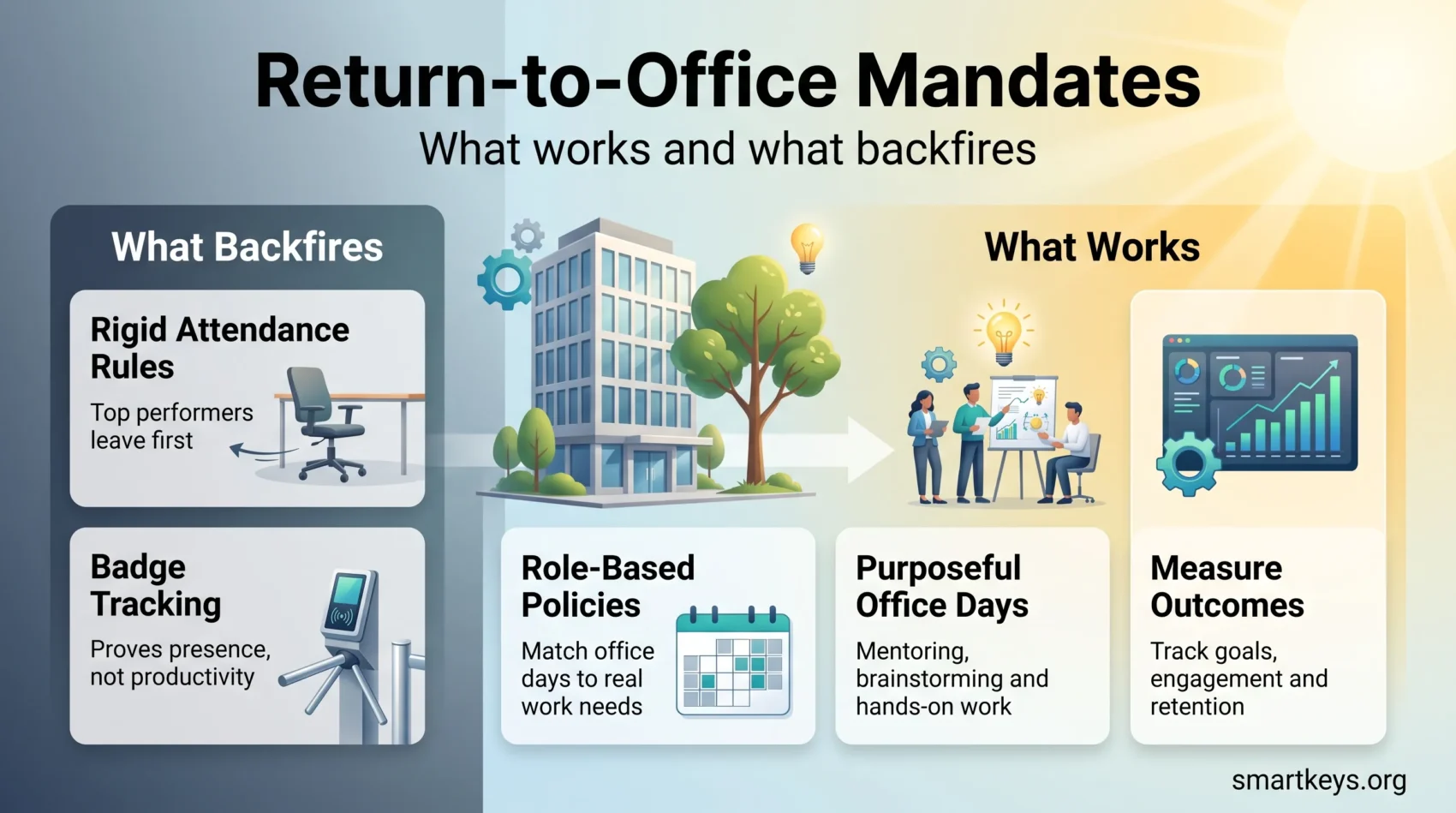
Multnomah County (Oregon) – Three Days In-Person by 2027 Multnomah County union workers staged a public rally on October 1, 2026, protesting a new return-to-office mandate that will require employees to report in person three days per week starting in 2027. The move has sparked organized labor opposition and signals broader friction in the public sector as remote work benefits become a negotiation point.
Fidelity Investments – Full Five-Day Mandate (Rolled Out April 2026) Fidelity Investments, one of the world's largest asset managers, mandated five days in-office for U.S. employees in April 2026, ending its previous hybrid arrangement that allowed staff to work remotely roughly half the month. The policy affects thousands of employees and represents one of the most aggressive RTO reversals among Fortune 500 firms.
Data & Research Spotlight
BLS Telework Share Stable at 22.6% In March 2026, 22.6% of U.S. workers teleworked or worked at home for pay, according to the Bureau of Labor Statistics. This figure represents a plateau in the post-pandemic remote work adoption curve—neither rapid growth nor significant decline—suggesting that remote work has become an embedded feature of the labor market rather than a temporary pandemic adaptation.
McKinsey: Hybrid Performance Concerns Persist McKinsey research highlights that the success of hybrid arrangements depends "less on company mandates and more on how teams coordinate schedules and build trust." The firm reports that managers cite reduced collaboration among team members (34%), lack of performance management processes (17%), and insufficient employee motivation (17%) as barriers to effective hybrid implementation.
Gallup: Hybrid Model Leveling Off Gallup's latest analysis notes that hybrid work adoption has stabilized, with office attendance remaining roughly 30% lower than pre-pandemic levels. Importantly, remote workers are working fewer hours overall, though this has not translated into measurable productivity declines in most sectors.
Deep Analysis — What's Really Happening
Remote work is neither expanding nor contracting sharply—it has stabilized at roughly 23% of the U.S. workforce. This equilibrium masks significant sectoral and organizational divergence. Financial services firms like Fidelity and tech companies with office-centric cultures are pushing hard for five-day mandates, while knowledge work sectors (software, marketing, design) remain more flexible. Public sector employers like Multnomah County are testing three-day hybrid models and facing organized labor pushback, suggesting that RTO decisions are becoming a union and collective bargaining issue, not just an HR preference.
The corporate argument for RTO centers on collaboration, culture, and manager supervision—themes echoed in McKinsey's finding that 34% of leaders cite reduced team collaboration as a key challenge in hybrid setups. However, this framing masks a deeper power dynamic: employers are reasserting control over workplace presence at a moment when worker bargaining power has softened and unemployment is rising. Workers, in turn, are defending remote work as a quality-of-life and flexibility win, particularly in public sector unions where job security is higher.
Productivity data remains mixed and contested. McKinsey warns that hybrid arrangements can depress performance without proper governance, yet Gallup's finding that remote workers log fewer hours without corresponding productivity collapse suggests that output-per-hour may actually be stable or rising. The disconnect reflects measurement challenges: companies are struggling to quantify "collaboration" and "culture" impact, making it easier for executives to default to mandate-based control.
Geographically, RTO enforcement is strongest in finance, asset management, and traditional corporate sectors (Boston, New York, San Francisco). Tech hubs like Austin and Seattle show more flexibility. Public sector RTO pushes—like Multnomah County's—are newer and facing union resistance, suggesting this policy wave may encounter legal and political friction in 2027 and beyond.
Remote Work Tooling & Practice
Slack & Notion Consolidation Slack and Notion remain the backbone of async remote operations, with Notion expanding its AI-powered database and workspace management features to support distributed teams managing complex project workflows. Both tools emphasize reducing synchronous meeting load.
Zoom + Grain AI Meeting Capture Zoom continues to dominate video conferencing, with new competitor Grain adding AI-powered meeting transcription and CRM-ready note automation—targeting remote teams that struggle with meeting follow-through and action item tracking.
Miro for Visual Collaboration Miro remains the leading whiteboarding and visual planning tool for distributed teams, especially in product, design, and strategy disciplines. The platform supports both real-time and asynchronous diagramming and brainstorming.
Worker Sentiment & Community Signals
Union-Led Pushback on RTO in Public Sector Multnomah County workers' organized rally reflects broader labor movement concern that RTO mandates erode work-life balance gains and disadvantage workers with caregiving obligations. Union framing emphasizes "return to the office" as a rollback of pandemic-era flexibility bargains, not a neutral policy change.
Talent Retention Risk Cited by Managers LinkedIn and Glassdoor discourse from remote workers express anxiety that RTO waves will trigger departures to remote-first employers. Tech workers, in particular, are signaling willingness to relocate or switch jobs to preserve flexibility.
Trust Deficit: Managers vs. Workers Reddit's r/remotework and Hacker News threads highlight persistent friction: managers cite culture and collaboration; workers cite surveillance concerns, commute burden, and real estate optimization by employers. Little evidence of productive dialogue between these camps.
What to Watch Next
-
Multnomah County Implementation & Legal Challenge (2027) — Watch for union grievances, arbitration, or legal challenges to the three-day mandate when it takes effect. Outcome may influence other public sector RTO moves.
-
McKinsey Q4 2026 Hybrid Work Update — Upcoming research release expected to quantify productivity and retention impact of aggressive RTO policies; may provide data ammunition for either mandate supporters or remote advocates.
-
Tech Sector Winter Hiring Slowdown — As recruitment cools, remote-first employers (Automattic, Zapier, GitLab) may hire more aggressively, creating talent magnet effect that draws workers away from RTO-mandating firms by end of 2026.
Reader Action Items
-
For remote workers: Document your output, meeting participation, and collaboration impact metrics now. If your employer announces RTO, you'll have quantified evidence of remote productivity to reference in any negotiation. Consider joining or supporting union organizing if you're in public sector.
-
For managers: Before imposing RTO, run a 30-day "coordination sprint"—establish explicit hybrid meeting schedules, async-first defaults, and trust-building rituals (office days for specific team rituals, not just presence). McKinsey's research shows success depends on how you coordinate, not the mandate itself.
-
For job seekers: If flexibility matters to you, target roles at Automattic, GitLab, Zapier, or fast-growing remote-first startups on We Work Remotely. Avoid roles at Fidelity, large finance, and established tech firms currently mid-RTO rollout unless you want office-intensive work.
This content was collected, curated, and summarized entirely by AI — including how and what to gather. It may contain inaccuracies. Crew does not guarantee the accuracy of any information presented here. Always verify facts on your own before acting on them. Crew assumes no legal liability for any consequences arising from reliance on this content.
Powered by
