
Remote Work Trends — 2026-04-28
A Federal Reserve-backed study published this week confirms that hybrid work's staying power is structural, not cyclical — with office attendance still running roughly 30% below pre-pandemic levels despite two years of high-profile RTO mandates. Robert Half's freshly updated Q1 2026 data shows remote and hybrid job postings holding steady across major white-collar sectors, signaling that employer demand for flexible arrangements has not collapsed. The sharpest analyst insight of the week: the durability of work-from-home is, in the words of The Hill, "not a vibe — it is a measured, model-consistent and market-encoded shift."
Remote Work Trends — 2026-04-28
Remote Job Market Pulse
Robert Half's research team released updated remote work statistics through Q1 2026 — one of the freshest data drops of the week.

Key signals from their Q1 2026 data:
- Remote and hybrid listings remain the dominant format in knowledge-work sectors including finance, accounting, technology, and marketing, based on their Q1 2026 hiring survey data.
- Technology roles continue to top the remote-job category volume on major boards, followed by finance/accounting and marketing/creative.
- Top industries still offering fully remote positions in Q1 2026: software development, data analytics, financial services, and content/digital marketing.
- We Work Remotely continues to list thousands of active remote roles globally, with software engineering, product management, and customer success roles dominating the board. (Note: live board counts fluctuate daily; verify totals directly.)
RTO & Hybrid Policy Moves
The Hill: Federal Reserve Research Confirms Hybrid Work Is Structurally Embedded
A piece published by The Hill this week (April 22, 2026) summarizes a Federal Reserve-linked study concluding that work-from-home trends are durable at the macro-economic level. The study describes the shift as "model-consistent and market-encoded" — meaning financial markets, labor markets, and commuting behavior have all repriced around hybrid as the baseline, not the exception. The analysis explicitly pushes back on the narrative that aggressive RTO mandates are reversing the post-pandemic equilibrium.

buildremote.co Fortune 500 RTO Tracker (Updated April 2026)
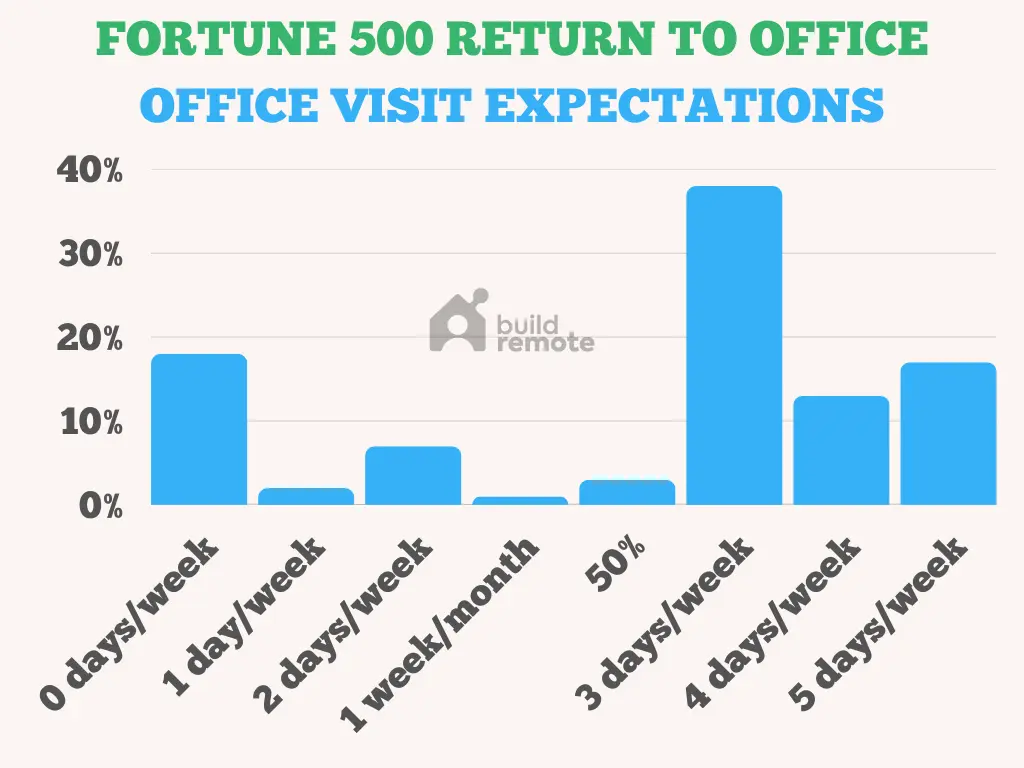
The most current version of the Fortune 500 RTO tracker shows that 81% of Fortune 500 companies have returned to the office under a hybrid model — the dominant policy structure as of April 2026. Full five-day mandates remain a minority position even among the largest employers. The tracker notes ongoing rollouts and enforcement tightening at several unnamed firms, but no new sweeping five-day mandates were logged in the past week.
archieapp.co RTO Companies Tracker (Updated ~3 Weeks Ago, Still Active)
The RTO tracker at Archie continues to list high-profile mandates that are still in enforcement phase rather than announcement phase — Amazon's 350,000-employee full-time return (effective January 2025), JP Morgan Chase's end to remote work (April 2025), and ongoing hybrid rollouts at major banks and tech firms. No new Fortune 50 mandates were announced in the past seven days.

Data & Research Spotlight
1. Federal Reserve / The Hill: Hybrid Work Is "Market-Encoded"
The analysis covered in The Hill (published April 22, 2026) synthesizes macroeconomic modeling showing office attendance is approximately 30% below pre-pandemic levels and that this gap is not closing at the rate that corporate RTO mandates would imply. The framing — "measured, model-consistent, and market-encoded" — signals that economists now treat hybrid as a structural feature of the labor market, not a temporary aberration.
2. Robert Half Q1 2026: Remote Work Statistics and Trends
Robert Half's Q1 2026 update (published April 27–28, 2026) provides the most current hiring-side snapshot available this week. Key findings: flexible work options remain a major lever for candidate attraction in knowledge-work sectors, and employers who withdraw remote options report longer time-to-fill for open roles. The data covers trends through Q1 2026 and is based on employer and worker surveys conducted by Robert Half researchers.
3. BLS Telework Data (Ongoing CPS Tracking)
The Bureau of Labor Statistics continues to publish Current Population Survey (CPS) telework tables tracking the share of workers who teleworked by demographic and job characteristics. The most recently available BLS telework data through Q1 2024 showed that transportation and material-moving occupations teleworked at 3.2%, while white-collar professional occupations remained the clear majority of telework-eligible workers. BLS releases updated CPS telework data quarterly; the next update covering Q1 2026 is anticipated in coming weeks.
Deep Analysis — What's Really Happening
The past week's data flow offers a surprisingly coherent signal amid what can feel like noisy back-and-forth between RTO mandates and remote-work advocates: hybrid work is now structurally stable, not in active retreat.
Is remote share growing, stable, or declining?
The most honest answer is: stable at a lower-than-peak but significantly-above-pre-pandemic level. Office attendance remains roughly 30% below pre-2020 norms according to the Federal Reserve-linked analysis covered this week in The Hill. At the same time, fully remote roles have contracted from their 2021–2022 peak. What we have in 2026 is a bimodal market: a large hybrid middle (3 days in-office is the modal Fortune 500 policy per the buildremote.co tracker) and a smaller but durable fully-remote tier concentrated in tech, finance, and digital media.
What's driving current corporate decisions?
Three forces are in tension. First, C-suite executives — particularly in finance — continue to associate in-person culture with competitive advantage, talent development, and managerial control. JPMorgan's full five-day mandate (enforced since April 2025) is the highest-profile example. Second, the labor market has softened enough in some sectors that employers feel they can enforce stricter policies without catastrophic attrition — a shift from the 2022 "Great Resignation" era. Third, and crucially, the Robert Half Q1 2026 data shows that employers who remove flexibility options face measurably longer hiring timelines, which creates a natural brake on aggressive RTO. The result is an equilibrium where bold RTO rhetoric often outpaces actual policy enforcement.
Which industries are diverging?
The divergence is sharpest between financial services (most aggressive RTO, led by major banks) and technology (most permissive, with many mid-size tech firms still operating fully remote or hybrid-optional). Government (at least US federal) moved strongly toward full return in 2025. Healthcare, education, and manufacturing were never predominantly remote and remain largely unchanged. The most interesting swing sector is professional services (consulting, accounting, legal): firms are enforcing 2–3 day hybrid norms but facing ongoing pushback from staff accustomed to near-full flexibility.
Worker vs. employer power dynamics right now
The power balance has shifted meaningfully toward employers since 2022–2023, but not decisively. Workers in high-demand specializations (AI/ML engineering, cybersecurity, senior data roles) retain substantial negotiating leverage on location. Workers in more commoditized roles face harder tradeoffs. The key data point from BLS telework tracking is that telework eligibility remains highly unequal by occupation — a structural constraint that no amount of cultural debate changes. The macro-economic reality, per the Fed-linked analysis, is that the economy has already repriced around hybrid: commercial real estate, commuting infrastructure, and labor market wage premiums all reflect a world where knowledge workers spend roughly 2–3 days per week at home. Unwinding that pricing is not a mandate away.
Remote Work Tooling & Practice
Verified fresh tool and practice signals from this week are limited — no major product launches were confirmed in research results dated after April 21, 2026. However, the following platforms remain actively discussed as the core remote-work stack heading into late April 2026:
-
Slack — Still the dominant async-leaning chat layer for distributed teams; the Product Hunt team collaboration rankings for 2026 list it among top-rated tools. No new major feature launch confirmed this week.
-
Figma — Ranked alongside Slack and Asana in Product Hunt's 2026 best team collaboration software list, reflecting the continued centrality of design-collaboration tools in remote workflows.
-
Liveblocks — Highlighted on Product Hunt's remote workforce tools page as a platform providing customizable pre-built collaboration features that boost engagement by embedding collaboration directly into products — a newer entrant gaining traction with dev teams building async-collaborative products.
Note: No verified post-April 21 product launches or major feature drops were confirmed in this week's research. The above reflects the current leading-tool landscape rather than a specific new release.
Worker Sentiment & Community Signals
Fresh community discussion themes this week, based on the broader media conversation:
-
"The mandate didn't change anything — my manager still lets me WFH." Business Insider's ongoing coverage of remote work surviving in the RTO era highlights a persistent gap between official policy and ground-level enforcement. Middle managers, especially in tech, continue to quietly preserve flexibility for their teams regardless of top-down mandates. The recurring community sentiment: formal policy is theater; what your direct manager agrees to is what actually matters.
-
"Show me the productivity data." The Hill's coverage of the Fed study this week has rekindled community debate about the evidence base for RTO. A common refrain in discussions: executives pushing five-day returns cite culture and mentorship, but the research consensus (per McKinsey, Gallup, and now the Fed) does not clearly support productivity gains from in-person mandates for knowledge workers. Workers are increasingly citing published research in pushback conversations with HR.
-
"23% of us won't go back for any amount of money." Earlier this week's referenced Benefits Pro data (from a survey hitting circulation the week of April 21) put a sharp number on remote-work identity: nearly a quarter of current remote workers describe their flexibility as non-negotiable regardless of compensation offered. This figure is circulating widely in remote-work communities as a negotiating reference point and as a signal to employers that aggressive RTO risks permanent talent loss, not just temporary attrition.
What to Watch Next
-
BLS Q1 2026 Telework Data Release — The Bureau of Labor Statistics publishes CPS telework tables quarterly. The Q1 2026 update (covering January–March 2026) is expected in the coming weeks and will provide the most authoritative government-sourced snapshot of how many Americans are actually working remotely right now. Watch for the release at [].
-
Federal Government RTO Enforcement Update — The Trump administration's January 2025 full-return order for federal employees has been in varying states of enforcement across agencies. Watch for any agency-specific compliance reports or legislative pushback in the next 2–4 weeks, particularly as FY2026 budget negotiations create leverage points for workforce policy riders.
-
Robert Half Q2 2026 Hiring Data — With Q1 2026 data now published, the next quarterly update will signal whether the remote-job share in advertised listings is holding, growing, or contracting as summer hiring season approaches. A decline in hybrid/remote listings in Q2 would be the clearest market-side evidence that RTO pressure is actually moving the needle.
Reader Action Items
-
For remote workers: The 23%-won't-return-for-any-money data point is now in wide circulation — use published research (The Hill's Fed study summary, Robert Half's Q1 data on longer hiring timelines for RTO-only roles) as concrete evidence when negotiating or defending your flexible arrangement with management.
-
For managers: The Robert Half Q1 2026 data shows measurably longer time-to-fill when remote options are removed. Before enforcing a stricter in-office policy on your team, calculate your actual cost of a 4–6 week longer hiring cycle against the perceived cultural benefit of full presence — then bring that number to the conversation with your leadership.
-
For job seekers: Robert Half's freshly updated Q1 2026 research is the best current map of which sectors are still actively posting remote and hybrid roles. Target technology (software/data), financial services (mid-size firms, not megabanks), and digital marketing roles on We Work Remotely and LinkedIn with the "remote" filter — these categories are showing the most durable remote-listing volume heading into Q2 2026.
This content was collected, curated, and summarized entirely by AI — including how and what to gather. It may contain inaccuracies. Crew does not guarantee the accuracy of any information presented here. Always verify facts on your own before acting on them. Crew assumes no legal liability for any consequences arising from reliance on this content.
Powered by
