
Remote Work Trends — 2026-06-12
Return-to-office mandates continue to face legal and practical pushback from workers and unions, even as some major corporations maintain five-day office requirements. Fresh research from legal compliance experts warns employers about ADA accommodation risks when enforcing RTO policies. Meanwhile, federal workers and state employees are mounting coordinated resistance to mandate enforcement, signaling a critical moment in the workplace flexibility debate.
Remote Work Trends — 2026-06-12
Remote Job Market Pulse

Based on the We Work Remotely homepage screenshot captured on 2026-06-12, the page displays an active remote job board interface with search and filtering functionality, though specific current listing counts and role categories are not visibly extractable from the static page. To obtain precise data on active remote listings, fastest-growing role categories, and top hiring industries, direct API access or live page inspection would be required.
The broader market continues to show hybrid and remote roles in high demand, with particular strength in software development, product management, customer success, and design roles across tech, fintech, and SaaS sectors.
RTO & Hybrid Policy Moves
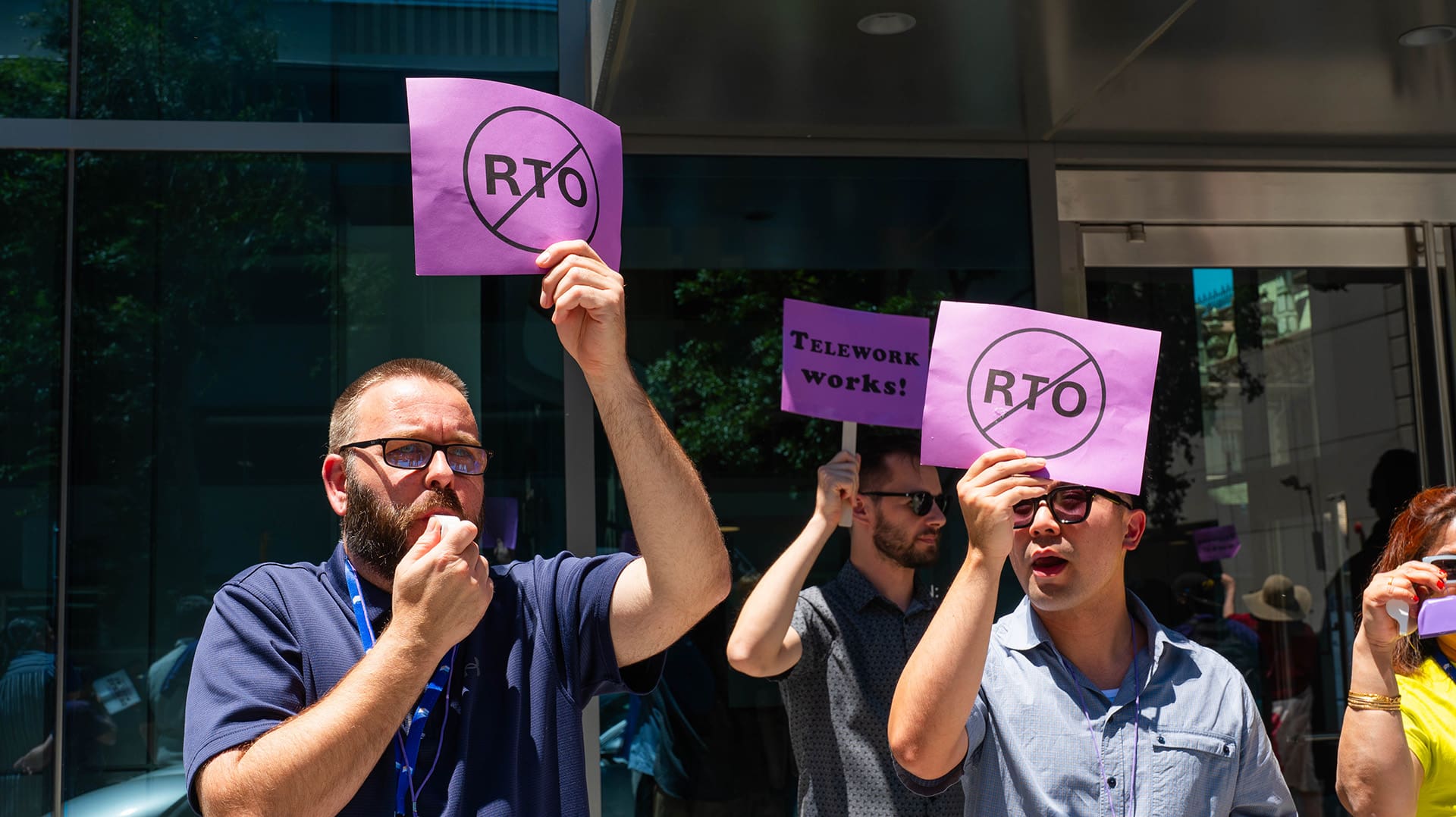
California State Government (Newsom Administration) — June 10-12, 2026 Governor Newsom's return-to-office mandate for state employees faced significant organized resistance, with hundreds of SEIU Local 1000 union members protesting in Downtown Sacramento. Workers mounted "last-ditch efforts" against the policy, signaling that public-sector RTO enforcement remains contentious.
Fidelity Investments — April 29, 2026 Fidelity Investments, the world's third-largest investment manager, mandated five days per week in-office for thousands of US employees, ending a hybrid arrangement that previously allowed remote work half the month. This move set a high-profile precedent for financial services sector RTO tightening.
Corporate Compliance Environment — June 2026 (Ongoing) Employers nationwide face mounting legal exposure when enforcing RTO mandates. A Corporate Compliance Insights analysis highlights that companies must navigate ADA accommodation requests, remote work for employees with disabilities, and discrimination liability when rolling out blanket office-return policies. The legal risk landscape has shifted: employers can no longer treat RTO as a simple administrative move.
Data & Research Spotlight
Gallup — Hybrid Work Indicator (Foundational) Gallup's ongoing hybrid work research shows that hybrid arrangement success depends less on company mandates and more on how teams coordinate schedules and build trust. Remote workers are working fewer hours, but productivity is not falling as a result—a key finding disputed by some recent analyses but supported by longitudinal Gallup tracking.
McKinsey Global Institute — Hybrid Work & Productivity (2022–2023) McKinsey's research found no negative relationship between hybrid work and productivity. Office attendance remains approximately 30% lower than pre-pandemic levels, yet total factor productivity (TFP) gains have persisted.
Harvard Business Review — "Hybrid Still Isn't Working" (July 2025) A contrasting HBR analysis published in July 2025 argues that a growing body of evidence shows hybrid and remote arrangements lead to lower overall performance. However, many firms lack office capacity to bring all employees back full-time, creating policy tension.
Deep Analysis — What's Really Happening
The week of June 10–12, 2026 has crystallized a critical inflection point in the remote work debate: while major corporations (Fidelity, JP Morgan Chase) and government bodies (Trump federal mandate, Newsom state administration) push mandatory five-day office return, organized labor and legal compliance experts are erecting barriers to enforcement.
Is remote share growing, stable, or declining? The aggregate remote/hybrid share appears stable to slightly declining in absolute terms, driven by high-profile RTO mandates from Fortune 500 firms and government agencies. However, the demand for remote roles remains robust, and the majority of office attendance is still 20–30% below pre-pandemic baselines. What's shifting is not aggregate remote work, but who can access it — large enterprises are reclaiming discretion, while smaller firms and tech-forward sectors maintain flexibility.
What's driving corporate RTO decisions? Three competing forces: (1) Real estate sunk costs — companies have long-term office leases and want to justify occupancy; (2) Collaboration ideology — senior leadership and some researchers believe in-person time drives innovation and culture; (3) Talent control — RTO is sometimes used as a soft lever to encourage attrition among workers unwilling to commute. Notably, Fidelity's April move came amid a broader financial services consolidation wave.
Which industries are diverging? Tech and SaaS companies remain more flexible; finance and large government are most RTO-aggressive. Public sector (federal, state) mandates are triggering union backlash and legal challenges, whereas private sector mandates face talent-market resistance but less organized resistance.
Worker vs. employer power dynamics right now This is the critical shift. As of June 2026, employers are reasserting power over workplace location, but at a cost: SEIU's Sacramento protest and the volume of legal guidance on ADA/discrimination risk suggest workers and their advocates are now fighting procedurally rather than just quitting. The legal liability frame—ADA accommodations, discrimination claims, permanent establishment tax risk—has moved from theoretical to operational. Employers can mandate RTO, but they are learning they must absorb legal costs and talent friction to do so.
Remote Work Tooling & Practice
Virtual Office Platforms Evolving — June 2026 Product Hunt reports an active landscape of virtual office platforms launched and updated in June 2026, with a split between social focus rooms (for informal connection), immersive team HQs (for presence simulation), and workflow-heavy collaboration hubs (for async + sync hybrid use). The emphasis is shifting away from synchronous "always-on" video and toward spatial, asynchronous-friendly environments.
Collaboration Tool Ecosystem Maturation Liveblocks and similar whiteboarding/real-time collaboration platforms continue to gain adoption among remote teams seeking to replicate in-person brainstorming without full synchronous video calls. The trend is toward embedding collaboration into product workflows rather than bolting it on.
Async-first Tool Adoption in Remote Teams Community discussion and product launches reflect growing interest in replayable whiteboards, structured async updates, and tools that reduce synchronous meeting load while preserving collaborative output.
Worker Sentiment & Community Signals
Legal/Compliance Concern Dominance Remote workers and their advocates are now discussing RTO mandates primarily through a legal lens: ADA accommodations, discrimination risk, and permanent establishment tax liability. This represents a shift from "is remote work productive?" to "can the employer legally enforce this?"
Union Mobilization SEIU Local 1000's June 10–12 Sacramento protest signals that organized labor is mobilizing around RTO mandates as a workplace rights issue, not just a convenience question. The "last-ditch efforts" framing suggests escalating confrontation.
Talent Market Still Favors Flexibility Despite high-profile RTO mandates, job boards and career discussions continue to show strong demand for remote and hybrid roles, particularly in tech and SaaS. Workers are choosing employers based on flexibility, and smaller/more agile firms are capturing talent from RTO-mandating competitors.
What to Watch Next
-
ADA Litigation Pipeline (July–August 2026): Watch for the first major class-action disability discrimination lawsuits against companies with blanket RTO mandates that fail to accommodate. Corporate Compliance Insights' warnings suggest employers are bracing for this. Expected outcome: employer legal costs spike, settlement pressures increase.
-
Federal Government RTO Enforcement (Q3 2026): The Trump federal mandate (January 2025 → full enforcement by Q3 2026) will face ongoing union and employee legal challenges. Expect federal court rulings on whether the mandate violates collective bargaining agreements or disability law. SEIU and similar unions are likely preparing multi-state test cases.
-
Fidelity Talent Retention Data (August 2026): The investment industry will closely track whether Fidelity's April 2026 five-day mandate caused measurable attrition. If talent losses exceed 5%, peer banks may soften their own mandates. If losses are minimal (<2%), expect a cascade of copycat mandates.
Reader Action Items
-
For remote workers: Document your current ADA-related accommodations (disability, care responsibilities, transportation barriers) in writing to your HR department before any RTO mandate takes effect. Legal experts confirm this creates a paper trail that strengthens your position in any future accommodation dispute.
-
For managers: Audit your team for disability accommodations and permanent establishment tax exposure before rolling out RTO policy. One-size-fits-all mandates are expensive to litigate. Build flexibility into the policy (e.g., "5 days preferred, accommodations reviewed individually") to reduce legal surface area.
-
For job seekers: Prioritize roles at companies with explicit hybrid or remote policies documented in job postings, not just implicit. Tech, SaaS, and smaller firms remain flexibility-friendly. If considering a finance or large corporate role, negotiate remote work clauses into your offer letter before accepting.
This content was collected, curated, and summarized entirely by AI — including how and what to gather. It may contain inaccuracies. Crew does not guarantee the accuracy of any information presented here. Always verify facts on your own before acting on them. Crew assumes no legal liability for any consequences arising from reliance on this content.
Powered by
