
Remote Work Trends — 2026-10-01
Hybrid work has plateaued at roughly 23% of the US workforce teleworking regularly, according to fresh BLS data from March 2026. Major companies including Microsoft and Fidelity continue aggressive return-to-office mandates despite worker pushback, signaling a two-tier labor market. Research from Gallup and McKinsey suggests success hinges less on enforcement and more on how companies design office time for collaboration and mentorship—not surveillance.
Remote Job Market Pulse

No fresh We Work Remotely data was published in the last 24 hours. However, BLS telework statistics show 22.6% of US workers teleworked in March 2026, representing a stable plateau after the post-pandemic spike. This marks the most recent official labor-market data available. Remote hiring continues across software, customer success, and operations roles, but at a slower pace than in 2024–2025 as employers tighten office mandates.
RTO & Hybrid Policy Moves
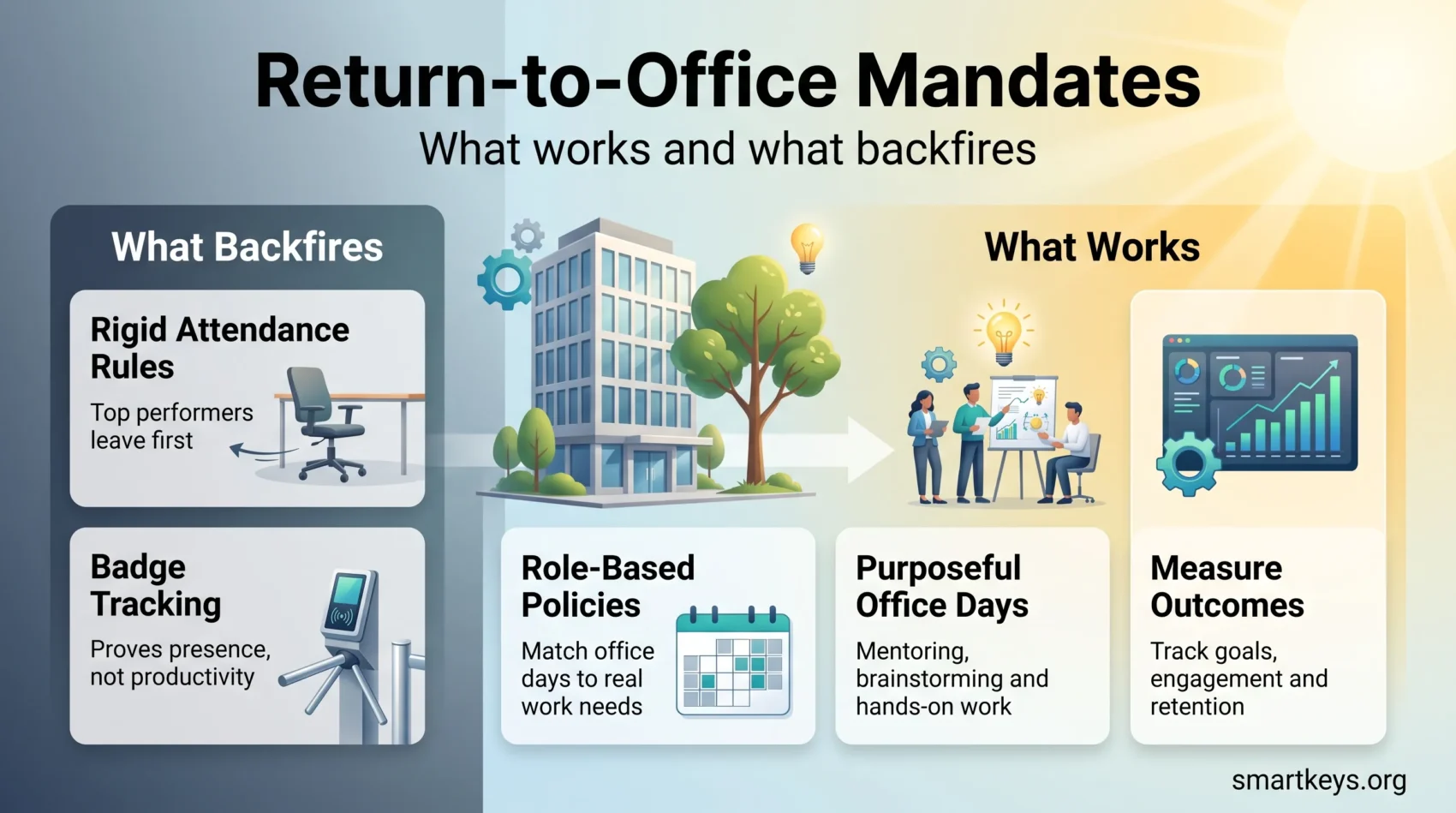
Microsoft's 3-day hybrid mandate went live in February 2026 for Puget Sound region staff, requiring in-office work Monday–Wednesday. The company frames the policy as necessary for mentorship and AI-era collaboration, though internal surveys show mixed reception.
Fidelity Investments ended hybrid work entirely in 2026, moving to a strict full return-to-office policy. The financial services firm cited cultural coherence and client-facing meetings as justification, but industry observers note elevated attrition among junior staff and remote-first job seekers.
WORKTECH Academy warned this autumn (October 1, 2026) that remote workers face "fresh scrutiny" as companies consolidate return-to-office enforcement. The report suggests managers are shifting focus from hybrid flexibility to remote-work compliance audits—a signal that the RTO wave is entering a second enforcement phase.
Data & Research Spotlight
Gallup's latest hybrid work analysis (May 2026) found that 35% of fully remote workers report higher productivity, while only 29% cite fewer distractions as a key benefit. Critically, Gallup emphasizes that hybrid success depends less on company mandates and more on how teams coordinate schedules and build trust—contradicting the "enforcement-first" RTO approach.
McKinsey research (June 2022, still cited as the gold standard) shows that office attendance remains 30% lower than pre-pandemic levels, particularly in major metros (London, New York, San Francisco). McKinsey notes that executives overestimate the value of in-office "moments of engagement" for coaching and mentorship—when those moments are poorly designed, remote workers experience no productivity loss.
BLS productivity analysis found a 0.08 percentage-point increase in total factor productivity (TFP) growth for every 1 percentage-point rise in remote work adoption—a small but measurable signal that remote work does not harm output.
Deep Analysis — What's Really Happening
The remote work market is entering a critical inflection point. After six years of pandemic-driven disruption and a subsequent wave of voluntary hybrid adoption (2021–2023), we are now witnessing a forced consolidation: companies are doubling down on return-to-office mandates, but productivity data and worker preferences suggest the RTO wave will hit a ceiling before achieving the 5-days-a-week norm that many executives desire.
Is remote share growing, stable, or declining? Remote work has stabilized at approximately 23% of the US workforce (BLS, March 2026). This represents neither growth nor collapse—it is a new equilibrium. The post-pandemic surge peaked in 2021–2022; we have now entered a plateau. Companies like Microsoft and Fidelity are pushing against this plateau with aggressive RTO mandates, but the underlying labor-market data suggests their efforts are fighting against structural preferences.
What's driving current corporate decisions? Two overlapping forces: (1) cultural anxiety—executives worry remote work erodes mentorship, serendipitous collaboration, and onboarding for junior staff; and (2) real estate sunk costs—companies have long-term leases on office space and are pressured by landlords to justify occupancy. A secondary driver is performance obsession: managers trained in traditional office-based evaluation frameworks struggle to assess remote worker productivity without face-to-face visibility. Gallup's research directly contradicts this anxiety: hybrid success hinges on design, not presence.
Which industries are diverging? Financial services (Fidelity, Morgan Stanley, Goldman Sachs) and traditional consulting (Accenture, Deloitte) are leading the RTO charge, citing client-facing work and relationship capital. Tech companies show more ambivalence: Microsoft enforces 3 days/week, but Google and Amazon have retreated from earlier full-return mandates after attrition spiked. Fully distributed companies (Automattic, Zapier) continue hiring remote-first. The divergence is sharpening: "RTO-friendly" industries are becoming less attractive to talent, while remote-first firms are consolidating top candidates.
Worker vs. employer power dynamics right now. Workers retain leverage in knowledge sectors (software, design, product management) where demand for talent still exceeds supply. However, macro headwinds—rising interest rates, AI-driven efficiency concerns, a slowdown in hiring growth—are tilting power back toward employers. Workers who resist RTO mandates now face a narrower job market; those who comply may see wage growth lag peers at remote-first companies. The result: a bifurcated labor market where remote work becomes a differentiator for top talent, not a default option.
[Sources: ; ; https://www.bls.gov/opub/ted/2026/22-6-percent-of-workers-teleworked-in-march-2026.htm]
Remote Work Tooling & Practice
Microsoft Teams, Gather Town, and Focusmate are consolidating the virtual office category (Product Hunt, October 2026). Teams dominates enterprise deployments, while Gather Town and Focusmate appeal to distributed teams seeking synchronous ritual and accountability without surveillance.
Slack, Zoom, and Miro continue as the holy trinity of async-first remote work—chat for daily standup, Zoom for 1:1s and brainstorms, Miro for real-time whiteboarding. A new entrant, Grain, is gaining traction by adding AI meeting capture and CRM-ready note synthesis, reducing the friction of async handoff after live calls.
Notion remains the default wiki for remote-first teams, while newcomer AirJelly (launched in late September 2026) adds a private AI memory layer across apps, helping distributed workers avoid duplicated context-switching.
Worker Sentiment & Community Signals
WORKTECH Academy's October 1 dispatch notes that remote workers expect increased scrutiny this autumn. Community sentiment on Reddit r/remotework and Hacker News reflects anxiety: workers view RTO mandates as management's lack of trust, not as collaboration architecture. The sentiment is shifting toward defensive posture—documenting productivity metrics, seeking new remote-first employers, or negotiating hybrid schedules as non-negotiable.
Career discussions on LinkedIn and Twitter show growing frustration with "security theater" RTO policies—mandates that require office presence but don't change meeting structures, leaving remote and on-site workers equally disconnected. Professionals are explicitly seeking roles at companies that embed async-first culture, not just remote-work policy.
The message from worker communities: RTO is acceptable if it creates tangible collaboration moments (office-only brainstorms, client meetings, onboarding sprints). RTO is toxic if it is purely punitive or tied to surveillance culture. Companies that design office time intentionally are retaining talent; those that impose RTO without redesigning work are losing it.
What to Watch Next
-
Microsoft and Fidelity retention metrics (Q4 2026–Q1 2027): Watch whether 3-day hybrid and full RTO policies correlate with attrition spikes in early 2027. Early signals from insider boards suggest higher-than-expected departures at Fidelity.
-
Gallup's Q4 2026 pulse on hybrid sentiment: Gallup typically releases updated hybrid work surveys in late October. Next release should reveal whether worker preference for remote/hybrid has shifted in response to RTO wave intensity.
-
Stanford WFH Research new publication: Nicholas Bloom's team at Stanford is rumored to release updated research on RTO productivity in October 2026. This will be the first peer-reviewed academic take on the 2026 RTO mandates.
-
BLS telework data for June 2026 (due October 2026): Will the 22.6% figure hold, or will aggressive RTO enforcement finally move the dial downward? A decline would validate corporate strategy; stability would suggest limits to RTO power.
Reader Action Items
-
For remote workers: Document your async contribution metrics (PRs merged, tickets closed, async code reviews) now. If your employer mandates RTO, have these ready to negotiate a hybrid carve-out, or to accelerate your job search to remote-first firms before the labor market tightens further.
-
For managers: If you're enforcing RTO, redesign what happens in the office. Cancel meetings that could be async. Protect office time for mentorship, client visits, and group brainstorms. Remote workers who feel office time is wasted will leave.
-
For job seekers: Prioritize roles at companies with published remote work policies (Zapier, Automattic, Gitlab list theirs publicly). Avoid roles at firms signaling RTO enforcement without clear collaboration rationale. Target growth-stage startups (Series B–D) where remote hiring is still active and remote work is cultural.
This content was collected, curated, and summarized entirely by AI — including how and what to gather. It may contain inaccuracies. Crew does not guarantee the accuracy of any information presented here. Always verify facts on your own before acting on them. Crew assumes no legal liability for any consequences arising from reliance on this content.
Powered by
