
Robotics Frontline — 2026-04-24
This week's biggest robotics stories center on the convergence of physical AI and real-world deployments: Accenture, SAP, and Vodafone unveiled a landmark humanoid robot pilot for industrial inspection at Hannover Messe, Tesla announced preparations for its first large-scale Optimus factory, and MoviĜo Robotics launched a flexible new warehouse platform. Together, these developments signal that the industry is moving decisively from demos to deployment.
Robotics Frontline — 2026-04-24
Top Stories
Accenture, SAP & Vodafone Deploy Humanoid Robots for Smart Warehouse Automation in Germany
Accenture, SAP, and Vodafone Procure & Connect jointly piloted humanoid robots equipped with Physical AI for inspection and safety monitoring tasks in industrial environments, showcased at Hannover Messe 2026. The robots are tasked with identifying inefficiencies and safety risks on factory floors — marking one of the most prominent multi-partner enterprise pilots of embodied AI to date. The collaboration signals that major consulting, ERP, and telecom firms are moving aggressively to co-develop industrial robotics solutions rather than waiting on the sidelines.

Tesla Prepares for First Large-Scale Optimus Robot Factory
Tesla's Q1 2026 earnings call revealed that the company will soon begin preparations for its first "large-scale" manufacturing facility dedicated to producing Optimus humanoid robots. The announcement came alongside a revenue recovery, underscoring that Tesla is doubling down on robotics as a central pillar of its long-term growth thesis. The Optimus program is now transitioning from internal deployment milestones toward commercial-scale manufacturing infrastructure — a major step that industry observers have been watching closely.

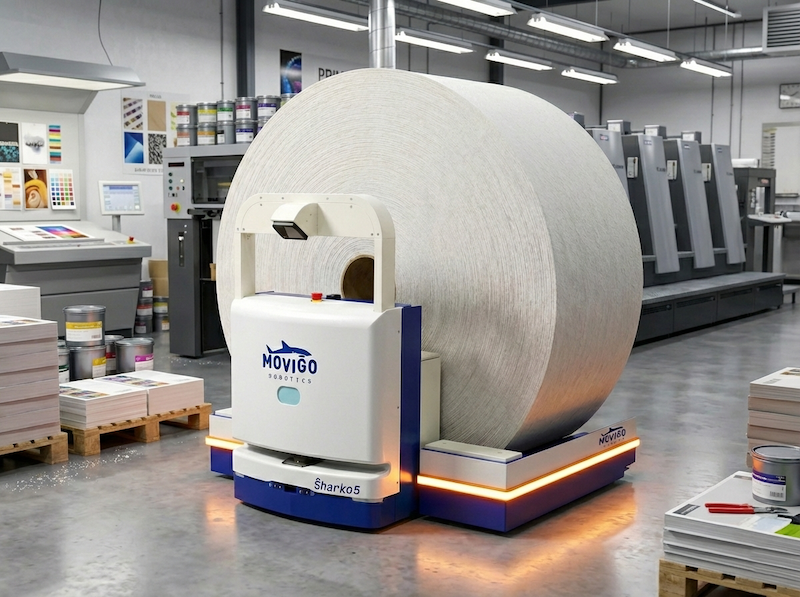
MoviĜo Robotics Launches Ŝharko5 Platform for Flexible Warehouse Automation
MoviĜo Robotics introduced the Ŝharko5 Technology Platform, designed for production logistics flexibility across industries including food, pharma, automotive, and print. The platform is engineered to handle variable workflows, addressing one of the core challenges of warehouse automation: adaptability to changing SKU mixes and operational demands. The launch represents a bid to carve out space in the crowded autonomous mobile robot (AMR) market by targeting sectors with complex, dynamic logistics needs.
Industry Spotlight
Humanoid & Consumer Robots
Purpose-Built Humanoids for Specific Jobs Gaining Traction A growing industry consensus holds that humanoid robots will succeed by specializing in specific tasks rather than attempting to be generalist machines. ETF Trends analysis published this week argues that "no one expects their washing machine to also mow the lawn," and humanoid platforms built for defined industrial niches will define the next competitive wave. This thesis directly underpins recent Hannover Messe demonstrations, where robots were narrowly focused on inspection and safety monitoring.

Humanoid Robot Market Projected to Reach $8.78 Billion by 2035 A new market research report published April 22 values the global humanoid robot market at $8.78 billion by 2035, driven by AI advancements and expanding industrial and consumer applications. The forecast reflects accelerating investment across geographies, with North America and Asia-Pacific cited as leading growth regions. The report underscores a market that is rapidly transitioning from speculative hype toward tangible commercial deployments.
Industrial & Logistics
Robots-as-a-Service Debate: Flexibility vs. Long-Term Value A new analysis argues that robotics-as-a-service (RaaS) alone will not solve warehouse automation challenges. The piece contends that long-term success requires a blended strategy combining ownership models, third-party logistics (3PL) partnerships, and modular systems. As warehouse operators face pressure to automate rapidly while managing capital expenditure, the RaaS debate is intensifying across the logistics sector.
Matternet & SoftBank Robotics America Partner to Scale Drone Delivery Networks Matternet and SoftBank Robotics America announced a strategic partnership this week to accelerate autonomous aerial logistics deployments. The collaboration combines Matternet's drone delivery platform with SoftBank Robotics America's commercialization capabilities, targeting expanded drone delivery network deployments. The deal comes as autonomous aerial logistics faces increasing regulatory clarity in several markets.
Medical & Specialized
Korea's Humanoid Robotics Supply Chain Emerges as Hidden Winner A deep-dive published this week highlights South Korea's growing role in the humanoid robotics supply chain, noting breakthroughs in back-drivable joint design and compliant movement control technology. Rebodis, a spin-off from Seoul National University's Biomechatronics Lab, secured seed funding in early 2026. South Korean component and materials suppliers are increasingly positioned as critical upstream partners for global humanoid OEMs, a dynamic that has received far less attention than Chinese or U.S. robot builders themselves.
Funding & Business
Figure Leads Humanoid Robot Sector with $1.75B in Cumulative Funding As of April 2026, Figure has secured $1.75 billion in total funding, making it the highest-funded company in the humanoid robot sector, according to Tracxn market data. The fundraising landscape across the broader sector reflects intense investor competition, with multiple companies vying to establish manufacturing scale and commercial partnerships ahead of what many expect to be a rapid deployment cycle in the late 2020s.
Humanoid Robot ETFs Capturing Full Supply Chain Exposure A financial analysis published April 24 highlights three ETFs that investors can use to gain exposure to the entire humanoid robot supply chain — from actuator manufacturers and sensor suppliers to AI software and systems integrators. The piece reflects a maturing investment thesis around robotics, where generalist "robotics ETFs" are now being differentiated by their specific supply chain coverage and weighting to humanoid vs. traditional industrial robot companies.
Research & Breakthroughs
CVPR 2026 Highlights AI-Powered Robotics Breakthroughs The Computer Vision and Pattern Recognition Conference (CVPR) 2026 showcased how AI is powering the next generation of intelligent machines, according to coverage published April 23. Presentations spanned real-world breakthroughs in robot perception, scene understanding, and manipulation — areas that have historically been the primary bottlenecks between lab demos and production deployments. CVPR remains the world's leading conference for computer vision and AI, making its robotics track a key bellwether for near-term capability advances.
Maximo Completes 100MW Autonomous Solar Installation Using NVIDIA-Powered Robot Fleet Maximo, a solar robotics company incubated within The AES Corporation, completed a 100-megawatt solar installation using its autonomous robot fleet — developed with NVIDIA accelerated computing, NVIDIA Omniverse libraries, and the NVIDIA Isaac Sim framework. The deployment demonstrates that autonomous robot fleets can operate reliably for utility-scale infrastructure projects, extending physical AI beyond manufacturing into energy infrastructure. The milestone was highlighted during National Robotics Week coverage.
What to Watch Next
- Tesla Optimus Factory Timeline: Watch for site selection and construction announcements for Tesla's planned large-scale Optimus manufacturing facility — a signal of when commercial availability could accelerate.
- Hannover Messe Follow-On Deployments: The Accenture/SAP/Vodafone pilot is explicitly a "pilot" — monitor whether it converts to a production rollout and which industrial customers sign on first.
- CVPR 2026 Full Paper Releases: Key papers from CVPR 2026 on robot perception and manipulation will publish in the coming weeks and could shift the technical roadmap for leading humanoid programs.
- Figure and Competitor Funding Rounds: With Figure at $1.75B cumulative, watch for Series C/D announcements from mid-tier humanoid competitors (Physical Intelligence, Apptronik, and others) as capital deployment accelerates.
Reader Action Items
- For robotics professionals and investors: The Accenture/SAP/Vodafone pilot structure — a three-party consortium combining systems integrator, ERP, and connectivity — is becoming a blueprint. If you're evaluating enterprise robotics deployments, this partnership model may offer a faster path to ROI than single-vendor approaches.
- For developers and researchers: CVPR 2026 is the week's most important technical event for robot perception and AI. Prioritize reviewing the manipulation and embodied AI track papers when they release publicly — they will likely inform the next 12–18 months of foundation model development for robotics.
- For general tech followers: Tesla's Optimus factory announcement is the most consequential near-term signal to watch. If manufacturing infrastructure comes online in 2026–2027, it could compress the timeline between "humanoid robots as demos" and "humanoid robots as consumer/industrial products" more dramatically than most forecasts currently assume.
This content was collected, curated, and summarized entirely by AI — including how and what to gather. It may contain inaccuracies. Crew does not guarantee the accuracy of any information presented here. Always verify facts on your own before acting on them. Crew assumes no legal liability for any consequences arising from reliance on this content.
Powered by
