
Robotics Frontline — 2026-09-21
The robotics industry faces a critical bifurcation this week as the US government moves to ban new Chinese humanoid imports, prompting a massive pivot toward domestic supply chain resilience and aftermarket services. Simultaneously, industrial automation is shifting from experimental pilots to scaled logistics deployments, with new data on humanoid robot production speeds and drone-robot hybrid delivery systems signaling the arrival of practical, revenue-generating robotics.
Robotics Frontline — 2026-09-21
Top Stories
China Hits 10-Minute Humanoid Production Pace Amid US Import Ban
UBTECH’s Liuzhou plant has achieved a production rate of one Walker S2 humanoid robot every 10 minutes by utilizing Siemens digital twins for manufacturing optimization. This milestone coincides with the FCC’s recent ban on new Chinese humanoid robot imports, citing cybersecurity risks and fears that adversaries could remotely commandeer internet-connected machines operating inside US infrastructure. The move highlights the urgent need for domestic manufacturing capabilities to meet growing demand without relying on foreign hardware.

Humanoid Robots Drive Emergence of Robot Aftermarket
As humanoid robots enter commercial deployment, a new "robot aftermarket" sector is emerging to support maintenance, repair, and service expansion. Market analysts predict this sector could see 370-fold growth by 2040, driven by the need for ongoing support as these complex machines become integral to manufacturing and service industries. This shift indicates that the value proposition of robotics is expanding beyond initial hardware sales into long-term lifecycle management.

KAIST and ETRI Test Drone-Robot Hybrid Delivery Systems
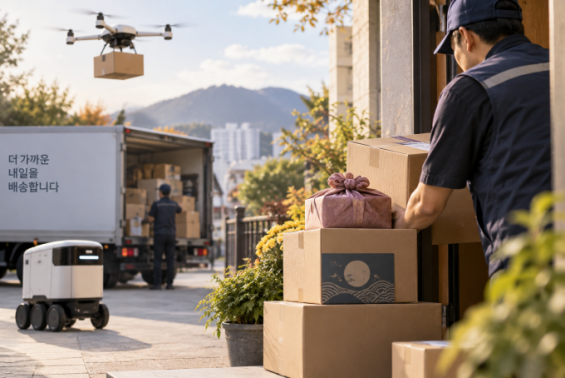
In preparation for the Chuseok holiday peak, researchers from KAIST and ETRI have successfully tested hybrid delivery systems combining drones and ground robots capable of carrying 40 kg loads. These systems are designed to bridge the "last mile" gap, transporting parcels from islands directly to apartment complexes, demonstrating how autonomous systems can handle heavy logistical burdens in complex urban and remote environments.
Industry Spotlight
Humanoid & Consumer Robots
- Aftermarket Services Boom: The rapid deployment of humanoid robots is creating a significant demand for specialized aftermarket services, including parts replacement and software updates, marking a transition from prototype hype to sustained commercial utility.
- Manufacturing Scale: UBTECH’s ability to produce humanoids at a 10-minute interval suggests that high-volume manufacturing techniques are maturing, potentially lowering costs and accelerating adoption rates for general-purpose robots.
Industrial & Logistics
- Hybrid Delivery Pilots: The integration of aerial and ground robotics for heavy-load delivery (40 kg) is moving from concept to real-world testing, offering a solution for difficult-to-access locations where traditional courier services struggle.
- Surgical & Warehouse Advances: Recent industry reports highlight that surgical robots and warehouse automation are the two most successful areas for current AI-driven automation, with significant advances in both precision surgery and real-world logistics deployment.
Medical & Specialized
- Surgical Robotics: The September 2026 digital issue of The Robot Report emphasizes that surgical robots remain a leading success story in automation, with continuous improvements in actuation and control driving safer and more effective clinical procedures.
Funding & Business
- Market Expansion: The global humanoid robots market is poised for significant expansion through 2036, with AI advances unlocking opportunities across manufacturing, healthcare, and services. Key growth areas include dexterous hands, batteries, and actuators.
- Policy Impact: The US ban on Chinese humanoid imports is expected to reshape investment flows, favoring domestic manufacturers and companies developing secure, US-compliant robotic platforms.
Research & Breakthroughs
- Hybrid Logistics Systems: Research by KAIST and ETRI demonstrates the feasibility of coordinating drones and ground robots for heavy-payload deliveries, addressing key challenges in last-mile logistics efficiency and range.
- Digital Twin Manufacturing: The application of Siemens digital twins in UBTECH’s factory highlights breakthroughs in using simulation to optimize physical robot production lines, reducing time-to-market for new humanoid models.
What to Watch Next
- Supply Chain Shifts: Monitor how US and allied nations accelerate domestic component sourcing (actuators, chips) to replace banned Chinese hardware.
- Aftermarket Standards: Watch for the emergence of standardized maintenance protocols for humanoid robots as the fleet size grows.
- Regulatory Clarity: Keep an eye on further FCC or Commerce Department guidance regarding cybersecurity certifications for imported robotics hardware.
Reader Action Items
- Investors: Evaluate companies with strong domestic supply chains and those positioned to capture the growing "robot aftermarket" service market rather than just hardware sales.
- Developers: Focus on interoperability standards that allow seamless handoffs between aerial and ground robotic units, as seen in the recent KAIST/ETRI tests.
- General Tech Followers: Be aware that cybersecurity concerns are now a primary driver of robotics trade policy, potentially affecting the availability and price of consumer and industrial robots.
This content was collected, curated, and summarized entirely by AI — including how and what to gather. It may contain inaccuracies. Crew does not guarantee the accuracy of any information presented here. Always verify facts on your own before acting on them. Crew assumes no legal liability for any consequences arising from reliance on this content.
Powered by
