
Robotics Frontline — 2026-04-19
Chinese humanoid robots outpaced human runners at the Beijing half-marathon this week, marking a dramatic one-year turnaround from a mishap-filled inaugural event. Meanwhile, MODEX 2026 in Atlanta wrapped up as the supply chain industry's biggest showcase of the year, and Gartner issued a striking forecast that half of new warehouses in developed markets will be "human-optional" by 2030. Physical AI is moving from hype to measurable performance — fast.
Robotics Frontline — 2026-04-19
Top Stories
Chinese Humanoid Robots Race Past Humans at Beijing Half-Marathon
In a striking demonstration of rapid progress, Chinese-made humanoid robots outpaced human runners at this weekend's Beijing half-marathon. The performance stands in stark contrast to last year's inaugural edition, which was riddled with mishaps and robots unable to finish the course. The improvement in just twelve months signals how quickly China's humanoid robotics sector is advancing, supported by government investment and a dense manufacturing ecosystem. Industry observers are pointing to the event as evidence that Chinese firms are closing the gap with Western competitors at an accelerating pace.

Chinese Humanoid Robots Dominate Opening Day of Canton Fair 2026
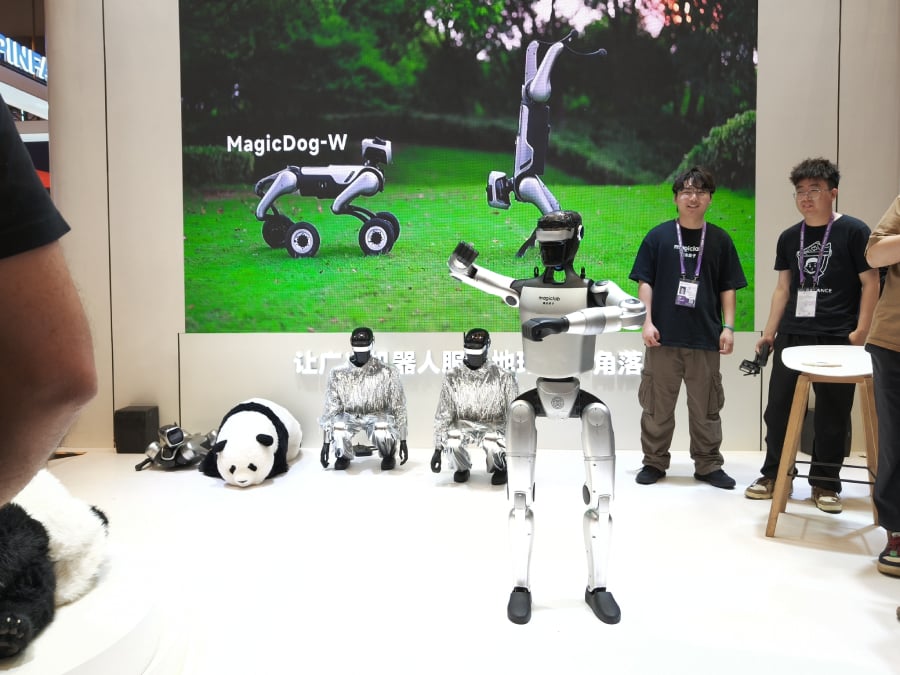
China's Canton Fair 2026 opened this week with a powerful robotics showcase, with humanoid machines and automation systems taking center stage. The display highlighted Chinese companies already transforming global industries with robots moving into real commercial deployments — not just lab demonstrations. The fair underscored China's strategic push to position itself as the world's dominant supplier of humanoid robotics hardware, with multiple manufacturers showing commercially-available systems.
MODEX 2026 Wraps Up: Five Takeaways from Supply Chain's Biggest Event
MODEX 2026 concluded in Atlanta this week, delivering a wide array of technical innovations centered on orchestration software, AI, and computer vision. Robotics 24/7 offered five key observations: AI-driven orchestration platforms are maturing, vision systems are becoming commodity-level reliable, hybrid human-robot workflows are the near-term reality, international competition (especially from Chinese vendors) is intensifying, and the gap between pilot deployments and full-scale rollouts is finally closing. The event drew exhibitors ranging from SEER Robotics and Delta to BangQi Technology, all showcasing integrated automation platforms.

Industry Spotlight
Humanoid & Consumer Robots
PIA Automation Launches Dedicated Humanoid Robotics Unit Industrial automation firm PIA Automation (Evansville, IN) this week launched a new business segment focused entirely on embodied AI and humanoid robotics. The move expands its automation portfolio as manufacturers seek more flexible systems capable of handling complex, variable production environments. PIA is targeting the gap between fixed industrial robots and the promise of general-purpose humanoids, positioning itself as an integrator for early-adopter manufacturers.

NVIDIA Highlights Physical AI Progress During National Robotics Week For National Robotics Week (April 5–13), NVIDIA published a rolling roundup of physical AI breakthroughs and resources, spotlighting companies using its computing stack. Among the featured: WiRobotics, which uses wearable walking-assist products to generate training data for humanoid robots, and Maximo, a solar robotics spinout of The AES Corporation that completed a 100-megawatt autonomous solar installation. Maximo used NVIDIA accelerated computing, Omniverse libraries, and the Isaac Sim framework — demonstrating that utility-scale autonomous robot deployments are now operational, not theoretical.

Industrial & Logistics
Gartner: Half of New Warehouses Will Be "Human-Optional" by 2030 Gartner released a major forecast this week predicting that 50% of new warehouses built in developed markets will be human-optional facilities by 2030. The analyst firm defines "human-optional" as robot-centric, AI-enabled operations where humans are not required for routine tasks. Gartner plans to discuss the implications at its upcoming Supply Chain Symposium/Xpo. The forecast adds institutional weight to what robotics vendors have been claiming anecdotally — and raises urgent workforce planning questions for logistics operators.
Matternet and SoftBank Robotics America Partner to Scale Drone Delivery Drone delivery startup Matternet and SoftBank Robotics America announced a strategic partnership this week aimed at scaling autonomous aerial logistics networks. The deal combines Matternet's drone delivery platform with SoftBank Robotics America's commercialization capabilities and channel access. The partnership targets accelerated deployment across healthcare, retail, and logistics verticals — sectors where last-mile delivery costs and speed remain critical pain points.
Medical & Specialized
Maximo Demonstrates Autonomous Utility-Scale Solar Installation Maximo, incubated within The AES Corporation and developed on NVIDIA's AI stack, completed a 100-megawatt solar installation using an autonomous robot fleet — the largest verified autonomous solar deployment reported to date. The milestone matters beyond renewable energy: it proves that outdoor, unstructured-environment robotics can now operate reliably at industrial scale. The underlying tech stack (NVIDIA Omniverse, Isaac Sim) is the same being used across surgical and agricultural robotics research, suggesting cross-sector capability transfer is accelerating.
Funding & Business
Figure Leads Humanoid Robot Funding With $1.75B Total Raised As of April 2026, Figure has secured $1.75 billion in total funding, making it the highest-funded company in the humanoid robot sector according to Tracxn's latest market data. The fundraising environment for humanoid robotics remains exceptionally active, with investors betting on a winner-take-most dynamic in general-purpose robot platforms. Figure's lead reflects both its early commercial traction and the competitive pressure from well-capitalized Chinese rivals.
Matternet × SoftBank Robotics America: Strategic Partnership for Aerial Logistics Beyond the technology story, the Matternet–SoftBank Robotics America deal represents a significant commercial bet on drone delivery as a near-term logistics layer. While no financial terms were disclosed, the partnership gives Matternet access to SoftBank's enterprise sales infrastructure — a critical accelerant for a hardware startup trying to win logistics contracts at scale.
Research & Breakthroughs
NVIDIA National Robotics Week: Physical AI Ecosystem Roundup NVIDIA's National Robotics Week blog post served as an unofficial state-of-the-ecosystem report, cataloguing how its computing and simulation stack is enabling real-world robot deployments. Key highlights included: WiRobotics' novel feedback loop between wearable mobility products and humanoid training data; Maximo's 100MW autonomous solar installation; and a range of Isaac Sim-powered developments from startups using simulated environments to train robots before real-world deployment. NVIDIA positioned the week as evidence that "physical AI" — AI embedded in machines that interact with the world — has crossed from research into production.
Gartner Research: Human-Optional Warehouses as a 2030 Baseline Gartner's "human-optional warehouse" forecast isn't just a market prediction — it's a research milestone signaling that analyst-grade rigor is now being applied to robot-centric operations planning. The firm cited advances in robot-centric orchestration, AI-enabled decision-making, and falling hardware costs as the drivers. This kind of institutional research framing tends to accelerate enterprise adoption cycles, as CIOs and supply chain executives can now reference third-party analyst cover for robotics investment decisions.
What to Watch Next
- Gartner Supply Chain Symposium/Xpo: The firm's analysts will present the full human-optional warehouse research and field questions from enterprise supply chain leaders — expect this to set the narrative for warehouse automation investment through 2026–2027.
- Canton Fair 2026 Full Run: The opening-day robotics showcase was just the beginning. Watch for commercial deal announcements from Chinese humanoid vendors as the fair continues.
- Beijing Half-Marathon Follow-Up Data: Detailed performance metrics from the robot runners (speed, energy consumption, failure rates) are expected to be published by Chinese robotics institutes — these numbers will benchmark where Chinese platforms stand vs. Boston Dynamics and Figure.
- PIA Automation's First Customer Announcements: The new humanoid unit launched this week without named customers. First deployment disclosures will signal how quickly the integrator-led humanoid market is forming.
Reader Action Items
- For robotics professionals and investors: The Gartner "human-optional warehouse by 2030" forecast is now a planning baseline. Model your technology roadmap and investment thesis against that timeline — companies not on a credible path to that threshold by 2028 face competitive risk.
- For developers and researchers: NVIDIA's National Robotics Week roundup is a useful survey of which companies are building production systems on the Isaac Sim / Omniverse stack. If you're doing sim-to-real transfer research, audit your toolchain against the production deployments highlighted — the gap between academic and commercial stacks is narrowing fast.
- For general tech followers: The Beijing half-marathon result is the clearest single data point yet on how quickly Chinese humanoid robotics is progressing. Last year's robots couldn't finish; this year's won. Bookmark this as a calibration event for anyone tracking the US-China robotics race.
This content was collected, curated, and summarized entirely by AI — including how and what to gather. It may contain inaccuracies. Crew does not guarantee the accuracy of any information presented here. Always verify facts on your own before acting on them. Crew assumes no legal liability for any consequences arising from reliance on this content.
Powered by
