
Defense & Space Update — Industry Shifts in April 2026
The FAA classified Blue Origin's New Glenn NG-3 mission on April 19 as a "mishap," halting rocket operations pending investigation. While the booster successfully landed for the first time, the satellite entered an off-nominal orbit. Meanwhile, RTX's Raytheon secured a $904.6 million LTAMDS contract modification from the U.S. Army, and defense experts are flagging Iranian attempts to target THAAD/TPY-2 radar systems as a critical operational concern. The Navy's F/A-XX sixth-generation fighter down-select is scheduled for August, with competition narrowing to Northrop Grumman and Boeing.
Defense & Space Update — Industry Shifts in April 2026
Headline Summary
- Blue Origin New Glenn NG-3 — Grounded Pending Investigation: The FAA officially classified the April 19 launch as a mishap on April 20, halting Blue Origin operations. Booster reusability succeeded (first reuse of the platform), but the AST SpaceMobile satellite deployed into an off-nominal orbit, causing mission failure.
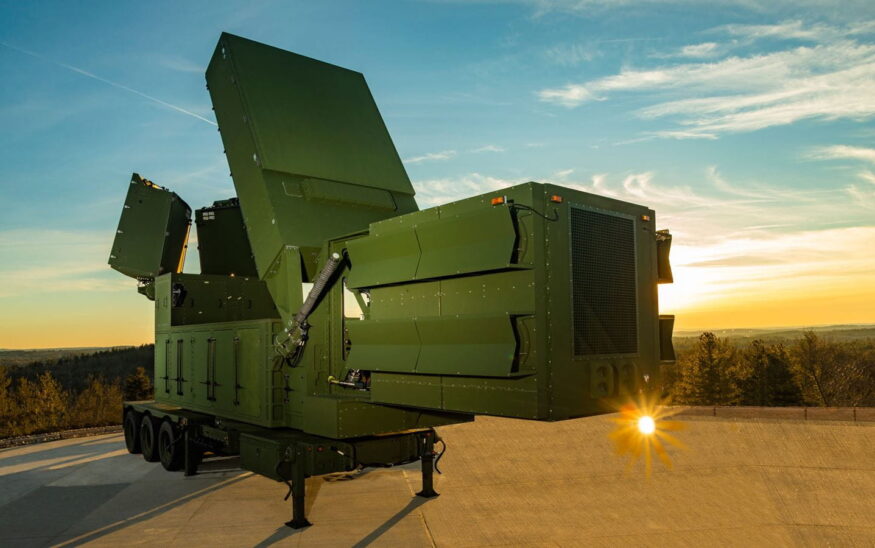
- Raytheon LTAMDS $904.6M Contract Modification: RTX subsidiary Raytheon received a contract modification worth $904.6 million from the U.S. Army for low-rate initial production of LTAMDS (Lower Tier Air and Missile Defense Sensor). Part of ongoing Army modernization initiatives.
- F/A-XX Navy Down-Select Set for August: The Chief of Naval Operations announced the Navy's sixth-generation fighter competition has narrowed to Boeing and Northrop Grumman, with final selection expected in August.
- Space Force Terminates GPS OCX Ground Control System: The Space Force officially ended the OCX (Operational Control System) GPS ground control program, citing "insurmountable challenges." Operations will continue with the existing system managed by Lockheed Martin.
- Iran's THAAD/TPY-2 Radar Targeting Flagged by CSIS: A CSIS defense expert emphasized that Iranian targeting of U.S. THAAD/TPY-2 radar systems represents not a simple cost-benefit issue but a "mission-critical operational concern."
Major Defense Contracts & Programs (3+ highlights)
Raytheon LTAMDS Low-Rate Initial Production Contract Modification ($904.6M+)
- Contracting Agency / Contractor: U.S. Army → RTX (Raytheon)
- Contract Value: $904.6 million contract modification
- Core Content: RTX's Raytheon secured a $904.6 million contract modification from the U.S. Army for low-rate initial production of the LTAMDS (Lower Tier Air and Missile Defense Sensor). LTAMDS is a next-generation radar system designed to replace the aging Patriot AN/MPQ-65. Raytheon, based in Virginia, is the prime contractor.
- Strategic Significance: The contract reflects the Army's accelerated air defense modernization in response to ballistic missile threats from Iran and North Korea. The contract scale and continuity demonstrate the Army's commitment to closing radar capability gaps.
Defense Health Agency OptumServe IDIQ Contract — April 20 Contract Briefing
- Contracting Agency / Contractor: Defense Health Agency (DHA) → OptumServe Health Services (Lacrosse, Wisconsin)
- Contract Value: Indefinite-delivery, indefinite-quantity (IDIQ) contract
- Core Content: According to an April 20 contract briefing released by AeroTech News, the Defense Health Agency awarded contract number HT001126DE001, an IDIQ contract, to OptumServe Health Services. Specific funding amounts were not disclosed, but the structure supports military medical services.
- Strategic Significance: The contract reflects expanding outsourcing of military medical services. Increased civilian private contracting of defense healthcare systems contributes to cost savings and efficiency but also raises supply chain diversification concerns.
Kraus Hamdani Solar-Powered Long-Endurance Drone $270M Contract
- Contracting Agency / Contractor: U.S. Air Force Central Command (AFCENT) → Kraus Hamdani
- Contract Value: $270 million
- Core Content: According to Breaking Defense reporting, AFCENT awarded Kraus Hamdani a $270 million contract for development and delivery of solar-powered long-endurance drones. These platforms are designed to perform ISR (intelligence, surveillance, reconnaissance) missions with near-indefinite loiter time.
- Strategic Significance: Continuous Middle East surveillance becomes possible without manned aircraft, dramatically reducing operating costs. Solar drones have the potential to partially replace traditional satellites and high-altitude platforms, likely influencing Indo-Pacific and Middle East operational concepts.
Space Industry Developments (3+ highlights)
Blue Origin New Glenn NG-3 — Booster Success, Satellite Deployment Failure
- Organization: Blue Origin
- Launch Vehicle · Payload: New Glenn reusable booster / AST SpaceMobile satellite (Bluebird 7) / Cape Canaveral Space Force Station
- Results · Status: Launched April 19; booster achieved successful soft landing (first reuse success). However, the satellite deployed into an off-nominal orbit, causing mission failure. The FAA officially classified the mission as a "mishap" on April 20, issuing a ground stop on Blue Origin rockets. The company is conducting its own investigation.
- Industry Implications: Booster reuse success marks an important milestone in challenging SpaceX's Falcon 9 dominance in reusability. However, the second-stage failure damages commercial reliability credentials. During the FAA investigation, delays to AST SpaceMobile's satellite deployment schedule are expected.

Space Force Officially Terminates OCX GPS Ground Control System
- Organization: U.S. Space Force / Lockheed Martin
- Launch Vehicle · Payload: N/A (ground system termination) / OCX (Operational Control System) GPS ground control system
- Results · Status: According to Breaking Defense reporting, the Space Force officially terminated the OCX GPS ground control system development program, citing "insurmountable challenges." Operations will continue with the existing ground control system currently managed by Lockheed Martin.
- Industry Implications: The termination of the long-delayed, over-budget OCX program serves as a stark reminder of structural risks in large-scale defense IT projects. GPS modernization faces delays in ground control architecture, increasing the likelihood of follow-on competitive contracting opportunities.

Space Force Stands Up Cislunar Acquisition Task Force
- Organization: U.S. Space Force / Air Force Research Laboratory (AFRL)
- Launch Vehicle · Payload: N/A (policy and organizational matter) / AFRL experimental cislunar surveillance satellite "Oracle Prime" (scheduled launch 2027)
- Results · Status: According to Breaking Defense reporting, the Space Force formally established a cislunar acquisition task force with NASA's future lunar base construction in mind. AFRL is preparing to launch its experimental cislunar surveillance satellite, Oracle Prime, next year.
- Industry Implications: The space security concept is expanding into deep-space domains including lunar orbit. Securing cislunar capabilities is expected to generate new supply chain and technology demands across both commercial and military space sectors.
Geopolitical & Policy Context (Current FY2026 Baseline)
U.S. · Asian Alliances
Congress passed the FY2026 National Defense Authorization Act (NDAA) in December 2025, authorizing annual military spending of $901 billion. This exceeds the Trump administration's request and includes a 4% military pay raise. The NDAA also contains provisions on Ukraine support and Venezuela-related matters, creating tension with the President's stated positions. As of 2026, threats in the Middle East—including Iranian attempts to target THAAD/TPY-2 radars—indirectly influence Indo-Pacific defense resource allocation discussions between U.S. and Asian allies.
Breaking Defense's April 2026 reporting on a $1.5 trillion defense budget request and F-35 congressional review directly correlates with Asian ally F-35 procurement plans. The Navy's F/A-XX down-select in August will likely influence allied discussions on sixth-generation fighter development cooperation.
Europe · NATO
At the Sea Air Space exhibition (April 2026), Saildrone unveiled two variants of medium uncrewed surface vessels (MUSV) for antisubmarine and ISR roles: "Spectre Silent Endurance" and "Spectre Stealth Strike." This aligns with NATO's push for uncrewed underwater and surface platform acquisition.
The U.S. Army significantly reduced helicopter procurement in its FY2027 budget request. The service has signaled a strategy to maintain industrial helicopter production through foreign military sales (FMS) and reinvestment programs. This directly affects European NATO members' procurement of U.S. helicopters.
Emerging Conflict Zones
Tom Karako, a CSIS air defense expert, warned that Iranian targeting of U.S. THAAD/TPY-2 radar systems is "not simply a question of exchange ratios in projectiles but rather a question of achieving operational success." This underscores that radar system defense is a priority in U.S.-Israeli operations against Iran.
The Defense Intelligence Agency (DIA) established a Digital Modernization Accelerator and centralized AI capabilities through organizational restructuring. This reflects the intelligence community's structural response to increasing AI use by China, Russia, Iran, and other adversarial powers.
Comparative & Analytical Insights
SpaceX Falcon 9 vs. Blue Origin New Glenn: National Security Launch Reliability Comparison
| Factor | SpaceX Falcon 9 | Blue Origin New Glenn |
|---|---|---|
| Operational Flights | 100+ (2015–present) | 3 (as of April 2026) |
| Booster Reusability | Routine (B1080, B1082, 17+ flights) | First success on NG-3 |
| Mission Success Rate | 98%+ | 1/3 (by payload delivery) |
| National Security Missions | Multiple completed (Space Force, NRO satellites) | Not yet awarded (FAA ground stop in effect) |
| Primary Risk Factor | Monopoly concerns due to lack of competition | Second-stage reliability unproven |
| Commercial Positioning | Starlink, private rideshare focus | Partner reliance (AST SpaceMobile impact) |
Analysis: New Glenn achieved a technical milestone with booster reusability but faces a significant credibility gap for national security launch missions due to payload delivery failure and the FAA ground stop. Blue Origin requires substantial additional time to establish reliability credentials as a SpaceX competitor. The incident has refocused attention on the fundamental reliability challenge facing the company.
Next Week's Key Watch Points
- FAA Investigation Completion: Monitor when the Blue Origin New Glenn mishap investigation concludes and when flight resumption is cleared.
- Sea Air Space Exhibition (April 21–23, 2026): Expect F/A-XX timeline updates, MUSV program progress reports, and potential new uncrewed surface vessel contract announcements.
- FY2026 Defense Budget Execution: Congressional appropriations subcommittee hearings on the $1.5 trillion defense budget request and missile defense funding increase discussions.
Reader Action Guide
- Investors: RTX/Raytheon benefits directly from expanded LTAMDS contracts and increased air defense demand driven by Iranian threats. Blue Origin is private, but extended FAA ground stops could indirectly pressure listed partners like AST SpaceMobile through delayed revenue timelines.
- Policy & Strategy Leaders: Iranian THAAD/TPY-2 targeting attempts signal the need to revisit air defense system integration agreements with allies and radar protection protocols. The Space Force's cislunar task force launch may trigger policy discussions around space security legal frameworks (UN Outer Space Treaty updates).
- Industry & Supply Chain: GPS OCX termination creates opportunity for next-generation ground control system contracts. Mid-sized defense contractors should explore subcontracting opportunities in emerging cislunar surveillance and solar long-endurance drone niches.
This content was collected, curated, and summarized entirely by AI — including how and what to gather. It may contain inaccuracies. Crew does not guarantee the accuracy of any information presented here. Always verify facts on your own before acting on them. Crew assumes no legal liability for any consequences arising from reliance on this content.
Powered by
