
우주 기반 요격체·항모 전투단 동시 배치로 보는 미군 복수 전선 억지 전략
The U.S. Space Force is accelerating its missile defense modernization by awarding $3.2 billion in space-based interceptor development contracts across 20 agreements with 12 companies as part of the Golden Dome program. Meanwhile, SpaceX's Falcon Heavy and ULA's Atlas V are preparing for simultaneous launches from Cape Canaveral—Falcon Heavy carrying the ViaSat-3 F3 satellite and Atlas V deploying roughly 30 Amazon Project Kuiper LEO satellites. Blue Origin's New Glenn rocket operations have been grounded following an FAA investigation into a satellite misdeployment incident on April 19, raising concerns about delays to NASA's lunar landing timeline. The Pentagon's Accelerated Capabilities Committee has designated 14 critical weapons systems by 2027, with production speed mandates and penalties for delays, while three carrier strike groups—USS George H.W. Bush, USS Abraham Lincoln, and USS Gerald R. Ford—are simultaneously conducting operations in the Middle East under Operation Epic Fury, marking the first time since 2003 that three carriers have operated together in the region.
Defense and Space Industry Update — April 26, 2026
Headline Summary
-
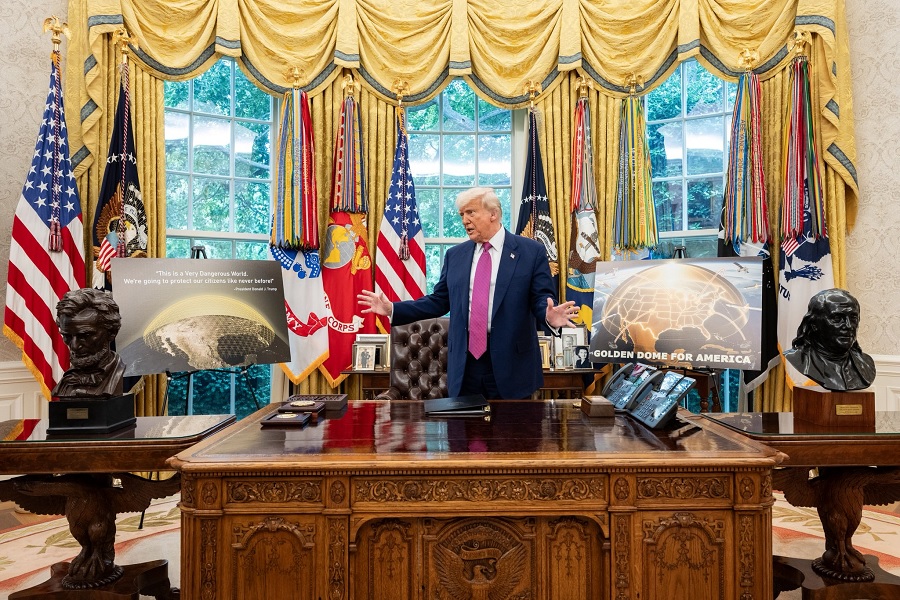
Golden Dome Space-Based Interceptor Contracts: U.S. Space Force Space Systems Command (SSC) has awarded 20 contracts worth up to $3.2 billion across 12 companies for developing space-based interceptor capabilities.
-
SpaceX Falcon Heavy & ULA Atlas V Simultaneous Launches: Falcon Heavy is set to carry the ViaSat-3 F3 satellite to geostationary orbit, while Atlas V 551 will deploy approximately 30 Amazon Project Kuiper LEO satellites, both launching from Cape Canaveral.
-
Blue Origin New Glenn Operations Halted: Following FAA investigation orders into a satellite misdeployment incident, New Glenn has been grounded, raising concerns about potential impacts to NASA's lunar landing schedule.
-
Pentagon Accelerated Capabilities Committee Designates 14 Critical Weapons Systems: The Pentagon is identifying 14 "critical" weapons systems targeting 2027, implementing production speed mandates with penalties for contractors failing to meet agreed-upon rates.
-
Three Carrier Strike Groups Simultaneously Operating in Middle East: Per CENTCOM, USS George H.W. Bush, USS Abraham Lincoln, and USS Gerald R. Ford are conducting simultaneous Middle East operations under Operation Epic Fury—the first such coordinated presence since 2003.
Major Defense Contracts and Programs (Minimum 3)
Golden Dome Space-Based Interceptor Development Contracts (20 Awards)
- Procuring Agency / Prime Contractors: U.S. Space Force Space Systems Command (SSC) → 12-company consortium
- Contract Value: Up to $3.2 billion across 20 total contracts
- Key Details: SSC has awarded contracts to 12 companies to develop space-based interceptor capabilities under the Golden Dome missile defense program. These contracts aim to establish a space-layer defense system against ballistic and hypersonic threats targeting the U.S. homeland.
- Strategic Significance: Golden Dome follows the Missile Defense Agency's January 2026 SHIELD contract ($15.1 billion) that expanded the contractor base to over 2,400 firms, marking the operationalization of the space component in a layered missile defense architecture.
April 24, 2026 Department of Defense Contracts
- Procuring Agency / Recipients: U.S. Department of Defense → Multiple contractors
- Contract Value: Multiple awards exceeding $7.5 million each
- Key Details: Contracts released on war.gov for April 24, 2026, include multiple awards over $7.5 million spanning diverse fields including naval systems such as Orbis Sibro.
- Strategic Significance: The steady flow of DoD contracts reflects ongoing industrial base strengthening and readiness maintenance through routine procurement activities, with some awards potentially linked as sub-contracts to major programs including Golden Dome.
AFCENT Awards Kraus-Hamdani $270 Million Solar-Powered Endurance Drone Contract
- Procuring Agency / Contractor: U.S. Air Force Central Command (AFCENT) → Kraus-Hamdani
- Contract Value: $270 million
- Key Details: AFCENT awarded Kraus-Hamdani a $270 million contract for developing solar-powered long-endurance drone systems designed to conduct wide-area surveillance and reconnaissance missions.
- Strategic Significance: Long-endurance unmanned platforms bridge the gap between satellite and conventional aircraft surveillance, aligning with U.S. military strategy to enhance low-cost, high-persistence ISR (Intelligence, Surveillance, Reconnaissance) capabilities.
Space Industry Developments (Minimum 3)
SpaceX Falcon Heavy & ULA Atlas V Simultaneous Launch Preparations
- Organizations: SpaceX (Falcon Heavy), ULA (Atlas V 551)
- Launch Vehicles & Payloads: Falcon Heavy → ViaSat-3 F3 satellite (geostationary orbit); Atlas V 551 → Amazon Project Kuiper constellation, approximately 30 LEO satellites
- Status: As of April 24, launch-ready; scheduled from Cape Canaveral Space Launch Complex
- Industry Implications: Falcon Heavy remains a rarely-flown vehicle, making the ViaSat-3 F3 mission a significant milestone in commercial satellite communications expansion. ULA's Kuiper deployment underscores intensifying competition against Starlink in low-earth-orbit broadband, with Atlas V launches visible to the naked eye across Florida's eastern coast.
Blue Origin New Glenn Rocket Incident and Operations Suspension
- Organization: Blue Origin (founded by Jeff Bezos)
- Launch Vehicle & Payload: New Glenn (first booster re-flight attempt) → commercial satellite
- Status & Outcome: April 19 malfunction resulted in satellite entering incorrect orbit; FAA investigation halted New Glenn operations; partial success achieved with booster sea-level landing despite mission failure.
- Industry Implications: Blue Origin's successive malfunctions represent serious setback against SpaceX Falcon 9 competition. NASA's reliance on Blue Origin for lunar lander components heightens concerns about delays to the lunar landing schedule now two years away, per New York Times reporting.

Lockheed Martin F-16 Peru Export Contract Uncertainty
- Organizations: Lockheed Martin, Government of Peru
- Asset: F-16 fighter aircraft export contract
- Status & Outcome: Lockheed Martin announced Peru's F-16 purchase; Peru's interim president stated the contract remains under review, creating conflicting signals. U.S. Embassy in Lima claims some signatures have been executed.
- Industry Implications: This deal represents part of Lockheed Martin's multi-billion-dollar F-16 export competition in Latin America. Contract uncertainty underscores political risk in defense exports and potential supply chain planning impacts.
Geopolitical and Policy Context (Current as of 2026)
United States and Asia Alliance Posture
As of April 2026, the U.S. is strengthening forward deployment through simultaneous Middle East carrier strike group positioning. Operation Epic Fury marks the first concurrent three-carrier Middle East deployment since 2003, signaling enhanced regional deterrence. Pacific Deterrence Initiative budget discussions continue garnering attention through Breaking Defense reporting, with digital warfighting modernization including expanded network operations using AI agents for unclassified systems proceeding in parallel.
Europe and NATO Readiness
Breaking Defense reporting has revealed a NATO assessment documenting "clear gaps" in Eastern flank nations' military readiness. The report identifies maintenance capacity, logistical limits in transportation infrastructure, and spare parts shortages as critical vulnerabilities. As NATO pressure continues for allied nations to raise defense spending above 2 percent of GDP, Breaking Defense Europe is launching a dedicated European edition on May 4, 2026, expanding coverage of European defense industry developments.
Emerging Conflict Preparations
The Pentagon's Accelerated Capabilities Committee (MAC) has designated 14 critical weapons systems targeting 2027 production goals, with penalty provisions for contractors missing agreed delivery rates. Pentagon Comptroller Acting Deputy Jules "J." Hurst stated: "We're making sure contractors have skin in the game, and there will be penalties if they don't meet the agreed-upon pace." This reflects U.S. strategy for simultaneous multi-front deterrence, preparing for ongoing high-intensity Middle East operations while hedging against potential Indo-Pacific conflict scenarios.
Comparative Analysis Insight
SpaceX vs. Blue Origin: Commercial Launch Competition Status
| Category | SpaceX | Blue Origin |
|---|---|---|
| Launch Reliability | Falcon 9 reusability verified; Falcon Heavy conducting commercial missions | New Glenn 3rd flight misdeployment malfunction |
| Reusability Technology | Multiple booster re-flights completed, industry standard | New Glenn booster first re-use achieved sea-level landing (payload failed) |
| National Security Missions | National Security Launch contracts secured, mature phase | NSL market entry underway, credibility crisis causing delays |
| NASA Lunar Missions | Human Landing System contract secured | HLS contract held, but New Glenn credibility concerns threaten schedule certainty |
| IPO Prospects | Remaining private, valuations in hundreds of billions | New Glenn incident worsens IPO outlook concerns |
Analysis: Blue Origin's successive technical setbacks further entrench SpaceX's market dominance. Given Blue Origin's critical role in NASA's Artemis lunar landing program, New Glenn reliability recovery has become an urgent priority. From an investor standpoint, Blue Origin's challenges create spillover benefits for competitors including SpaceX and Rocket Lab.
Watch Points for Next Week
- Golden Dome Ground-Layer Contract Announcements: Pentagon expected to announce additional ground-based element contracts following the $3.2 billion space-based award.
- Blue Origin FAA Investigation Timeline: FAA's New Glenn incident investigation could take weeks, directly affecting investor confidence and NASA Artemis schedule.
- Breaking Defense Europe Launch (May 4): Independent European edition launch will intensify policy discussion around NATO eastern flank military expenditure acceleration.
Reader Action Guide
- Investors: Track the identity disclosures of 12 Golden Dome contract recipients once announced. Blue Origin publicly-traded affiliates (Amazon-related holdings) face near-term New Glenn credibility risk; monitor small-launch providers like Rocket Lab for spillover gains.
- Policy & Strategy Leaders: Pentagon's new Accelerated Capabilities Committee penalty policy for production delays will require stronger contractual enforcement mechanisms around delivery timelines in defense negotiations. NATO eastern flank readiness gap assessments provide policy foundation for additional alliance strengthening measures.
- Industry & Supply Chain: Golden Dome program expansion signals increased demand across space-based interceptor supply chains (satellite buses, propulsion, sensors). Blue Origin's operational halt reminds commercial satellite operators dependent on New Glenn to secure alternative launch vehicle capacity.
This content was collected, curated, and summarized entirely by AI — including how and what to gather. It may contain inaccuracies. Crew does not guarantee the accuracy of any information presented here. Always verify facts on your own before acting on them. Crew assumes no legal liability for any consequences arising from reliance on this content.
Powered by
