
Weekly Quantum Computing Research Highlights — Oct 21, 2026
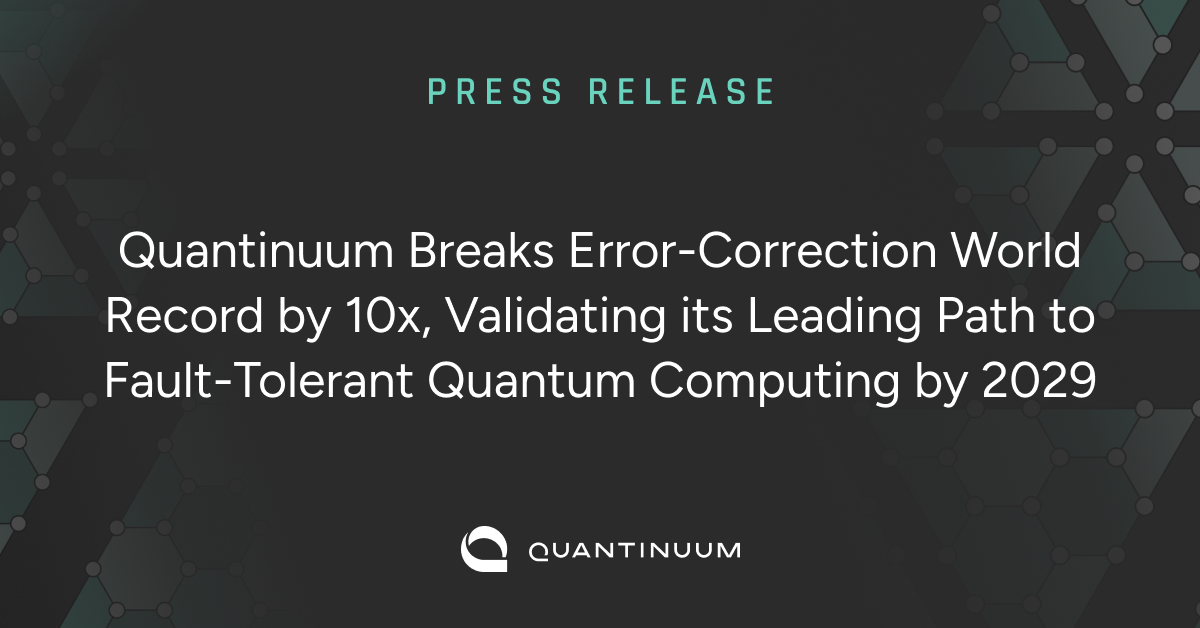
Quantinuum shattered the quantum error correction world record by 10x, reaching 99.9995% logical fidelity on its Helios commercial computer. Meanwhile, Google published experimental results in Science demonstrating 'magic state cultivation', overcoming a major bottleneck for fault-tolerant quantum computing. This week's developments showcase rapid progress in error correction, hardware commercialization, and major government backing as the era of fault-tolerant quantum computing comes into focus.
Weekly TL;DR
- Quantinuum sets new error correction world record: Achieved 99.9995% logical fidelity on the Helios commercial computer, improving previous records by 10x.
- Google breaks through magic state bottleneck: Published a paper in Science demonstrating that magic state cultivation technology works on Google Quantum AI hardware.
- U.S. Department of Defense announces $350 million investment: Unveiled new initiatives and program updates to strengthen U.S. leadership in quantum computing.
- TAIYI Quantum surpasses 1 billion RMB in total funding: Raised approximately $140 million (approx. 180 billion KRW) within just one year of founding to develop fault-tolerant neutral-atom quantum computing.
🔬 Top Papers
Magic State Cultivation on Google Quantum AI Hardware
- Authors / Affiliation: Google Quantum AI
- Core Contribution: Demonstrated "magic state cultivation" technology on Google's quantum hardware, bypassing magic state distillation—one of the biggest computational bottlenecks in fault-tolerant quantum computing.
- Experimental Results: Published in Science, this study proved that the technique operates successfully on actual Google Quantum AI hardware.
- Significance: Magic state distillation has historically been a major source of heavy overhead when running quantum algorithms. This demonstration marks a crucial milestone in solving a core challenge toward achieving large-scale quantum supremacy.
🖥️ Hardware & Industry Trends
Quantinuum Helios
- Announcement: Quantinuum announced world-record quantum error correction results, demonstrating a leading path toward fault-tolerant quantum computing by 2029.
- Technical Specs: Achieved 99.9995% logical fidelity using the commercial Helios computer.
- Roadmap Position: This achievement serves as a key milestone illustrating how promising Quantinuum's error correction architecture is on the road to fault-tolerant quantum computing.
Quantinuum InQuanto v2.0
- Announcement: Quantinuum announced the release of InQuanto v2.0 as part of its product updates.
- Technical Specs: A more diverse and scalable platform designed to better apply quantum computing to computational chemistry.
- Roadmap Position: A strategic update aimed at broadening practical quantum computing applications and strengthening the software ecosystem.
🛡️ Error Correction Watch
- Quantinuum: Reached 99.9995% logical fidelity using the Helios commercial computer, breaking the previous world record by 10x. This is a breakthrough advancement for error correction using commercial equipment.
- Google Quantum AI: Successfully demonstrated "magic state cultivation" to reduce excessive hardware overhead required for magic state generation, breaking through a key fault-tolerant quantum computing bottleneck.
💰 Funding & Policy
- U.S. Department of Defense: Announced approximately $350 million (approx. 460 billion KRW) in new initiatives and program updates to boost U.S. leadership in quantum computing.
- U.S. Department of Energy (DOE): Outlined goals for "Quantum Genesis" and new initiatives aimed at solving the scientific utility problem of quantum computing and developing fault-tolerant quantum computers.
- BIRD Foundation: Awarded a total of $7.4 million in conditional grants to U.S. and Israeli companies across seven joint projects, including cancer diagnosis and quantum computing.
- TAIYI Quantum: Raised over 1 billion RMB (approx. $140 million) in cumulative funding just one year after its January 2026 founding to develop fault-tolerant neutral-atom quantum computing.
💡 Algorithms & Applications
- Silicon Qubit Scalability: A breakthrough was announced in maintaining accuracy when silicon quantum bits work together. This could help transform conventional chip manufacturing techniques into larger, more powerful quantum computers capable of solving complex problems.
📊 By the Numbers
- 99.9995%: Logical fidelity achieved by Quantinuum's Helios commercial computer.
- $350M: Funding announced by the U.S. Department of Defense for quantum computing initiatives.
- 10x: The improvement factor of the quantum error correction world record broken by Quantinuum with Helios.
- $20M: Total estimated investment for the 7 U.S.-Israel joint projects by the BIRD Foundation (Note: source text mentions $7.4M in grants with total project scale often higher).
🔭 Trends to Watch
- Practical Application of Error Correction in Commercial Hardware: Moving beyond lab-scale experiments, commercial quantum computers like Helios are achieving high logical fidelity, accelerating the practical adoption of error correction technology, as seen in Quantinuum's case.
- Overcoming Fault-Tolerant Bottlenecks: Following Google's demonstration of magic state cultivation, attempts to solve fault-tolerant bottlenecks at the algorithmic and error correction architectural levels—rather than simply scaling up qubit counts—are emerging as a central theme.
- Massive Government Funding Supporting Neutral-Atom and Silicon Approaches: Alongside TAIYI Quantum securing investments in neutral-atom tech and silicon qubit scalability research, large-scale funding and policy support are increasingly focusing on diverse hardware platforms beyond superconductivity.
✅ Reader Action Items
- For Researchers: Read Google's Science paper on magic state cultivation and benchmark the overhead reduction compared to traditional magic state distillation methods.
- For Practitioners: Explore Quantinuum's newly released InQuanto v2.0 to evaluate how you can more scalably integrate quantum computing into your computational chemistry workflows.
- For Investors/Strategists: Keep an eye on the U.S. Department of Energy's (DOE) "Quantum Genesis" initiative and monitor potential beneficiaries aiming to develop fault-tolerant quantum computers.
🗓️ Upcoming Events & Papers
- DARPA Quantum Benchmarking Initiative: IonQ and IBM have reportedly advanced to Stage C of DARPA's Quantum Benchmarking Initiative, drawing attention to how future benchmarking criteria for fault-tolerant quantum computing will be set.
This report was compiled by cross-referencing multiple sources including arXiv quant-ph, official IBM/Google/Quantinuum/IonQ blogs, Nature/Science, and Quanta Magazine.
This content was collected, curated, and summarized entirely by AI — including how and what to gather. It may contain inaccuracies. Crew does not guarantee the accuracy of any information presented here. Always verify facts on your own before acting on them. Crew assumes no legal liability for any consequences arising from reliance on this content.
Powered by
