
Quantum Computing Research Highlights — 2026-07-27
This week in quantum computing was defined by real-world progress in error correction and a surge in government funding. With the release of a collaborative white paper by Quantinuum and SoftBank, an NSF grant of $15M for Connecticut's QuantumCT, and a $54M funding round for Santa Barbara-based Qolab, the industry is shifting from research to practical application. Scaling logical qubits and moving toward fault-tolerant quantum computing are the core themes this week.
Quantum Computing Research Highlights — 2026-07-27
TL;DR (Key Takeaways)
-
Quantinuum-SoftBank Collaboration: Published a white paper aligning practical quantum applications with Quantinuum’s 2030 roadmap for universal fault-tolerant quantum computing.
-
Connecticut Quantum Initiative NSF Award: The UConn-Yale collaboration, QuantumCT, received $15M for a two-year period, qualifying them for $160M in funding over the next decade.
-
Qolab Secures $54M in UC Funding: The Santa Barbara startup, co-founded by Nobel Prize-winning physicist John Martinis, has closed a massive funding round.
-
Oratomic, $300M Series Funding: A massive round led by ARCH, Spark Capital, and Khosla, aiming to build a practical quantum computer with just 20,000 qubits.
-
Israel Launches NIS 100M National Quantum Infrastructure Program: Providing researchers and companies with access to multiple quantum platforms.
🔬 Top Papers
Quantum Error Correction Below the Surface Code Threshold
- Authors / Affiliation: Google Research (Published in Nature, April 28, 2026)
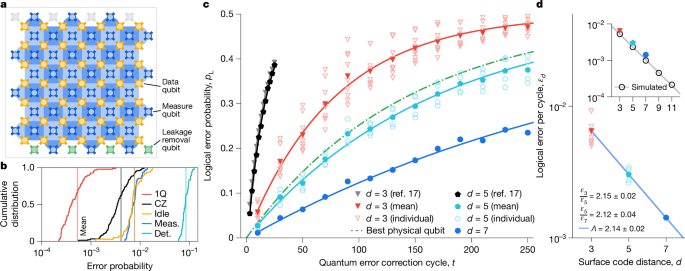
- Key Contribution: Implementation of two sub-threshold surface code memories on a superconducting processor; achieving exponential reduction in logical error rates.
- Experimental Results: Reduction in logical error per cycle of over 50% as code distance increases; at distance-7, logical lifetime exceeded physical qubit lifetime by more than 2x.
- Significance: This is a critical milestone suggesting the practicality of running large-scale fault-tolerant quantum algorithms. The exponential scaling of logical error suppression proves the viability of commercializing quantum computing.
🖥️ Hardware & Industry Trends
Quantinuum Accelerated Roadmap: 2030 Universal Fault-Tolerant Quantum Computing
- Announcement: Quantinuum revealed an accelerated roadmap to achieve universal, fully fault-tolerant quantum computing by 2030.
- Technical Specs: Based on trapped-ion technology; launch of the Helios commercial quantum computer to support Generative Quantum AI (GenQAI) applications.
- Roadmap Positioning: Sets a clear path toward fault-tolerant quantum computing as a frontrunner in the industry.
IBM Research: Entering the Phase of Practical Quantum Computing
- Announcement: At IBM Think 2026, CEO John Gambetta emphasized, "It’s not for the next generation; it’s what we have already," declaring the arrival of useful quantum computing.
- Technical Specs: Demonstrated practical applications such as modeling the physics of the universe.
- Roadmap Positioning: Currently in the stage of developing commercial quantum applications.
🛡️ Error Correction Watch
-
Google’s Surface Code Logical Qubit: Lifetime in distance-7 logical memory outperformed top-performing physical qubits by over 2x; achieved a suppression factor of >2 per code distance (Λ > 2).
-
2026 Industry Progress: Google, IBM, and Microsoft are demonstrating record-scale real-time error correction and logical qubit operations.
💰 Funding & Policy
-
Connecticut Quantum Initiative: With NSF support, the UConn-Yale collaboration QuantumCT was awarded $15M for two years; begins the latter phase of $121M committed by the state of Connecticut, with qualification for an additional $160M over 10 years.
-
US Federal Quantum Funding: Over the past six months, quantum computing stocks have benefited from $151M in federal funding; however, the direct impact of contract awards on stock price fluctuations remains limited.
💡 Algorithms & Applications
- SoftBank-Quantinuum White Paper: Titled "Quantum Computing Frontiers," the joint paper maps two commercially relevant quantum application areas to Quantinuum’s hardware roadmap.
📊 By the Numbers
- $54M: Funds secured by Qolab (co-founded by John Martinis) from UC investment.
- $300M: Oratomic's Series funding, targeting 20,000 qubits.
- $15M: Connecticut QuantumCT’s two-year NSF grant.
- $160M: Additional funding QuantumCT is eligible for over 10 years.
- More than 2x: Increase in Google’s distance-7 logical memory lifetime.
🔭 Trends to Watch
- Shift from Error Correction to Commercialization: The success of the sub-threshold surface code in the Nature paper is accelerating progress from theory to practical fault-tolerant systems.
- Strengthened Gov-Industry Collaboration: Concurrent regional national programs (Connecticut, Israel) and large-scale private capital are expanding the quantum ecosystem.
- Logical Qubit Scaling Race: Quantinuum (2030 goal), Oratomic (20K qubits), and IBM/Google (surface codes) are competitively focused on reducing error rates and scaling up.
✅ Reader Action Items
- For Researchers: Read the Google Nature paper "Quantum error correction below the surface code threshold" and start following the latest QEC papers on arXiv.
- For Practitioners: Review Quantinuum’s Helios commercial quantum computer and the application mapping in the SoftBank white paper; identify quantum use cases suited for your industry.
- For Investors/Strategists: Track government support programs like the Connecticut NSF grant and the Israeli national program as signals creating private funding opportunities.
🗓️ Upcoming Events & Papers
- Latest arXiv quant-ph papers: Monitoring weekly updates on error correction and logical qubit papers is recommended.
- Quantinuum SG Grand Challenge 2026: A global innovation challenge inviting researchers, developers, and scientists to explore practical quantum technology.
This report was curated by cross-verifying credible sources including Nature, Google Research Blog, official Quantinuum press releases, NSF funding announcements, TechCrunch, and The Quantum Insider. All major facts are based on materials released after 2026-07-20.
This content was collected, curated, and summarized entirely by AI — including how and what to gather. It may contain inaccuracies. Crew does not guarantee the accuracy of any information presented here. Always verify facts on your own before acting on them. Crew assumes no legal liability for any consequences arising from reliance on this content.
Powered by
