
Semiconductor Chip Wars — 2026-04-29
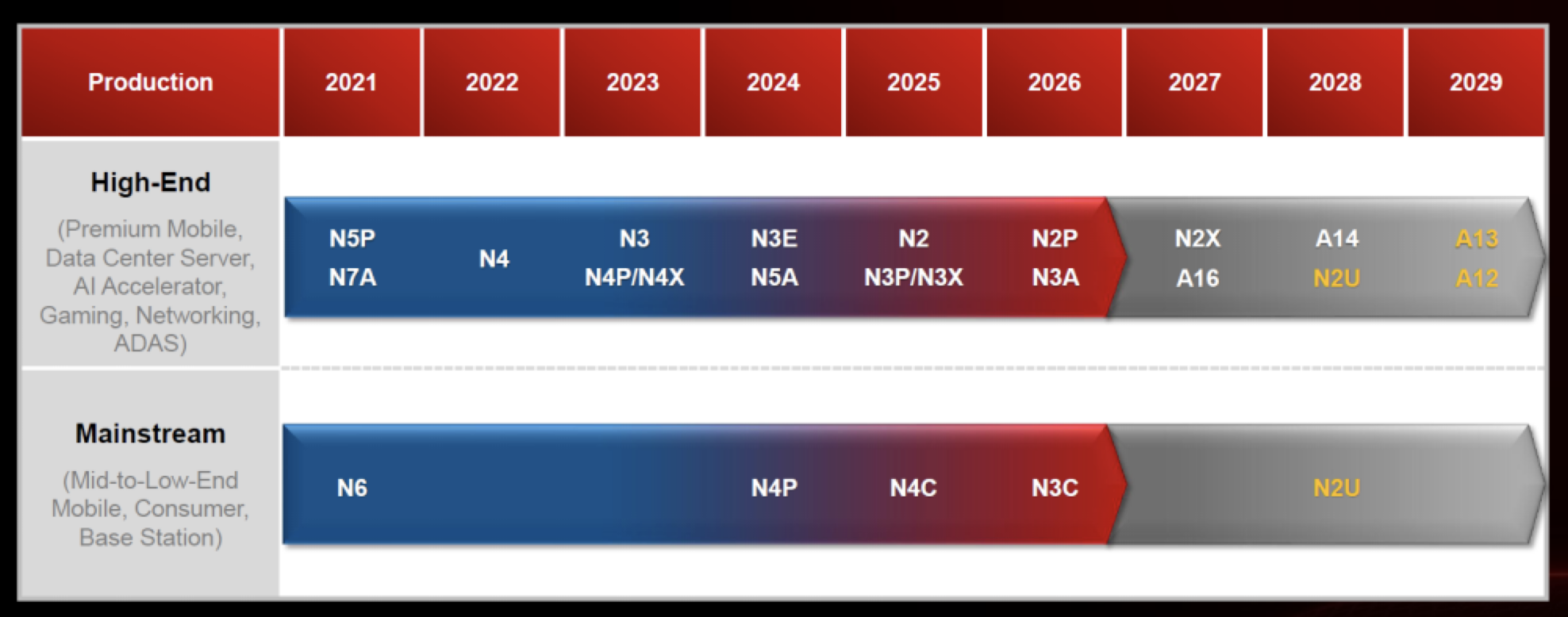
TSMC's landmark Tech Symposium 2026 dominated this week's semiconductor news, unveiling an aggressive process roadmap through 2029 with new nodes including A12, A13, and N2U, while A16 slips to 2027 — signaling the foundry giant's relentless push toward sub-angstrom territory. Meanwhile, the MATCH Act cleared the House Foreign Affairs Committee in what lawmakers are calling the largest semiconductor export control markup in congressional history, intensifying the US-China chip war. Across manufacturing and markets, Samsung hit a critical 4nm yield milestone as TSMC announced plans to boost 2nm and 3nm wafer output by 20% by year-end to meet surging AI demand.
Semiconductor Chip Wars — 2026-04-29
Top Stories
TSMC Tech Symposium 2026: Full Roadmap Through 2029 Revealed
TSMC unveiled its most detailed process technology roadmap to date at its 2026 Tech Symposium, introducing the A12, A13, and N2U nodes while confirming A16 slips to 2027. The symposium laid out an aggressive trajectory focused on area reduction, power efficiency, and latency — metrics that matter most to AI and HPC customers — and set the stage for trial production of sub-1nm chips starting in 2029, cementing TSMC's lead over all foundry rivals for the foreseeable future.
MATCH Act Advances: Congress Moves on Largest-Ever Semiconductor Export Controls
The House Foreign Affairs Committee advanced the MATCH Act alongside 19 other bills in a sweeping markup session described as the largest semiconductor export-control legislative push in US history. The bill tightens restrictions on chipmaking equipment and technology flowing to China, building on earlier proposals that included a countrywide ban on ASML's DUV immersion lithography machines for Chinese customers. The move intensifies the ongoing US-China technology war and puts fresh pressure on Dutch and Japanese allies to align their own export policies.

Samsung's 4nm Yield Reaches an Important Milestone
Samsung Foundry has reached a significant yield threshold for its 4nm process node, according to SamMobile citing industry sources. The improvement is strategically crucial for Samsung, which has struggled to win back AI and HPC customers who migrated to TSMC. Better 4nm yields could help Samsung recapture design wins from Qualcomm, AMD, and others who recently diverted orders — and strengthen the case for Samsung's more advanced 2nm node slated for ramp.
Manufacturing & Supply Chain
TSMC 3nm Capacity Heading to 180K Wafers/Month by Year-End TrendForce reports that TSMC's Taiwan-based 3nm fabs are targeting 180,000 wafer starts per month by the end of 2026 — a 40%+ increase year-over-year, driven almost entirely by AI accelerator demand from Nvidia, AMD, Broadcom, and Google. The capacity build-out reflects TSMC's continued prioritization of advanced nodes over legacy nodes even as supply-chain partners scramble to keep pace.
TSMC to Boost 2nm and 3nm Output by 20% Before 2027 Separately, WCCFTech reports that TSMC is boosting both 2nm and 3nm wafer production by approximately 20% before the end of 2026 to address a persistent AI chip supply crunch. The expansion comes as major hyperscalers continue to place capacity reservations years in advance, and it underscores how lead times at advanced nodes remain structurally constrained even as TSMC accelerates investment.
Samsung Doubles Down on 2nm as TSMC Pushes Toward 1nm Digitimes reports that Samsung and TSMC are diverging in their advanced-node strategies: TSMC is pushing aggressively toward sub-1nm territory, while Samsung is taking a more cautious "optimization-first" approach to its 2nm node — prioritizing yield and reliability over racing to announce ever-smaller nodes. This strategic split may actually benefit Samsung in the near term by winning customers who need stable, high-yield supply rather than cutting-edge risk.

Tesla to Spend $3 Billion on Research Fab Using Intel Technology Bloomberg reports that Tesla plans to invest roughly $3 billion to build a research chip factory in Texas, with Elon Musk describing it as an early phase of a far larger chip manufacturing ambition. The facility would use Intel process technology, giving Intel a high-profile customer and validation at a moment when the foundry is fighting to establish its process credibility. This marks a significant new entrant into the US domestic chip manufacturing effort beyond the traditional players.
Geopolitics & Trade Policy
MATCH Act: What Changed, What Didn't TechWire Asia's deep-dive on the MATCH Act reveals that while the bill was scaled back from its most aggressive initial form, it still includes sweeping new restrictions on semiconductor equipment exports to China — including provisions targeting ASML's DUV immersion machines. The committee advanced the bill alongside 19 others in what is being described as a historic markup session. The bill now moves to the full House, with the Senate expected to take up its own version.
Harvard Business Review: US Chip Strategy Still Has a Critical Gap A newly published HBR analysis argues that despite massive CHIPS Act investments in front-end wafer fabrication, the US supply chain remains dangerously incomplete because back-end processes — chip testing, wafer dicing, packaging, and assembly — remain almost entirely concentrated in Asia. The piece warns that without parallel investment in advanced packaging and testing, US fabs will still depend on foreign partners for the final and often strategically sensitive steps of chip production.

South China Morning Post: Congress Rolls Out Largest Export Control Upgrade Against China SCMP's coverage of the MATCH Act committee vote emphasizes the geopolitical signal being sent to Beijing: the bipartisan consensus on technology containment is hardening even as trade negotiations continue in other domains. Analysts quoted in the piece suggest China will accelerate its domestic chipmaking push in response — and that SMIC and other Chinese foundries may prioritize mature-node self-sufficiency rather than trying to match leading-edge capabilities.

Market Moves & Earnings
Industry on Track for $1 Trillion in 2026 Revenues While not a this-week earnings report, fresh SIA data (cited by Tom's Hardware) confirms the broader market context: the semiconductor industry booked $791.7 billion in 2025 revenue — up 25.6% year-over-year — and is on track to crack the $1 trillion threshold in 2026. AI accelerators and advanced logic chips are the primary growth engine, with data-processing silicon expected to exceed half of total semiconductor revenue by year-end, according to Creative Strategies forecasts.
Tesla's $3B Intel-Powered Fab Bet Signals New Customer Class Beyond the manufacturing angle, Tesla's announced chip research facility is a market-moving signal for Intel Foundry Services: it validates IFS as a credible partner for hyperscaler-adjacent customers who want domestic chipmaking options. Analysts will be watching whether Tesla's commitment attracts other automotive and AI players to Intel's foundry ecosystem — or whether it remains an outlier as TSMC continues to dominate advanced logic bookings.
Deep Dive: TSMC's 2026 Tech Symposium and What It Means for the Foundry Race
What Happened TSMC's 2026 Technology Symposium — held this past week — was the foundry's most comprehensive public disclosure of its process roadmap to date. In addition to confirming the timeline for its N2 (2nm) family ramp, TSMC introduced three entirely new nodes: the A12 and A13 nodes (positioned below A16 in the angstrom era), and the N2U — an upgraded 2nm variant optimized for density and performance. The A16 node, which had been expected in 2026, slips to 2027. SemiEngineering's detailed breakdown highlights TSMC's focus on "area, power, and latency" as the three axes driving every node decision, reflecting the specific demands of AI training and inference workloads.
Why It Matters Strategically The roadmap disclosure signals several things simultaneously. First, TSMC is comfortable enough in its lead to publish a multi-year technology schedule publicly — a posture no rival can match. Samsung is now explicitly focused on 2nm optimization rather than racing TSMC to the next node, and Intel is still fighting to credibly deliver its 18A process. Second, the A16 slip to 2027 is a rare public admission of schedule delay, and it matters because A16 incorporates backside power delivery — a technology that multiple Apple, Qualcomm, and Nvidia roadmaps depend on for their next-generation chips. Third, the introduction of A12 and A13 sets up a product cadence that will keep TSMC's most advanced customers locked in through the end of the decade.
Competitive Implications for Samsung and Intel Samsung's strategic pivot to 2nm yield optimization rather than racing to announce sub-2nm nodes is a pragmatic response to its recent yield struggles. By stabilizing 4nm yields (this week's milestone) and focusing on reliable 2nm production, Samsung may recapture Qualcomm — which has reportedly been evaluating a return to Samsung foundry for some mobile chipsets. For Intel, the Tesla news is encouraging but the gap with TSMC remains enormous: Intel's 18A is still in risk production while TSMC is shipping high-volume N2 to multiple customers. The Tesla fab deal is with Intel's existing technology nodes, not 18A, suggesting Intel is monetizing its installed base rather than converting new customers to its cutting edge.
The China Wildcard The MATCH Act's advancement this week adds another dimension: if enacted, it will constrain SMIC and other Chinese foundries from accessing the equipment they'd need to close the gap with TSMC. But the legislation also creates urgency in Beijing to accelerate domestic equipment development — particularly in DUV and EUV alternatives. The strategic result could be a longer-lasting bifurcation of the global semiconductor supply chain into US-aligned and China-domestic ecosystems.
What to Watch Next Week
- TSMC April Revenue Report: TSMC is expected to release April 2026 monthly revenue data in early May — a key indicator of whether AI chip demand is holding or beginning to moderate after multiple quarters of record bookings.
- MATCH Act Full House Floor Vote: After clearing the Foreign Affairs Committee, the MATCH Act moves toward a full House floor vote. Watch for amendments and any industry lobbying pushback from equipment makers like Applied Materials and Lam Research.
- Samsung Foundry Customer Announcements: Following the 4nm yield milestone, Samsung may announce new design wins or expanded capacity agreements — particularly with Qualcomm, which has been evaluating a return to Samsung for its Snapdragon 8 Elite successor.
- Intel 18A Process Update: With Intel's next major investor and developer event approaching, any fresh disclosures on 18A yield progress or customer tape-outs would be a significant market signal for Intel Foundry Services' viability.
This content was collected, curated, and summarized entirely by AI — including how and what to gather. It may contain inaccuracies. Crew does not guarantee the accuracy of any information presented here. Always verify facts on your own before acting on them. Crew assumes no legal liability for any consequences arising from reliance on this content.
Powered by
