
Semiconductor Chip Wars — 2026-10-13
The semiconductor industry faces a reality check as Elon Musk’s Terafab project encounters significant manufacturing and supply chain hurdles, while Samsung’s HBM4E memory clears critical quality validation. Meanwhile, TSMC continues its massive $165 billion US expansion, reinforcing the trend of reshoring advanced manufacturing amidst intensifying geopolitical scrutiny of chip smuggling.
Semiconductor Chip Wars — 2026-10-13
Top Stories


Terafab Faces Reality Check; Samsung HBM4E Validated
This week's industry coverage highlights a divergence in high-profile hardware projects. Elon Musk’s ambitious Terafab initiative is facing serious questions regarding manufacturing yield, packaging, and printed circuit board (PCB) partnerships, suggesting potential delays in its AI hardware roadmap. Conversely, Samsung has successfully cleared quality validation for its HBM4E memory, a critical component for next-generation AI accelerators, signaling improved competitiveness against SK Hynix in the high-bandwidth memory market.

TSMC’s $165 Billion US Expansion Gains Momentum
TSMC’s strategic push to deepen its footprint in the United States is gaining traction, with recent reports confirming that the company's plan to invest $165 billion—including three new fabrication plants and two advanced packaging facilities—is driving momentum in the broader semiconductor ecosystem. This massive capital expenditure underscores TSMC’s commitment to diversifying supply chains and mitigating geopolitical risks associated with Taiwan-centric manufacturing.
US and Taiwan Indict 11 for Illegal Chip Resale to China
In a significant enforcement action, US and Taiwanese authorities have separately indicted 11 individuals across two cases for illegally reselling US-manufactured semiconductor chips to the People's Republic of China. This crackdown highlights the persistent challenge of export control enforcement and the sophistication of networks attempting to bypass restrictions on advanced computing hardware.
Manufacturing & Supply Chain
TSMC Arizona Packaging Plant Timeline Confirmed
While not breaking news within the last 24 hours, ongoing developments confirm TSMC’s plan to open a chip packaging plant in Arizona by 2029. This facility is crucial for localizing the final stages of advanced chip production, reducing reliance on Asian packaging hubs for US-bound chips.
SMIC Warns of Margin Pressure Amid Capacity Surge
China’s largest contract chipmaker, SMIC, has warned of margin pressure due to a surge in depreciation costs resulting from a massive capacity expansion. Despite the financial strain, the move is driven by strong domestic demand for chips as Chinese firms accelerate efforts to build resilient supply chains independent of Western technology.
SK Hynix Accelerates Fab Openings
SK Hynix is accelerating the opening of a new factory by three months and beginning operations at another plant earlier than planned. This move is a direct response to surging global memory demand, particularly from the AI sector, indicating that memory manufacturers are prioritizing speed to market over traditional capacity ramp-up schedules.
Geopolitics & Trade Policy
Enforcement Actions Highlight Export Control Loopholes
The recent indictments of 11 individuals for illegally reselling US chips to China underscore the limitations of current export control frameworks. Authorities are increasingly focusing on transshipment hubs and complex resale networks rather than just direct sales, indicating a more aggressive enforcement posture from both the US and Taiwan.
US-Taiwan Trade Deal Focuses on Semiconductors
The recently clinched trade deal between the US and Taiwan, which cuts tariffs on many semiconductor exports and directs new investments into the US technology industry, continues to shape market expectations. While finalized in early 2026, its implementation details regarding tariff reductions on specific chip categories remain a key focus for industry stakeholders navigating the new regulatory landscape.
Limits of Export Controls Debated
Analysts continue to debate the efficacy of export controls alone in containing China's semiconductor progress. Recent policy analyses suggest that while controls slow progress, they cannot substitute for comprehensive industrial policy measures necessary to ensure long-term US leadership in design, production, and infrastructure.
Market Moves & Earnings
TSMC Stock Forecasted to Double in Three Years
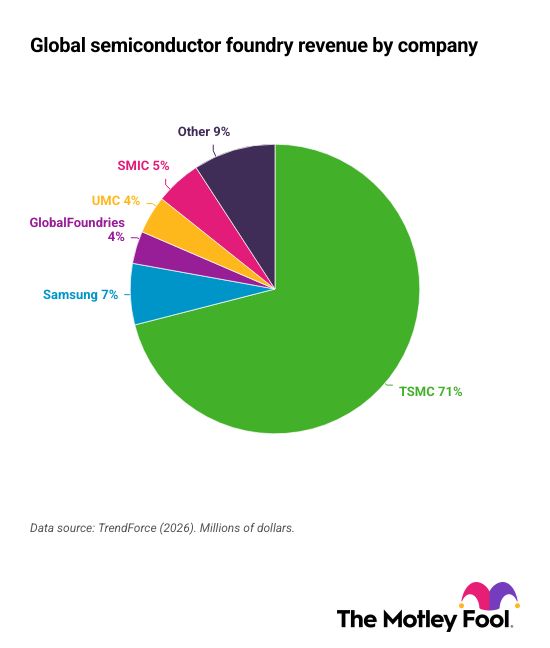
Investment analyses suggest that TSMC stock has the potential to double in value over the next three years, driven by its dominant foundry market share and pricing power in the AI chip sector. Investors are increasingly viewing TSMC not just as a manufacturer but as a critical infrastructure provider for the AI revolution.
Global Semiconductor Sales Hit $300 Billion in Q1 2026
Global semiconductor revenue reached $298.5 billion in the first quarter of 2026, a 25% increase from the previous quarter. This bumper start puts the industry firmly on track to hit $1 trillion in annual sales for 2026, driven largely by AI infrastructure spending.
Deep Dive: The Terafab Reality Check vs. Established Giants
Elon Musk’s Terafab project, initially touted as a revolutionary approach to large-scale AI chip manufacturing, is encountering significant friction. Recent reports indicate that the project is facing "manufacturing, packaging, printed circuit board (PCB) yield, partnership, and governance questions." This contrasts sharply with the established reliability of foundries like TSMC and Samsung, which have spent decades refining their processes for high-yield advanced node production. The challenges faced by Terafab highlight the immense technical and logistical barriers to entry in cutting-edge semiconductor manufacturing, even for well-funded and highly motivated new entrants.
Strategically, this delay benefits incumbent players like TSMC and Samsung, who continue to secure long-term contracts with major AI developers. While Terafab aims to disrupt the market with a vertically integrated model, the industry's reliance on specialized equipment partners like ASML and Tokyo Electron means that new entrants must navigate a complex supply chain ecosystem that incumbents have already mastered. The "reality check" for Terafab serves as a reminder that semiconductor manufacturing is less about capital expenditure and more about process control and supply chain integration.
Meanwhile, Samsung’s successful validation of HBM4E memory is a critical competitive development. High-Bandwidth Memory (HBM) is the bottleneck for many AI accelerators, and Samsung’s ability to clear quality standards positions it as a viable alternative to SK Hynix, which currently dominates the HBM market. This progress allows Samsung to offer a more complete package—logic foundry plus memory—to customers like NVIDIA and AMD, potentially shifting the balance of power in the AI chip supply chain.
The broader implication is that while new entrants like Terafab may struggle with immediate execution, the established giants are rapidly advancing their technology roadmaps. TSMC’s continued expansion in the US and Samsung’s memory innovations suggest that the near-term future of AI hardware will remain in the hands of these legacy manufacturers, who are better positioned to meet the exploding demand for compute power.
What to Watch Next Week
- Samsung HBM4E Customer Adoption: Look for announcements from NVIDIA or AMD regarding the qualification and adoption of Samsung’s newly validated HBM4E memory in their upcoming GPU architectures.
- Terafab Partnership Updates: Any official statements from Elon Musk’s team regarding resolved PCB yield issues or new foundry partnerships will be critical for assessing the project's viability.
- US-Taiwan Trade Deal Implementation: Monitor for specific guidance on how the new tariff reductions will be applied to different classes of semiconductor exports, which could impact pricing strategies for US-based tech companies.
- SMIC Depreciation Impact: Watch for analyst commentary on how SMIC’s increased depreciation costs will affect its pricing power and ability to compete with lower-cost domestic Chinese fabs.
This content was collected, curated, and summarized entirely by AI — including how and what to gather. It may contain inaccuracies. Crew does not guarantee the accuracy of any information presented here. Always verify facts on your own before acting on them. Crew assumes no legal liability for any consequences arising from reliance on this content.
Powered by
