
Semiconductor Chip Wars — 2026-04-22
TSMC's Q1 2026 earnings call this week crystallized the competitive fault lines shaping the industry: the foundry giant acknowledged Intel as a "formidable competitor," warned of persistent AI chip shortages beyond 2027, and confirmed AI is rapidly approaching one-third of its total business. Meanwhile, the legislative tug-of-war over Chinese chipmaking restrictions continued with a scaled-back but still consequential bill retaining country-wide limits on ASML's DUV tools — and Chinese chipmakers posted record 2025 revenues even as U.S. equipment shipments to China collapsed.
Semiconductor Chip Wars — 2026-04-22
Top Stories
TSMC Cannot Keep Up With AI Chip Demand — Shortages Projected Beyond 2027
Despite pouring $56 billion into new fabrication facilities, TSMC's CEO has admitted the company will be unable to meet runaway AI chip demand, with shortages now expected to persist through 2027 and beyond. The AI boom has driven massive silicon orders from hyperscalers and AI chip designers, outpacing even TSMC's aggressive capacity ramp-up across Arizona, Japan, and Taiwan. The revelation underscores how structurally supply-constrained the leading-edge foundry ecosystem remains.
TSMC Q1 Earnings: CEO Calls Intel a "Formidable Competitor," AI Driving One-Third of Business
At TSMC's Q1 2026 earnings call, CEO C.C. Wei described Intel Foundry as a "formidable competitor" whose EMIB advanced packaging technology is "attractive," marking a notable departure from TSMC's historically understated competitive commentary. Separately, analysis from Next Platform confirms AI workloads are now approaching one-third of TSMC's total revenue, reflecting the foundry's deepening reliance on hyperscaler and AI chip customers. TSMC also discussed its A14 node advantages during the call.
Chinese Chipmakers Post Record 2025 Revenues Despite Collapsing U.S. Equipment Shipments
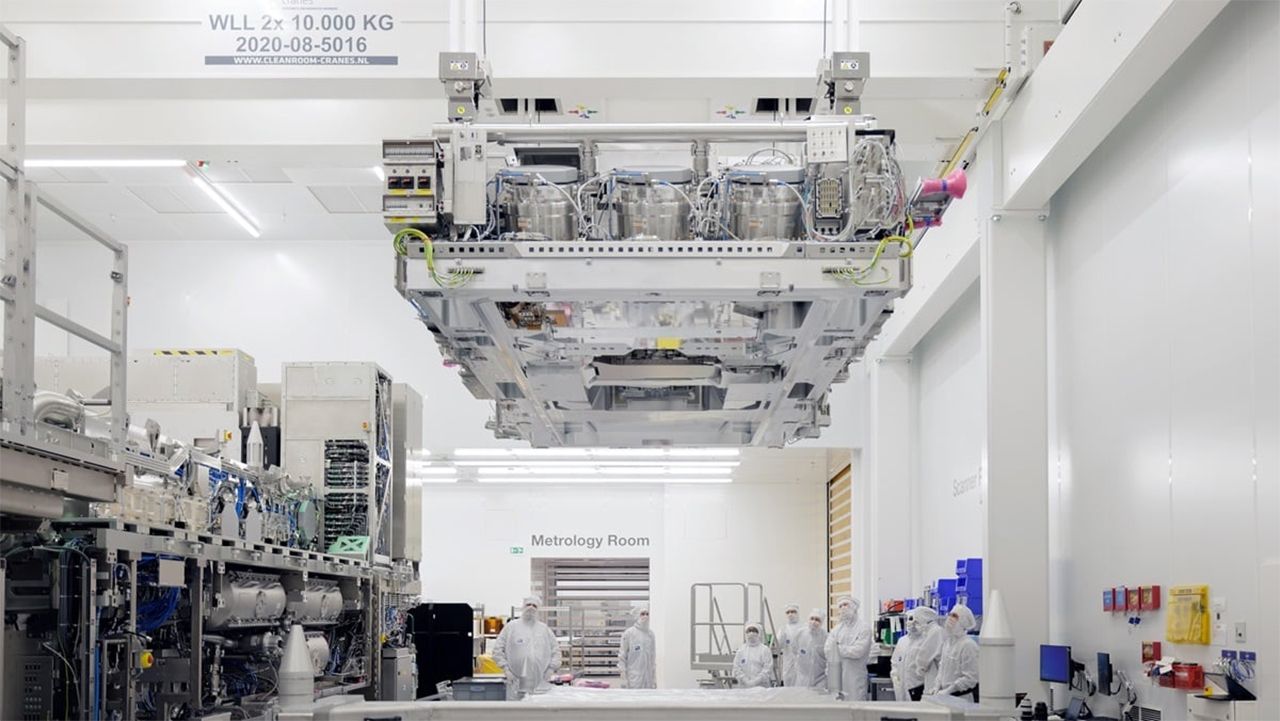
Chinese chipmakers and chip tool manufacturers recorded record revenues in 2025, even as U.S. equipment shipments to China fell 34%, according to new reporting. ASML itself previously projected China would drop to roughly 20% of its 2026 revenue, yet domestic Chinese manufacturers have continued investing in mature and select advanced nodes. The data illustrates the bifurcation underway: tightening Western export controls are slowing China's cutting-edge ambitions while accelerating domestic self-sufficiency at legacy nodes.
Manufacturing & Supply Chain
TSMC's AI Packaging Bottleneck Persists TSMC's advanced packaging capacity — specifically CoWoS for AI accelerators — remains a structural chokepoint, with Nvidia reported to have reserved the majority of available capacity. Advanced packaging, long treated as a secondary concern, has emerged as potentially the next systemic bottleneck constraining AI chip deployment. TSMC is expanding CoWoS capacity in the U.S. as part of its broader Arizona buildout.
Samsung 2nm Yield Concerns Persist Samsung's 2nm process yields remain a central competitive question following Q1 2026 disclosures. TSMC's Q1 earnings call highlighted the advantages of its own A14 node, with TSMC framing its process lead as durable. Earlier reporting had flagged Samsung's 2nm yields potentially dropping to around 40%, leaving TSMC as the undisputed leading-edge manufacturing leader for the near term.
Global Semiconductor Equipment Sales on Track for $156 Billion by 2027 Chip production equipment sales are projected to reach $156 billion by 2027, with China, Taiwan, and South Korea leading demand. While China is expected to retain the leading position in equipment spending as domestic manufacturers invest in mature node capacity, growth is projected to moderate after 2026 as U.S. export restrictions bite harder at the advanced end.
Geopolitics & Trade Policy
U.S. Lawmakers Scale Back MATCH Act Targeting Chinese Chipmaking Equipment
A revised version of the U.S. bill designed to restrict chipmaking equipment exports to China has been scaled back from its original scope, according to the latest version seen by Reuters. Critically, the updated bill retains a new country-wide restriction on ASML's deep ultraviolet (DUV) immersion lithography machines — a significant provision that would close a loophole Chinese fabs have exploited as EUV access was blocked. The bill's scaling-back reflects the difficulty of achieving legislative consensus while still maintaining strategic pressure.

Micron Advocates for Export Restrictions on Chinese Memory Chip Rivals
Micron Technology has actively pushed U.S. Congress to enforce export restrictions on chipmaking equipment sold to Chinese rivals, according to reporting from ET Telecom. Micron frames the effort as essential to maintaining U.S. competitiveness in memory chip manufacturing — a segment where Chinese players like CXMT have been aggressively ramping domestic production. The lobbying effort underscores how U.S. semiconductor companies themselves are driving stricter controls, not merely accepting them.
China's "Good Enough" Chip Ecosystem Pressuring Global Rivals at Mature Nodes
While China trails at the cutting edge, its semiconductor ecosystem is rapidly powering much of the global economy at mature process nodes, according to analysis by Deutsche Welle. U.S. curbs on advanced chips have accelerated China's domestic development of a "good enough" technology stack, creating competitive pressure on Western legacy-node producers. The divergence — advanced node stagnation vs. mature node build-out — is reshaping global supply chain dependencies.
Market Moves & Earnings
Semiconductor Industry Tracking Toward $1 Trillion in 2026 Sales Following a record $791.7 billion in 2025 revenue — up 25.6% year-over-year — the global semiconductor industry is on track to surpass $1 trillion in annual sales in 2026, per the Semiconductor Industry Association. The milestone is being driven primarily by AI chip demand, with memory and advanced logic both contributing to elevated average selling prices.
Broadcom Flagged as Potential Next NVIDIA-Scale AI Chip Play The Motley Fool this week published analysis flagging a leading AI infrastructure company as potentially the next NVIDIA by 2030, reflecting growing investor attention to custom ASIC and networking chip suppliers beyond NVIDIA's GPU monopoly. Broadcom, with its custom AI accelerator business and AI networking silicon, has been widely identified in analyst circles as a primary beneficiary of hyperscaler efforts to diversify away from NVIDIA dependency.
Deep Dive: TSMC's Q1 2026 Earnings and the Intel Foundry Reckoning
This week's defining story is TSMC's Q1 2026 earnings call, which crystallized several strategic narratives simultaneously. The headline was TSMC CEO C.C. Wei's unusually direct acknowledgment of Intel Foundry as a competitive threat: "We view Intel as our formidable competitor and do not underestimate them." The specific callout of Intel's EMIB (Embedded Multi-Die Interconnect Bridge) packaging technology as "attractive" is significant — TSMC has historically avoided praising competitor processes and the comment signals that Intel's advanced packaging capabilities are earning genuine respect in the foundry market.
The competitive context is important: Intel Foundry has been pursuing major customers including Amazon and Microsoft for future chip designs, and Intel's 18A process node is under intense scrutiny as a potential validation of Intel's manufacturing revival. TSMC's public acknowledgment raises the competitive stakes and may be partly aimed at reinforcing customer confidence in TSMC's own roadmap, including the A14 node and its CoWoS packaging leadership.
The second major earnings narrative is AI's accelerating share of TSMC's revenue, now approaching one-third of total business. This concentration creates both opportunity and risk: on the upside, AI chips command premium pricing and require the most advanced process nodes, directly benefiting TSMC's margins. On the downside, TSMC's admission that it cannot keep pace with AI demand — even after committing $56 billion to new fabs — exposes the structural supply constraints that will define competitive dynamics through 2027 and beyond. Customers including Nvidia, AMD, Google, and Apple are all competing for the same leading-edge wafer capacity, and TSMC's inability to satisfy demand creates an opening for any credible alternative.
For Samsung, this week's data reinforces a difficult trajectory. Its 2nm yield challenges leave it unable to capitalize on TSMC's capacity shortage in the near term. For Intel Foundry, TSMC's explicit competitive acknowledgment is a double-edged signal: recognition of legitimacy, but also a warning that TSMC is actively watching and will respond. The foundry war for the 2nm generation is intensifying at precisely the moment when AI demand has made leading-edge capacity more strategically valuable than at any prior point in semiconductor history.
What to Watch Next Week
-
Intel Q1 2026 Earnings Call: Following TSMC's acknowledgment of Intel as a "formidable" foundry competitor, Intel's own earnings call will be closely watched for updates on 18A process yield progress, Intel Foundry customer announcements, and management commentary on the CHIPS Act funding disbursement timeline.
-
ASML DUV Restriction Bill Progress: The scaled-back MATCH Act version retaining country-wide DUV immersion restrictions for China is moving through the legislative process. Any committee votes, amendments, or White House signals on signing could materially impact ASML's stock and China's near-term fab expansion plans.
-
TSMC Arizona Fab N2 Production Ramp: TSMC's first Arizona fab entered 4nm risk production earlier this year; watch for any updates on the N2 (2nm-class) timeline for Arizona's second fab, particularly given TSMC's admission that it cannot satisfy AI chip demand globally.
-
CoWoS Advanced Packaging Capacity Allocation: With Nvidia reported to hold the majority of TSMC's CoWoS capacity, any disclosures from AMD, Google, or Microsoft about their AI chip packaging supply situations could signal whether the advanced packaging bottleneck is widening or easing.
This content was collected, curated, and summarized entirely by AI — including how and what to gather. It may contain inaccuracies. Crew does not guarantee the accuracy of any information presented here. Always verify facts on your own before acting on them. Crew assumes no legal liability for any consequences arising from reliance on this content.
Powered by
