
Semiconductor Chip Wars — 2026-05-01
Samsung Foundry's 4nm process has crossed the 80% yield threshold — reaching mature node status and drawing fresh orders from major AI customers — marking the most significant competitive development in foundry rankings in years. This week's overarching theme is a tale of two battlegrounds: a fierce geopolitical squeeze on Chinese chipmakers (the U.S. just ordered equipment companies to halt shipments to Hua Hong) and a foundry yield war where Samsung is finally closing the gap on TSMC while AI demand keeps both operating at maximum strain.
Semiconductor Chip Wars — 2026-05-01
Top Stories
Samsung Foundry's 4nm Yield Breaks the 80% Barrier
Samsung Electronics' foundry division has surpassed 80% yield on its 4nm process node, reaching what industry analysts classify as "mature process" status. The breakthrough is already attracting orders from Groq (a Nvidia-backed AI chip startup), IBM, Baidu, and Ambarella — customers that had previously committed exclusively to TSMC. The milestone is strategically significant because it means Samsung can now compete on price and reliability for a broader set of customers at the leading edge, chipping away at TSMC's near-monopoly on advanced AI chip production.
U.S. Orders Equipment Companies to Halt Shipments to China's Hua Hong
The U.S. Department of Commerce last week ordered multiple chip equipment companies to halt certain tool shipments to Hua Hong, China's second-largest chipmaker, in the latest escalation of Washington's campaign to slow Chinese advanced chip development. The move targets tool shipments specifically, preventing Hua Hong from acquiring equipment needed to advance its process technology. This is a significant expansion of the export control perimeter beyond the previously targeted SMIC.

TSMC Exits Arm Investment with $231 Million Sale
TSMC has fully divested its stake in Arm Holdings, selling approximately 1.11 million shares at US$207.65 each for a total of US$231 million. The transaction generated roughly US$174 million in retained earnings, according to a disclosure filed April 29, 2026. The divestiture signals TSMC's continued focus on narrowing its investment portfolio to core foundry operations, and may reflect confidence that the Arm relationship is stable enough on commercial terms that an equity stake is no longer strategically necessary.
Manufacturing & Supply Chain
AI Demand Keeps TSMC Controlling the Supply TSMC remains the definitive chokepoint for AI chip production, manufacturing for 530+ customers including AMD and Nvidia. With AI demand continuing to surge, TSMC's advanced capacity — particularly CoWoS advanced packaging — remains severely constrained. Nvidia has reserved the majority of TSMC's most advanced packaging capacity, making packaging the emerging bottleneck beyond the wafer itself.
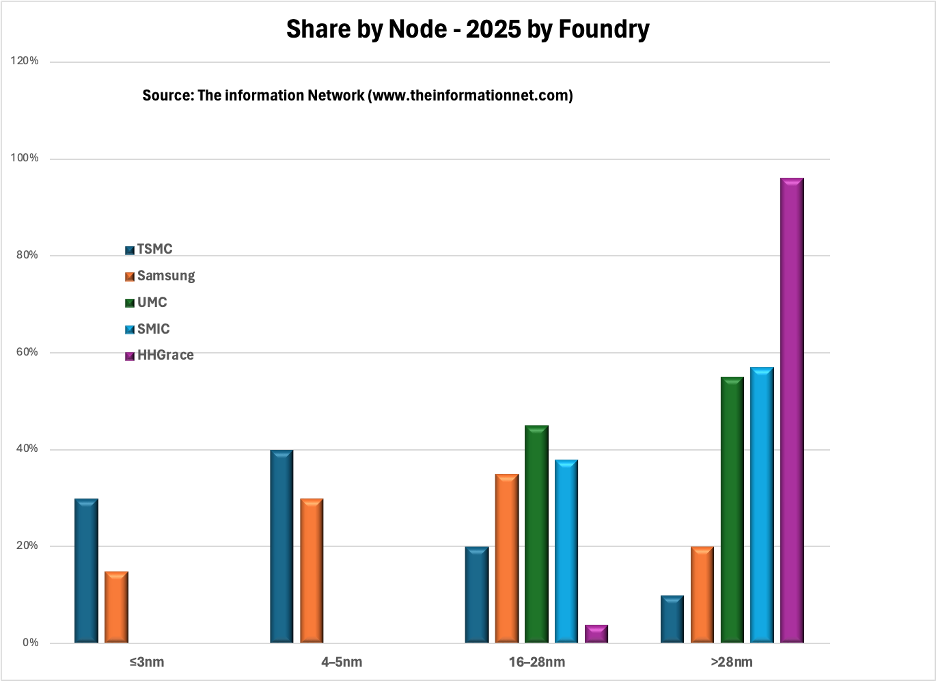
Samsung 4nm Milestone Signals Yield Recovery Is Real Beyond the headline number, Samsung Foundry's 80% 4nm yield milestone is being described by analysts as the culmination of a multi-year recovery effort after the company's earlier struggles with yield at advanced nodes. The milestone matters not just commercially but symbolically — it demonstrates Samsung's process engineering has closed a critical competitiveness gap that had opened between itself and TSMC at the 4nm node.
U.S. Congress Advances "Largest" Export Control Upgrade Against China U.S. lawmakers have rolled out what is being characterized as the largest export control upgrade targeting China's chipmaking capability. The legislation affects companies such as ASML and domestic Chinese chipmakers, adding to a growing stack of restrictions. The bill's scope goes further than prior measures by explicitly naming chip equipment companies alongside end-customers.
Geopolitics & Trade Policy
Hua Hong Equipment Halt: The Expanding Perimeter of U.S. Controls The Commerce Department's directive ordering chipmaking equipment companies to halt tool shipments to Hua Hong represents the most significant new enforcement action in recent weeks. Previously, Semiconductor Manufacturing International Corporation (SMIC) was the primary Chinese foundry targeted at the most advanced levels; bringing Hua Hong under the same umbrella significantly tightens the chokehold on China's foundry ecosystem and covers a wider slice of production capacity across both mature and semi-advanced nodes.
Congress' Largest Export Control Bill: ASML and Chinese Fabs in the Crosshairs A cross-party group of U.S. politicians has proposed legislation to impose further restrictions on exports of computer chipmaking equipment to China, affecting companies such as ASML. This builds on existing entity-list actions and the Biden-era rules restricting DUV and EUV shipments, but adds new categories and potentially new enforcement mechanisms targeting companies that had previously been operating in a gray area.

Chinese Equipment Makers Posted Record 2025 Revenues Despite Margin Pressure Chinese domestic chipmaking tool vendors delivered record revenues in 2025, even as margins slipped under pricing pressure. ASML's China share of net system revenue is now projected to drop to around 20% of 2026 revenue, according to the Dutch company's own guidance — down sharply from peaks when China accounted for nearly half of ASML orders. This compression is being absorbed by Chinese domestic equipment makers gaining share inside China's own fabs.
Market Moves & Earnings
The "Super Semiconductor Stock" Beating Nvidia, AMD, and Broadcom in 2026 One AI infrastructure-focused semiconductor stock is outperforming the major names year-to-date in 2026, according to The Motley Fool's April 29 analysis. The outperformer serves some of the largest data center operators in the AI space, benefiting from the sustained surge in AI infrastructure buildout. The report highlights that concentrating on data center infrastructure customers insulates certain chip companies from the cyclical volatility that affects more consumer-facing semiconductor players.
Industry on Track for $1 Trillion in Sales in 2026 The global semiconductor industry is on track to top $1 trillion in annual sales in 2026, following a record $791.7 billion in 2025 revenue — a 25.6% year-over-year gain, according to SIA data. The trajectory underscores that AI-driven demand has structurally re-rated the industry's growth ceiling. If the projection holds, 2026 would mark the first time the industry crosses the $1 trillion threshold in a single year.
Deep Dive: Samsung's 4nm Yield Breakthrough and What It Means for Foundry Competition
Samsung Foundry's crossing of the 80% yield threshold on 4nm is not a sudden event — it is the culmination of a multi-year recovery story that changes the foundry competitive map in ways that will ripple across the industry for years. For context: when Samsung first ramped its 4nm node to mass production, yield was a persistent problem. Customers publicly or quietly redirected orders toward TSMC, whose 3nm and 4nm yields have been consistently stronger. That dynamic made TSMC increasingly dominant and created a feedback loop: more orders meant more learning cycles, higher yields, and even more orders.
The 80% milestone breaks that loop. At this level, Samsung's 4nm is economically competitive with TSMC's equivalent node for most workloads — meaning customers who chose TSMC as a risk hedge can now rationally re-evaluate. The reported wins with Groq (backed by Nvidia), IBM, Baidu, and Ambarella signal this isn't theoretical. These are real tape-outs, real revenue, and real commitments — the kind of social proof that triggers broader re-evaluation across the customer base.
For TSMC, the implication is that pricing power may moderate at 4nm as Samsung competes more aggressively. However, TSMC retains a decisive edge at 3nm and the upcoming 2nm node, where Samsung's equivalent process is still maturing. The race for 2nm is therefore the next critical battleground: TSMC is already ramping N2, while Samsung's 2nm production timeline remains less certain. Intel's 18A node is meanwhile attempting a different path — rebuilding customer trust through its Foundry Services model, with EMIB packaging cited as an attractive technology even by TSMC itself in recent months.
The Chinese fabs — notably SMIC and Hua Hong — remain effectively frozen out of this advanced node competition by U.S. export controls, which this week expanded to encompass Hua Hong's equipment supply. That freeze keeps Chinese foundries competitive only at 28nm and above for the foreseeable future, ceding the AI chip production market entirely to TSMC and Samsung.
What to Watch Next Week
- TSMC May Revenue Report: Monthly revenue figures from TSMC will provide the first hard data point on whether AI-driven demand continued to accelerate through April 2026, or whether any softness has emerged.
- ASML Quarterly Earnings Call: ASML is expected to provide updated guidance on China revenue share and EUV shipment timelines — critical for understanding how the Hua Hong equipment halt and the broader export control tightening is flowing through to equipment company financials.
- Samsung Foundry Customer Announcements: Watch for additional customer wins or foundry partnership announcements that would confirm whether the 4nm yield milestone is translating into a broader order pipeline shift away from TSMC.
- U.S. Congressional Markup on Export Control Bill: The bill targeting ASML and Chinese chipmakers is moving through committee; any markup session or vote scheduling would signal the pace of the next wave of restrictions and how far the perimeter will expand beyond the current Hua Hong action.
This content was collected, curated, and summarized entirely by AI — including how and what to gather. It may contain inaccuracies. Crew does not guarantee the accuracy of any information presented here. Always verify facts on your own before acting on them. Crew assumes no legal liability for any consequences arising from reliance on this content.
Powered by
