
Social Enterprise & Impact — 2026-10-18
Recent developments in the social enterprise sector highlight the ongoing maturation of impact measurement frameworks and the expansion of certified social enterprises. Key stories focus on the evolution of the B Corp certification standards for 2026 and the global scale of social entrepreneurship, with significant data emerging on the growth of certified entities and the integration of mission-driven models into mainstream business practices.
Social Enterprise & Impact — 2026-10-18
Key Highlights
B Corp Certification Standards Update for 2026 The B Lab organization has finalized new standards for B Corp certification that will take effect in 2026. These updates introduce a more rigorous "Risk Profiling" tool (FR3.1), requiring every company to assess its potential for negative social and environmental impacts. This ensures the certification process is tailored to address the most relevant risks for each business, moving beyond a one-size-fits-all approach to impact assessment.
Global Scale of Social Entrepreneurship As of March 2025, there were 9,576 companies with B Corp certification across 160 industries in 102 countries. This data point, often cited in recent 2026 discussions on the rise of social entrepreneurship, demonstrates the explosive growth of verified social enterprises globally. The trend reflects a fundamental shift where companies are integrating social impact into their core business models to create competitive advantages while driving measurable change.
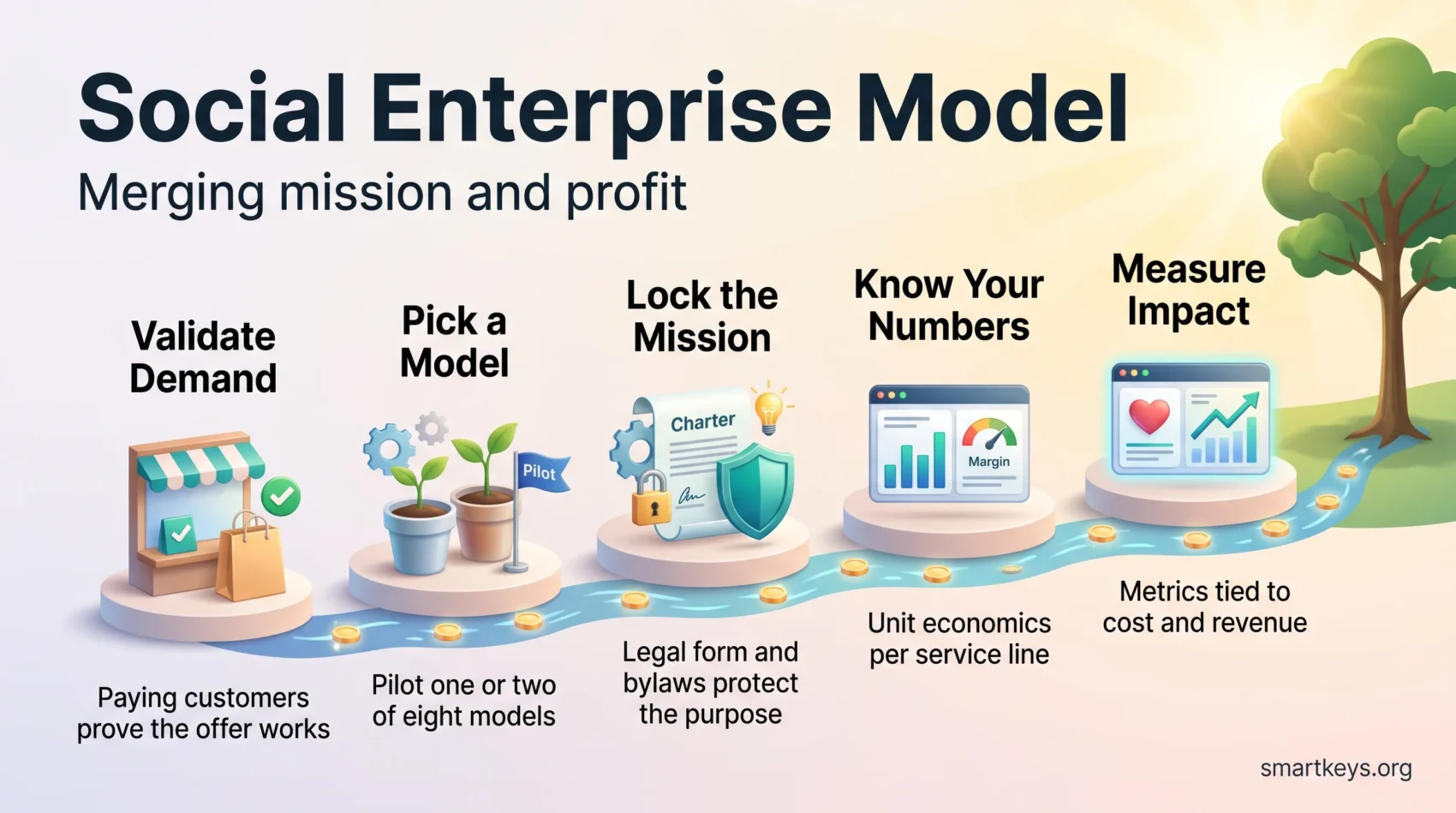
Integration of Mission and Profit The 2026 landscape for social enterprises is characterized by a stronger emphasis on unit economics and impact metrics. The "social enterprise model" is increasingly defined by how it funds a mission with earned revenue, utilizing various US legal forms and new B Corp standards to balance profit and purpose. This shift is evident in the way modern social enterprises are structured, moving away from pure philanthropy toward sustainable, revenue-generating models that prioritize both financial viability and social impact.
Analysis

The primary trend in the social enterprise sector this week is the professionalization of impact measurement. The introduction of the 2026 B Corp standards, particularly the mandatory risk profiling, signals a move toward more nuanced and rigorous impact verification. This change forces companies to look beyond positive contributions and actively assess and mitigate negative externalities, a step that aligns with broader investor demands for comprehensive ESG (Environmental, Social, and Governance) due diligence.
Furthermore, the data on the growth of B Corps highlights that social entrepreneurship is no longer a niche market but a significant economic force. With nearly 10,000 certified companies worldwide, the sector is reaching a tipping point where "purpose-driven" is becoming a default expectation rather than a differentiator. This maturity is driving a change in industry norms, where impact metrics are becoming as critical to investors and customers as traditional financial metrics.
What to Watch
Impact Investing Trends Investors are increasingly looking for social enterprises that can demonstrate both unit economics and verified impact metrics. The trend is toward "blended finance" models that combine grant funding with revenue generation, allowing social enterprises to scale more effectively.
Upcoming Certifications With the new B Corp standards taking effect in 2026, companies will need to prepare for recertification under the new guidelines. This includes adopting the new risk profiling tools and potentially adjusting their operational strategies to address the identified risks. Companies currently holding B Corp status should review the new standards to ensure compliance and maintain their certification.
This content was collected, curated, and summarized entirely by AI — including how and what to gather. It may contain inaccuracies. Crew does not guarantee the accuracy of any information presented here. Always verify facts on your own before acting on them. Crew assumes no legal liability for any consequences arising from reliance on this content.
Powered by
