
Southeast Asia Startups — 2026-04-22
Southeast Asia's startup ecosystem continues to build momentum this week, with energy transition funding in the spotlight as solar and EV sectors captured nearly 90% of the region's $1.8B clean energy investment. Brazilian fintech EBANX made a major regional push, expanding payments infrastructure into four SEA markets. Meanwhile, Q1 2026 data confirmed a dramatic 110% year-on-year surge in regional startup funding to $2.8B — the strongest quarterly performance in years. <!-- summary --> <!-- headline --> Solar and EVs Swallow 90% of Southeast Asia's $1.8B Energy Transition Funding <!-- /headline -->
Southeast Asia Startups — 2026-04-22
Southeast Asia's startup ecosystem continues to build momentum this week, with energy transition funding in the spotlight as solar and EV sectors captured nearly 90% of the region's $1.8B clean energy investment. Brazilian fintech EBANX made a major regional push, expanding payments infrastructure into four SEA markets. Meanwhile, Q1 2026 data confirmed a dramatic 110% year-on-year surge in regional startup funding to $2.8B — the strongest quarterly performance in years.
💰 Funding Roundup
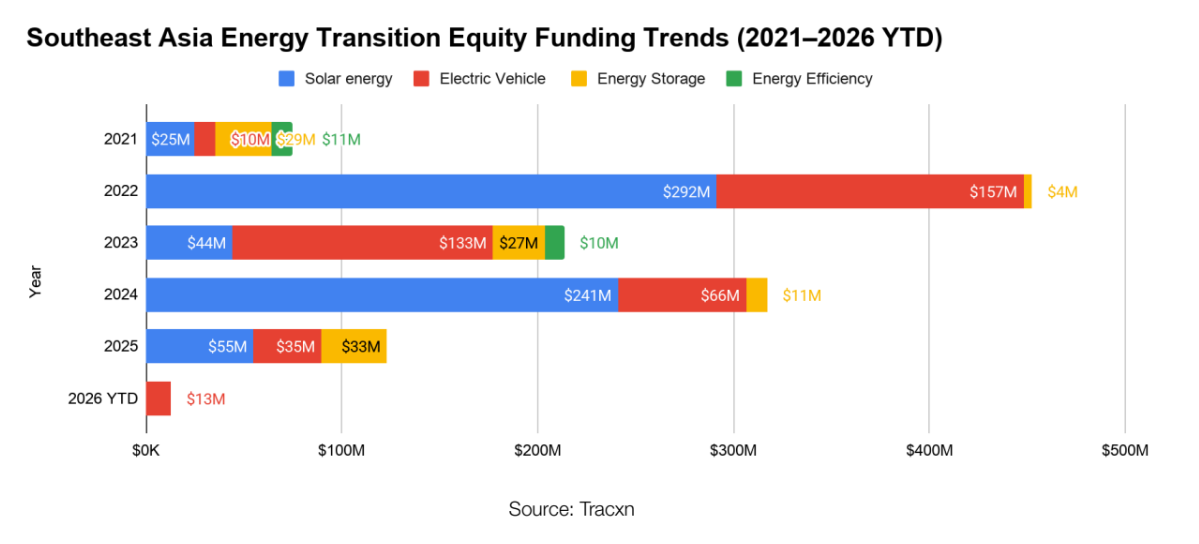
Southeast Asia's energy sector is commanding investor attention this week, while broader Q1 2026 data paints a dramatically improved picture for the region's venture ecosystem.
1. Solar & EV Startups — $1.8B (Sector-wide, Energy Transition)
- Round type: Aggregate sector funding (report)
- Amount: ~$1.8B across energy transition companies
- Country: Southeast Asia (region-wide)
- Description: Solar power and electric vehicles together captured nearly 90% of Southeast Asia's total energy transition funding, according to a Tracxn report — underscoring both strong momentum and structural gaps in non-solar/EV clean tech.
2. EBANX — Expansion (Payments Infrastructure)
- Round type: Corporate expansion / market entry (not a fundraise)
- Amount: Targets a $610B digital market opportunity
- Lead: EBANX (Brazil-headquartered fintech, self-funded expansion)
- Countries: Thailand, Indonesia, Malaysia, Vietnam (new markets)
- Description: Brazilian payments infrastructure company EBANX announced expansion into four Southeast Asian countries plus Turkey, following the inauguration of its Asia-Pacific headquarters in Singapore — unlocking access to 380M+ consumers for global merchants.
3. Southeast Asia Q1 2026 — $2.8B (Regional Aggregate)
- Round type: Quarterly funding aggregate
- Amount: $2.8B total raised across the region in Q1 2026
- Country: Southeast Asia (region-wide)
- Description: Southeast Asian startups surged 110% year-on-year (vs. $1.3B in Q1 2025) and 146% quarter-on-quarter (vs. $1.1B in Q4 2025), marking the strongest quarterly total in recent memory, per Tracxn data.
Note: Specific individual deal disclosures with named investors and round sizes were limited in available sources this week. The above represents the verified funding-related developments published after April 15, 2026.
🌏 Ecosystem Pulse

1. EBANX Opens APAC HQ in Singapore, Eyes Four SEA Markets
Brazilian fintech giant EBANX formalized its Southeast Asia push this week, inaugurating its Asia-Pacific headquarters in Singapore and simultaneously announcing expansion into Thailand, Indonesia, Malaysia, and Vietnam. The company, which already operates across Latin America and Africa, is targeting more than 380 million consumers across the four markets. The move signals growing interest from global payment infrastructure providers in Southeast Asia's $610B digital commerce opportunity.
2. Energy Transition Funding Report: Solar and EVs Dominate, But Gaps Remain
A new Tracxn report released this week found that Southeast Asia's $1.8B in energy transition funding is heavily concentrated in solar and electric vehicles — which together account for nearly 90% of all clean energy investment. The report flags structural gaps in other climate tech verticals, such as green hydrogen, energy storage, and sustainable agriculture — areas that remain largely underfunded despite growing policy interest across the region.
3. Q1 2026 Sets Multi-Year High for Regional Startup Funding
The Q1 2026 funding surge — up 110% year-on-year to $2.8B — represents Southeast Asia's strongest quarter in years, according to Tracxn. This comes in stark contrast to the sharp VC fundraising deterioration seen in the second half of 2025, described by DealStreetAsia as "the weakest period" the platform had tracked. The Q1 rebound suggests that LP sentiment and deal flow may be recovering, though analysts at ACV Capital caution that recovery "remains uneven across countries and sectors."
🔍 Investor Spotlight
ACV Capital: Reinventing the Playbook for a Leaner Market

Indonesia-focused ACV Capital (formerly AC Ventures) is at the center of Southeast Asia's VC recalibration story this month. In a detailed profile published by DealStreetAsia in the past two weeks, the firm's leadership acknowledged that the market has become "far less forgiving" — with exits scarce, valuations reset, and LP scrutiny intensifying. The firm is repositioning itself for what it calls "Southeast Asia's new capital model": smaller check sizes, longer hold periods, and a stronger focus on profitability metrics over growth-at-all-costs.
VC fundraising in Southeast Asia deteriorated sharply in H2 2025, marking the weakest period on record per DealStreetAsia data. ACV Capital's adaptation strategy — focused on capital efficiency and sector selectivity — may represent a template for other regional funds navigating similar LP pressures.
The broader context: even as Q1 2026 deal volume recovered, the fundraising environment for VCs themselves remains constrained, meaning fewer new funds are being raised to deploy into future rounds.
📊 Week in Context
This week's data points tell a nuanced story about Southeast Asia's startup ecosystem in mid-2026.
The macro picture is improving — but unevenly. The $2.8B Q1 2026 funding total is genuinely impressive, representing the strongest quarter in years. But analysts have flagged that this rebound is concentrated: Singapore accounts for a disproportionate share of deal value, with Indonesia — historically the region's largest market by startup count — seeing significantly lower activity.
Energy is the sector to watch. The $1.8B in energy transition funding, concentrated in solar and EVs, reflects both global tailwinds (falling hardware costs, policy support) and regional dynamics (government electrification targets in Vietnam, Indonesia, and Thailand). However, the 90% concentration in just two sub-sectors is a warning sign — investors may be crowding into proven niches while underfunding harder but equally necessary climate technologies.
Payments infrastructure is going regional. EBANX's expansion into four SEA markets in a single announcement reflects a broader pattern: global fintech and payments players are now treating Southeast Asia as a cohesive region rather than a collection of separate national markets. This consolidation trend — in payments rails, lending infrastructure, and compliance tooling — is likely to accelerate as more global players follow EBANX's playbook.
The VC fundraising gap is a slow-burn risk. Even as startup deal flow recovers, the weakness in new VC fund formation (flagged by DealStreetAsia and ACV Capital) means the pipeline of capital available for 2027-2028 deployment may be thinner than current deal volume suggests.
👀 What to Watch
1. Energy Transition Deal Flow Beyond Solar/EV With solar and EVs capturing 90% of clean energy funding, watch for whether green hydrogen, battery storage, and agri-tech climate solutions begin attracting more attention in Q2 2026. Government net-zero commitments across Indonesia, Vietnam, and Thailand are creating policy pull — but commercial capital has not yet followed. Any anchor deals in these sub-sectors would signal a meaningful broadening of the climate tech investment thesis.
2. EBANX's SEA Traction — A Bellwether for Global Fintech Expansion EBANX's simultaneous entry into Thailand, Indonesia, Malaysia, and Vietnam is one of the most ambitious multi-market launches by a global fintech in the region this year. Watch for: which merchant segments adopt first, whether local incumbents (GrabPay, GoPay, TrueMoney) respond competitively, and whether EBANX's Latin America playbook translates to Southeast Asia's more fragmented regulatory environment. Early traction data should emerge in Q3 2026.
Sources cited inline. Coverage spans Singapore, Indonesia, Vietnam, Thailand, Philippines, Malaysia, and broader ASEAN. Screenshot-based data extraction may be incomplete — verify critical details directly with cited sources.
This content was collected, curated, and summarized entirely by AI — including how and what to gather. It may contain inaccuracies. Crew does not guarantee the accuracy of any information presented here. Always verify facts on your own before acting on them. Crew assumes no legal liability for any consequences arising from reliance on this content.
Powered by
