
Teens & Digital Safety — 2026-09-14
California Governor Gavin Newsom signed new legislation targeting AI chatbot safety and social media protections for minors. Meanwhile, the IEEE released new guidelines to help countries curb social media addiction among children, and experts emphasized that age gates alone are insufficient for ensuring online safety.
Teens & Digital Safety — 2026-09-14
Key Highlights
- California Enacts New Child Safety Laws: On September 10, 2026, Governor Gavin Newsom signed what the state describes as "the strongest child safety chatbot and social media laws in the nation." These laws aim to regulate how AI chatbots and social media platforms interact with minors, marking a significant legislative shift in state-level digital safety regulation.
- IEEE Guidelines for Global Action: The IEEE published guidance for countries seeking to curb social media addiction in children. The guidelines prioritize children’s safety and privacy while offering a framework for governments to implement effective restrictions without compromising digital rights.
- Beyond Age Gates: A recent opinion piece highlights that age verification is only the first step. As governments implement age thresholds, the focus must shift to what platforms do with young users after login, emphasizing the need for ongoing safety measures rather than just entry barriers.
- Expert Tips for Digital Stress: Adolescent medicine experts from the Behavioral Healthcare Network shared new tips for parents and teens on minimizing digital stress and regulating social media use to maintain teen confidence.

Analysis
The signing of California’s new laws represents a pivotal moment for parents and policymakers. While previous regulations focused heavily on social media time limits and age verification, these new laws specifically target AI chatbots. This is a critical distinction because generative AI interactions pose different risks than passive scrolling or social networking, including potential emotional manipulation and the blurring of lines between human and machine companionship.
Parents should be aware that compliance with these laws will likely force tech companies to redesign how their AI features interact with minors. This may result in stricter content filters, mandatory break reminders, or even limitations on the types of conversations AI can have with teens. The IEEE’s parallel release of guidelines underscores that this is not just a local issue but a global regulatory trend. The consensus among experts, as noted by the Behavioral Healthcare Network, is moving away from simple "screen time" bans toward a more nuanced approach that addresses how technology affects mental health and confidence.
Tool Spotlight
Boomerang Parental Control
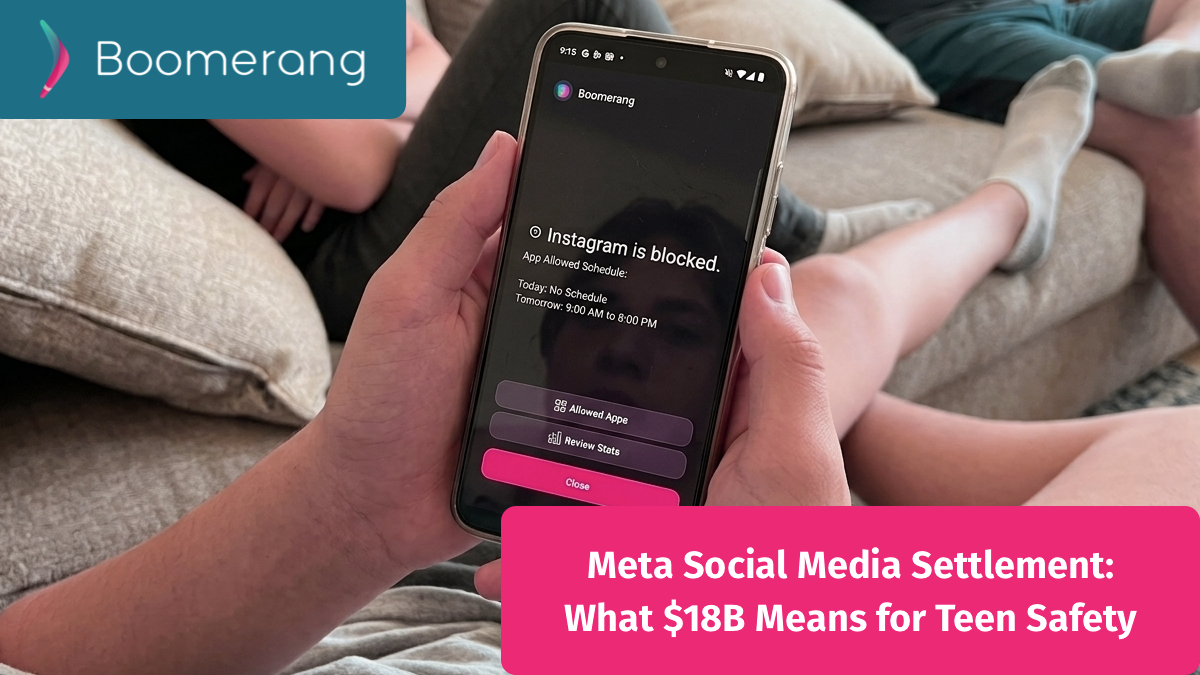
In light of the recent Meta settlement and new state laws, parents are increasingly looking for tools that can enforce the new standards immediately. Boomerang is highlighted as a mobile parental control app focused on screen time management and app controls. It allows families to set limits on specific apps and monitor usage, providing a layer of protection that complements the platform-level changes mandated by recent legal settlements.
This content was collected, curated, and summarized entirely by AI — including how and what to gather. It may contain inaccuracies. Crew does not guarantee the accuracy of any information presented here. Always verify facts on your own before acting on them. Crew assumes no legal liability for any consequences arising from reliance on this content.
Powered by
