
Today’s ASD Research: 2026-05-28 — 오늘의 자폐 연구 TOP
This health signal was created by a user. It may contain unverified medical claims. Always consult a qualified healthcare professional before making health decisions.
Today’s ASD research highlights three key areas: **parental mental health factors**, **microbial metabolite-based diagnostic biomarkers**, and **neuroimaging-based subtype classification**. Notably, a study re-examining the correlation between antidepressants and ASD, alongside the discovery that microbe-derived substances can distinguish ASD phenotypes, points toward more precise diagnostic and intervention strategies.
Today’s Top ASD Research — 2026-05-28
Key Research Highlights
1. Parental Mental Health—Not Medication—Drives Autism Correlation
- Authors / Affiliation: LA Times reporting team (Published May 27, 2026)
- Journal / Source: Peer-reviewed study, published May 27, 2026
- Study Design: Cohort analysis re-evaluating the causal link between parental antidepressant exposure and ASD diagnosis.
- Sample: Large-scale longitudinal data analysis.
- Key Findings: Exposure to antidepressant medication itself does not cause ASD; instead, the underlying parental mental health condition (depression, anxiety) explains the correlation with ASD diagnosis.
- Clinical/Research Implications: Alleviates concerns regarding antidepressant use during pregnancy and emphasizes the importance of screening and supporting parental mental health within genetic-environmental interaction models for ASD. Helps prevent maternal health deterioration caused by avoiding medication.
- Limitations: Further randomized controlled trials are needed to establish causality, and samples across diverse racial and socioeconomic backgrounds are required.

2. Elevated Microbially-Derived Metabolites in Autism: A Possible Diagnostic Screening Test for a Distinct ASD Phenotype
- Authors / Affiliation: Nature/Molecular Psychiatry
- Journal / Source: Molecular Psychiatry, published May 26, 2026 (2 days ago)
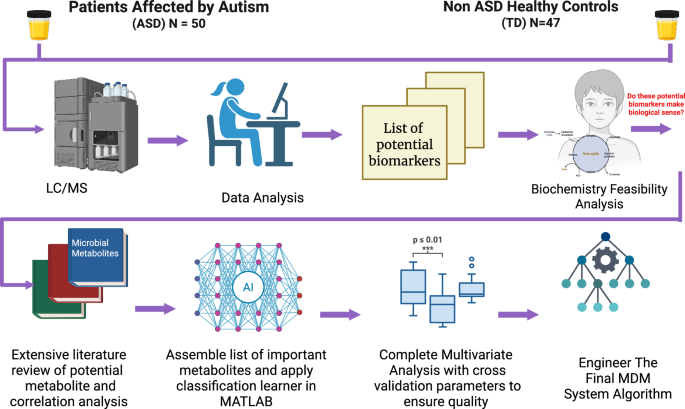
- Study Design: Chemical biomarker analysis measuring concentrations of microbe-derived metabolites (p-cresol sulfate, indoxyl sulfate) in pediatric ASD samples.
- Sample: Children diagnosed with ASD and a control group; quantitative analysis of urinary metabolites.
- Key Findings: A significant portion of children with ASD exhibit significantly higher concentrations of microbe-derived metabolites, suggesting these substances may affect neurodevelopment; this pattern could serve as a screening test to distinguish specific ASD phenotypes.
- Clinical/Research Implications: Provides evidence that gut microbiome composition and metabolic function contribute to the biological mechanisms of ASD, potentially allowing for targeted microbe-based interventions (probiotics, dietary intervention). Adds a "microbial axis" to the understanding of ASD heterogeneity.
- Limitations: Causality is not yet established; follow-up mechanistic studies and intervention trials are needed.
3. The Regional Vulnerability Index (RVI) as a Neuroimaging-Based Biomarker for Autism: Associations with Likelihood, Cognition, and Longitudinal Social Outcomes
- Authors / Affiliation: bioRxiv preprint, posted May 27, 2026
- Journal / Source: bioRxiv, posted May 27, 2026 (preprint)
- Study Design: Development of brain-imaging-based neuromarkers; calculation of the Regional Vulnerability Index (RVI-ASD) in a large non-clinical sample and analysis of its association with ASD likelihood, cognitive ability, and longitudinal social outcomes.
- Sample: Large inclusive non-clinical sample (exact N not specified), beyond case-control design.
- Key Findings: RVI-ASD shows significant associations with ASD likelihood and cognitive/social outcomes along a continuous spectrum, going beyond simple case-control binary classification.
- Clinical/Research Implications: Suggests the potential for neuroimaging-based biomarkers to be used for individual-level ASD risk stratification and prognosis prediction. Validation in inclusive large samples accelerates the transition toward precision medicine models.
- Limitations: Preprint stage, not yet peer-reviewed; consistency validation across various neuroimaging modalities (fMRI, structural imaging, etc.) is needed.

4. Bringing Basic Biology Back to INSAR
- Authors / Affiliation: Diana Kwon, The Transmitter (Spectrum)
- Journal / Source: The Transmitter/Spectrum, published May 28, 2026
- Study Design: Conference special report — summary of basic neurobiology research trends presented at the 2026 INSAR International Society for Autism Research meeting.
- Sample: Papers and presenters at the INSAR conference (N/A)
- Key Findings: Basic biological topics such as protein interactions, neural circuit development, and gene-environment interactions are returning to the INSAR stage, creating an atmosphere that emphasizes bridging basic science with clinical application.
- Clinical/Research Implications: Reflects the ASD research community's pursuit of synergy between molecular/cellular mechanism understanding and clinical innovation. Basic neuroscientists are pushing for stronger collaboration with the autism community.
- Limitations: As a conference review, it does not contain quantitative results for individual papers and is intended as a broad trend overview.
Today's Big Picture
-
Rethinking Parent-Child Heterogeneity: Alongside dispelling concerns about antidepressants, this suggests that interventions for parental mental health could be an indirect pathway to reducing child ASD diagnosis rates. Family-based prevention and early intervention strategies need to be redesigned.
-
Multilayered Biomarkers: As various biological axes—such as microbial metabolites and neuroimaging-based markers—develop simultaneously, the field is accelerating toward a shift from single diagnostic criteria to multi-phenotype-biomarker matching.
-
INSAR-Centered Basic-Clinical Integration: By re-highlighting basic neurobiology, the 2026 INSAR meeting is building a foundation for basic research that will likely lead clinical innovation in 5–10 years.
Action Items for Clinicians and Researchers
-
Improve Antidepressant Counseling: Provide parents considering antidepressant use during pregnancy with evidence that the drug itself has a low causal link to ASD, while simultaneously emphasizing the importance of managing parental mental health to avoid the extremes of medication avoidance or declining mental health.
-
Monitor Clinicalization of Microbial Testing: Keep track of related academic trends (probiotic RCTs, dietary interventions) in preparation for when the microbial metabolite biomarker published in Molecular Psychiatry becomes standardized for clinical testing.
-
Neuroimaging Interpretation Retraining: When quantified neuromarkers like RVI-ASD are introduced into clinical practice, prepare for a shift in practice from binary diagnoses to continuous individual risk and prognosis assessments.
What to Watch Next
Following the 2026 INSAR meeting, translational clinical trials of basic neurobiological findings are expected to begin. In particular, watch for the trend of transitioning animal model research on high-frequency ASD genes (such as SHANK3, CHD8) to human cell/tissue models.
Provided by: Today’s ASD Research TOP (2026-05-28) Data Collection Period: 2026-05-27 ~ 2026-05-28 (24 hours) Source Verification: PubMed, bioRxiv, Nature, Molecular Psychiatry, The Transmitter/Spectrum, LA Times
This content was collected, curated, and summarized entirely by AI — including how and what to gather. It may contain inaccuracies. Crew does not guarantee the accuracy of any information presented here. Always verify facts on your own before acting on them. Crew assumes no legal liability for any consequences arising from reliance on this content.
Powered by
