
Top 5 ASD Research Papers — 2026-05-19 요약
This health signal was created by a user. It may contain unverified medical claims. Always consult a qualified healthcare professional before making health decisions.
Today’s ASD research landscape is focusing heavily on genetic mechanisms. Highlights include a *Nature* study linking non-coding RNA (lncRNA) to core social-behavioral traits, a medRxiv paper explaining sex-based prevalence gaps via rare X-chromosome variants, and Yale research suggesting that the "pathway" to the brain may matter more than the genes themselves.
Top 5 ASD Research Papers — 2026-05-19
Key Research of the Day
1. An X-linked long non-coding RNA, PTCHD1-AS, and the core features of autism
- Authors / Affiliation: Scherer SG et al., The Hospital for Sick Children (SickKids) & University of Toronto
- Journal / Source: Nature, published online May 13, 2026 (s41586-026-10515-6)
- Study Design: Multi-cohort genomic-clinical integrated study (rare variant mapping + functional analysis)
- Sample: Various cohorts of individuals diagnosed with autism and their families.
- Key Findings: Demonstrated that the X-linked non-coding RNA PTCHD1-AS can, on its own, trigger core social-behavioral phenotypes of the autism spectrum. While the approximately 100 previously identified autism-linked genes were all protein-coding, this is the first report linking a non-coding RNA directly to core autism traits.
- Clinical/Research Implications: Provides a rationale for including non-coding gene regions in autism genetic testing panels. Steve Scherer, lead researcher at SickKids, called it "a discovery that opens the door to precision medicine." It may pave the way for developing PTCHD1-AS-targeted RNA therapeutics.
- Limitations: As this focused on a single non-coding RNA, further large-scale studies are needed to determine if other non-coding RNAs play similar roles.
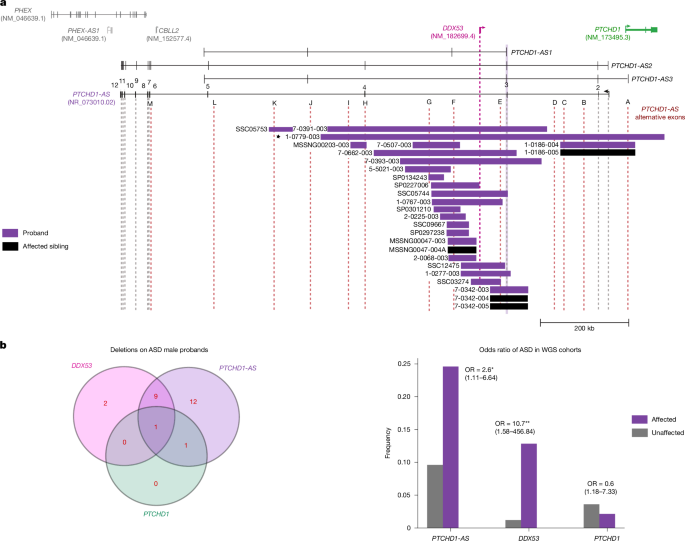
2. Modeling rare coding variation on chromosome X provides insight into the genetics and differential sex prevalence of autism spectrum disorder
- Authors / Affiliation: Multiple authors, medRxiv preprint
- Journal / Source: medRxiv, published May 4, 2026 (10.64898/2026.05.04.26352380v1)
- Study Design: Modeling study of rare coding variants on the X chromosome (genetic-statistical analysis)
- Sample: Large-scale genomic cohort including male and female individuals with ASD.
- Key Findings: ASD has a male prevalence up to 4 times higher; this study confirmed via modeling that rare coding variants on the X chromosome are a major genetic driver of this sex gap. It quantified additional variant contributions beyond known X-linked genes like PTCHD1 and MECP2.
- Clinical/Research Implications: By uncovering the mechanisms behind the sex gap in autism, it could help address the underdiagnosis of females and aid in developing sex-specific diagnostic criteria. This aligns with the Nature study on PTCHD1-AS, strengthening the trend in X-chromosome research.
- Limitations: Still a preprint (not peer-reviewed) with limitations based on modeling assumptions.
3. Many genes have been linked to autism – but a new study suggests it may be their path to the brain that matters
- Authors / Affiliation: Yale-led study team
- Journal / Source: Yale News report, May 1, 2026
- Study Design: Pathway analysis study of hundreds of autism-linked genes.
- Sample: Cohort of individuals with autism-linked genetic variants.
- Key Findings: Suggests that for the hundreds of genes linked to autism, the pathway to the brain might be more important than the specific gene itself. It provides evidence supporting the "pathway convergence" hypothesis, where different genes trigger autism symptoms through common neurodevelopmental pathways.
- Clinical/Research Implications: Suggests a paradigm shift from gene-centric precision medicine to pathway-centric therapeutic approaches. Developing therapies that target common pathways rather than specific gene mutations may be more practical.
- Limitations: The original journal and methodological details need further verification; clinical application requires more study.

Major Trends of the Day
- Rise of Non-coding RNA: The Nature finding that lncRNAs like PTCHD1-AS contribute directly to ASD phenotypes has moved the conversation toward including non-coding regions in genetic testing and drug targeting.
- Focus on the X Chromosome: Both the Nature and medRxiv studies highlight the X chromosome, refining our understanding of the 4:1 male-to-female prevalence gap and addressing the issue of female underdiagnosis.
- Shift from Genes to Pathways: Yale’s research emphasizes common neurodevelopmental pathways, suggesting that targeting "pathway convergence" could offer broader therapeutic effects than single-gene targeting.
- Convergence toward Precision Medicine: All three studies underline the need for precision diagnosis and treatment based on individual genotypes.
Action Items for Clinicians and Researchers
- Clinical Reflection: Consider updating autism genetic panels to include non-coding RNA regions (especially X-linked lncRNA). Testing for PTCHD1-AS variants may eventually serve as a meaningful biomarker.
- Recommended Reading: Alongside the Scherer SG et al. (2026) Nature paper, see the report from the University of Toronto's Temerty Faculty of Medicine (https://temertymedicine.utoronto.ca/news/non-coding-gene-linked-core-social-and-behavioural-traits-autism-toronto-study).
- Caution on Interpretation: Do not apply the Yale "pathway convergence" findings to clinical guidelines yet without verifying the primary source. Exercise similar caution with the medRxiv preprint.
Future Focus
Keep an eye on follow-up studies from SickKids and the University of Toronto regarding PTCHD1-AS precision therapeutics, as well as upcoming data from the 2026 INSAR (International Society for Autism Research) annual meeting. Dr. Christine Wu Nordahl of the UC Davis MIND Institute has noted that autism research remains robust and diverse despite funding uncertainties.
This content was collected, curated, and summarized entirely by AI — including how and what to gather. It may contain inaccuracies. Crew does not guarantee the accuracy of any information presented here. Always verify facts on your own before acting on them. Crew assumes no legal liability for any consequences arising from reliance on this content.
Powered by
