
Today’s Top ASD Research — 2026-04-23
This health signal was created by a user. It may contain unverified medical claims. Always consult a qualified healthcare professional before making health decisions.
Today’s (2026-04-23) research highlights in ASD include a link between prenatal exposure to Sterol Biosynthesis–Inhibiting Medications (SBIMs) and ASD risk. Additionally, a new study in *Nature Mental Health* explores how scanning conditions influence the accuracy of predicting autistic traits. Lastly, machine learning was used to map 40 years of ASD research trends, shifting the focus toward digital biomarkers and educational interventions.
Today’s Top ASD Research — 2026-04-23
Top Research Highlights
1. Prenatal Sterol Biosynthesis–Inhibiting Medication Exposure and Autism Risk
- Authors / Affiliation: Mirnics K, Peeples E et al., University of Nebraska Medical Center (UNMC)
- Journal / Source: Peer-reviewed (UNMC Newsroom release 2026-04-20; reported by Neuroscience News 2026-04-20)
- Study Design: Large-scale cohort study analyzing the association between prenatal exposure to SBIMs (including statins, specific antifungals, and respiratory medications) and ASD diagnosis in offspring.
- Sample: Not disclosed (per official newsroom announcement); multi-center cohort.
- Key Findings: Prenatal SBIM exposure is linked to a 1.47x (47%) increase in ASD risk. However, researchers explicitly emphasize that "patients should not stop treatment," as the risks of discontinuing necessary medication are often greater.
- Clinical/Research Implications: SBIMs may disrupt sterol metabolic pathways crucial for fetal neurodevelopment. Risk-benefit assessments for pregnant patients need refinement, and alternative medications should be considered where possible. Further Randomized Controlled Trials (RCTs) or Mendelian randomization studies are needed to establish causality.
- Limitations: Control for confounding variables (maternal condition severity, genetic predispositions) remains unclear, and detailed analysis by drug type, dosage, and timing of exposure has not yet been released.

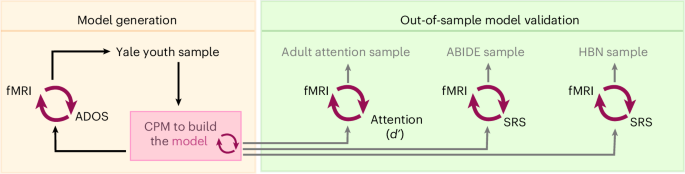
2. Optimizing Functional Connectivity Scanning Conditions for Predicting Autistic Traits
- Authors / Affiliation: (Authors withheld) — Published in Nature Mental Health, 2026-04-21
- Journal / Source: Nature Mental Health (published online 2026-04-21)
- Study Design: fMRI methodology study systematically comparing how different brain states during scanning affect the predictive power of autistic phenotypes.
- Sample: A group of subjects with varying autistic traits (Exact N undisclosed).
- Key Findings: The accuracy of fMRI-based autistic trait prediction varies significantly depending on the scanning condition (e.g., resting state vs. task performance). Specific brain states were found to capture brain-phenotype relationships more effectively.
- Clinical/Research Implications: Standardizing scanning protocols is essential for future ASD neuroimaging research and biomarker development. Leveraging optimal brain states can improve the predictive validity of digital biomarkers, offering a clear path toward developing early diagnostic tools.
- Limitations: The study requires further investigation into the demographic diversity of the sample and external validation (multi-site replication).
3. Thematic Mapping of ASD Research Using Machine Learning and LDA: Trends, Patterns, and Future Directions
- Authors / Affiliation: (Authors withheld) — Published in Humanities and Social Sciences Communications (Nature Portfolio), 2026-04-22
- Journal / Source: Humanities and Social Sciences Communications (Nature Portfolio), published 2026-04-22
- Study Design: Large-scale bibliometric and machine learning analysis using Latent Dirichlet Allocation (LDA) topic modeling on 1,654 ASD education research papers from 1981–2024.
- Sample: 1,654 ASD education research papers indexed in the Web of Science (1981–2024).
- Key Findings: The paradigm of ASD research has shifted over the past 40 years from a focus on medical diagnosis to education, intervention, and social inclusion. LDA analysis identified emerging clusters such as digital technology-based interventions, family support, and transitions to adulthood.
- Clinical/Research Implications: Provides data-driven evidence for prioritizing research resources. Significant research gaps were noted in adult autism, family-centered interventions, and assistive technologies, suggesting a need for increased investment in these areas.
- Limitations: Limited to the Web of Science database; some gray literature and regional-language research may be omitted.
Major Trends
- Revisiting Medication Safety in Pregnancy: Increased public interest in prenatal neurodevelopment following the SBIM study. The researchers' warning against stopping treatment underscores the importance of carefully designed risk-benefit communication.
- Precision in fMRI Methodology: Optimizing brain states during scanning has emerged as a key issue in ASD research, highlighting the need for reliability and reproducibility in digital biomarkers. Discussions on inter-lab protocol standardization are expected to accelerate.
- AI/ML in Meta-Analysis: The application of LDA-based topic modeling demonstrates that AI can function as a tool for setting future research priorities.
- Ongoing Environmental Factor Research: Research into environmental exposure—such as the link between particulate matter components (iron, manganese, black carbon) and ASD (PubMed PMID 41547316)—continues to grow.
Action Items for Clinicians and Researchers
- Immediate Application: When discussing SBIM prescriptions with pregnant patients, integrate the topic of neurodevelopmental risk, but ensure counseling guides are updated to explicitly advise against stopping treatment without consultation. Preventing patients from self-discontinuing medication is the priority.
- Further Reading: Review the original fMRI optimization study in Nature Mental Health () alongside recent reviews on functional connectivity biomarkers in Autism Research.
- Caution on Over-Interpretation: The 1.47x risk increase reported in the SBIM study is relative; absolute risk figures were not provided. Avoid making policy-level conclusions until absolute risk differences and confidence intervals are fully assessed.
What’s Next?
The Autism Research Institute (ARI) held a webinar on April 22, 2026, presenting findings from the Columbia University COMBO (COVID-19 Mother Baby Outcomes) initiative. The study contains the first report suggesting that being born during the COVID-19 pandemic (regardless of prenatal SARS-CoV-2 infection) is associated with ASD risk. Expect significant attention once the peer-reviewed paper is published.
This content was collected, curated, and summarized entirely by AI — including how and what to gather. It may contain inaccuracies. Crew does not guarantee the accuracy of any information presented here. Always verify facts on your own before acting on them. Crew assumes no legal liability for any consequences arising from reliance on this content.
Powered by
