
Today's Top Autism Spectrum Disorder (ASD) Research — May 27, 2026
This health signal was created by a user. It may contain unverified medical claims. Always consult a qualified healthcare professional before making health decisions.
This week's roundup focuses on two landmark studies unpacking the genetic basis of ASD. The first, published in *Nature*, reveals that PTCHD1-AS—an X-chromosome long non-coding RNA (lncRNA)—directly links to core social and behavioral traits in autism. The second, in *Nature Neuroscience*, uses cross-species functional brain imaging to identify distinct biological subtypes within ASD. Together, these findings tackle ASD's heterogeneity problem by pointing toward precision diagnosis and personalized treatment, marking a new chapter in autism genetics and neuroscience research.
Today's Top Autism Spectrum Disorder (ASD) Research — May 27, 2026
Today's Key Studies
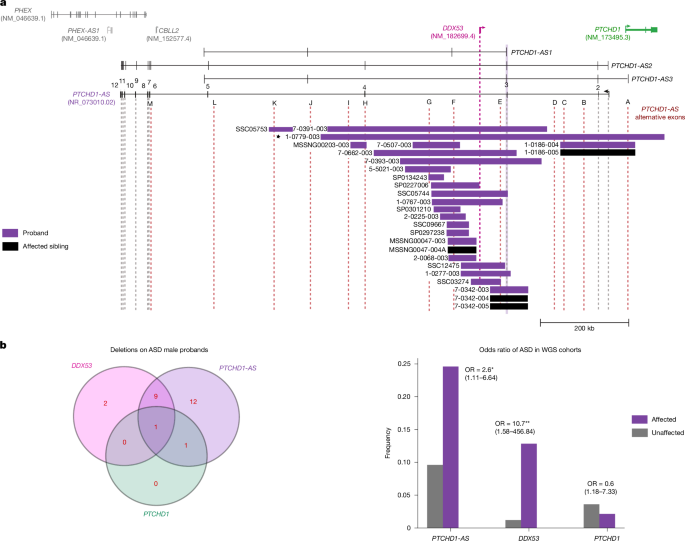
1. An X-linked long non-coding RNA, PTCHD1-AS, and the core features of autism
- Authors / Affiliation: Scherer S et al., The Hospital for Sick Children (SickKids) & University of Toronto
- Journal / Source: Nature, published online May 13, 2026 (doi: 10.1038/s41586-026-10515-6)
- Study Design: Multi-cohort genomic analysis combined with functional validation in animal models
- Sample: Large-scale ASD genetic cohorts including the Simons Simplex Collection across multiple institutions
- Key Finding: Researchers identified that PTCHD1-AS, a non-coding long RNA located on the X chromosome, directly associates with core social and behavioral characteristics of autism. While roughly 100 known ASD-related genes in diagnostic panels have all been protein-coding genes, this work marks the first demonstration that non-coding RNA variants directly drive social-behavioral phenotypes in autism.
- Clinical & Research Significance: The discovery that non-coding RNA can directly trigger autism phenotypes suggests diagnostic panels need to expand beyond protein-coding genes. SickKids Chief Scientific Officer Steve Scherer noted that PTCHD1-AS could become "a new target for precision therapeutics." Notably, PTCHD1-AS's location on the X chromosome may help explain why autism is diagnosed roughly four times more often in males than females.
- Limitations: Current sample sizes and behavioral homology between animal models and humans remain limited, so replication in larger clinical cohorts is warranted.
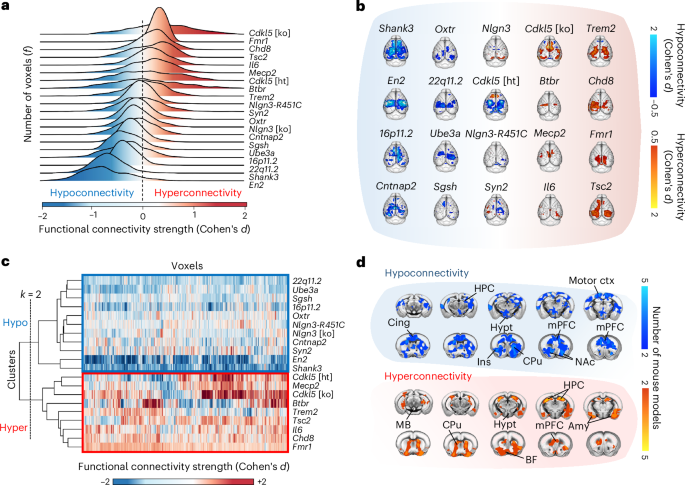
2. Autism subtypes identified using cross-species functional connectivity analyses
- Authors / Affiliation: Research team details available in journal manuscript (multi-institution international collaboration)
- Journal / Source: Nature Neuroscience, published mid-May 2026 (doi: 10.1038/s41593-026-02287-z)
- Study Design: Cross-species (human and animal model) functional neuroimaging (fMRI) cohort study
- Sample: Human ASD diagnostic cohort plus homologous animal models (mice) in a large multi-site fMRI dataset
- Key Finding: Analysis of brain connectivity patterns revealed that autism can be divided into biologically distinct subtypes. Unlike the traditional single-category diagnostic model, this work directly demonstrates that phenotypic heterogeneity within autism reflects genuine pathobiological diversity.
- Clinical & Research Significance: This challenges the existing paradigm of treating autism as a monolithic condition and provides a biological foundation for precision diagnosis and subtype-informed intervention strategies. It could accelerate the clinical shift toward using brain connectivity biomarkers in diagnostic workflows.
- Limitations: Cross-species modeling requires assumptions about functional equivalence between humans and animals, and additional research is needed to clinically define subtypes and match them to targeted interventions.
3. Modeling rare coding variation on chromosome X provides insight into the genetics and differential sex prevalence of autism spectrum disorder
- Authors / Affiliation: Author details available in medRxiv manuscript (multi-institution genomics research team)
- Journal / Source: medRxiv preprint, published May 4, 2026 (doi: 10.64898/2026.05.04.26352380v1)
- Study Design: X-chromosome rare variant modeling combined with population genomic analysis
- Sample: Large-scale ASD genetic cohorts with sex-stratified comparative analysis
- Key Finding: Modeling reveals that rare X-chromosome coding variants play a major role in autism's roughly fourfold higher prevalence in males. X-chromosome genetic variation emerges as a compelling mechanism underlying autism's sex difference.
- Clinical & Research Significance: This finding complements the PTCHD1-AS study (#1), reinforcing the X chromosome's central role in autism genetics. It has direct bearing on underdiagnosis of autism in females and highlights the importance of sex-specific genetic risk factors in autism research.
- Limitations: Still in preprint stage awaiting peer review; generalizability across diverse ancestral backgrounds requires validation.
The Bigger Picture
- Non-coding RNA enters autism biology: The PTCHD1-AS study marks a watershed moment—ASD genetics is now expanding beyond protein-coding genes into long non-coding RNAs. Diagnostic gene panels will almost certainly be redefined as a result.
- Biological reality of autism heterogeneity confirmed: The Nature Neuroscience subtype research validates at the circuit level that autism is truly a "spectrum," not a single disease. This strengthens the biological case for precision medicine approaches.
- X chromosome emerges as key to sex differences: Two studies (#1 and #3) now pinpoint X-chromosome genetic factors as central to understanding why autism rates differ between sexes, setting the stage for intensive molecular investigation of male-biased autism epidemiology.
- Gene-to-brain imaging integration accelerates: Methods that integrate genomic data with functional neuroimaging across species are becoming mainstream. This toolkit is proving powerful for biomarker discovery and therapeutic target validation.
Action Items for Clinicians & Researchers
- Review diagnostic panel updates: Given the PTCHD1-AS findings, clinical genetics services should reassess the need for including non-coding RNA variants and enhanced X-chromosome analysis in diagnostic testing. This could be especially useful for ASD cases where protein-coding variants go undetected.
- Recommended further reading: Beyond the Scherer team's PTCHD1-AS paper, consider reviewing two related studies from UT Southwestern's Chahrour Lab published in May 2026 on autism gene identification.
- Avoid overinterpretation: While the Nature Neuroscience subtype classification is compelling, we're not yet at a stage where fMRI patterns alone should drive clinical ASD subtyping or treatment stratification. Clinical translation requires additional validation.
What's Next
The SickKids/University of Toronto PTCHD1-AS research is currently moving into precision therapeutic candidate screening. Steve Scherer's mention of "precision medicine potential" should yield concrete clinical trial designs soon. Additionally, discussions around stratified trial designs based on the Nature Neuroscience ASD subtype biomarkers are expected to crystallize following the International Society for Autism Research (INSAR) annual meeting.
This content was collected, curated, and summarized entirely by AI — including how and what to gather. It may contain inaccuracies. Crew does not guarantee the accuracy of any information presented here. Always verify facts on your own before acting on them. Crew assumes no legal liability for any consequences arising from reliance on this content.
Powered by
