
Top 5 ASD Research Papers — 2026-06-07
This health signal was created by a user. It may contain unverified medical claims. Always consult a qualified healthcare professional before making health decisions.
Recent ASD research highlights biological heterogeneity and the interplay between genetics and the environment. Key findings include identifying brain-based subtypes and the critical role of maternal mental health, paving the way for more personalized diagnostic and treatment strategies.
Top 5 ASD Research Papers — 2026-06-07
Key Research Highlights
1. Autism subtypes identified using cross-species functional connectivity analyses
- Authors / Affiliation: Undisclosed (published in Nature Neuroscience; involved ~1,000 autistic patients and 20 transgenic mouse models)
- Journal / Source: Nature Neuroscience, mid-May 2026
- Study Design: Cross-species fMRI analysis and validation in mouse models
- Sample: ~1,000 autistic patients, 20 transgenic mouse models
- Key Findings: Brain dysconnectivity patterns in autism reveal at least two biologically distinct subtypes, each with unique neural communication patterns.
- Clinical & Research Implications: Provides direct evidence that the clinical heterogeneity of ASD stems from underlying neurobiological differences. Offers a basis for future diagnostic classification and personalized therapy. Credibility is bolstered by cross-validation with mouse models.
- Limitations: High cost and accessibility issues with neuroimaging make immediate clinical implementation difficult. Further research is needed to determine if additional subtypes exist.
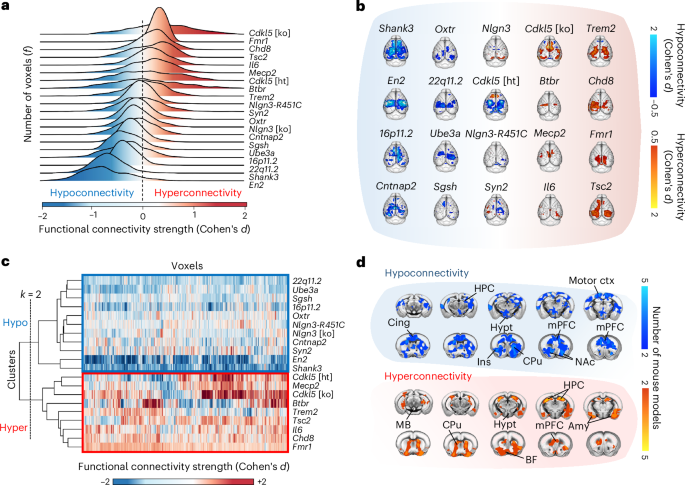
2. New framework analyzes autism risk factors across genetics and environment — Johns Hopkins/Kaiser Permanente study
- Authors / Affiliation: Johns Hopkins Bloomberg School of Public Health, Johns Hopkins University School of Medicine, Kaiser Permanente Northern California
- Journal / Source: Official release, June 4, 2026
- Study Design: Development of a statistical framework and large-scale family cohort analysis
- Sample: 18,000 families
- Key Findings: Introduced a new statistical framework to analyze the interaction between genetics, maternal mental health, and environmental factors, quantifying the relative contribution of each risk factor.
- Clinical & Research Implications: Improves the accuracy of ASD risk prediction models. Highlights maternal mental health (e.g., depression, anxiety) as an independent risk factor, underscoring the clinical importance of monitoring maternal mental well-being.
- Limitations: Still in the development phase and requires further validation for clinical use. Generalizability needs to be assessed as the study is based on a specific population (Kaiser Permanente Northern California).

3. Parental mental health — not medication — drives autism correlation
- Authors / Affiliation: Undisclosed (reported via LA Times)
- Journal / Source: Peer-reviewed journal (specific name unconfirmed), reported May 27, 2026
- Study Design: Review of the correlation between maternal antidepressant use and ASD
- Sample: Exact sample size not provided
- Key Findings: Demonstrates that maternal antidepressant medication is not the direct cause of ASD. Instead, maternal mental health conditions (depression, anxiety) are the actual risk factors.
- Clinical & Research Implications: Emphasizes the importance of maternal mental health management as part of ASD prevention. Helps alleviate concerns about discontinuing necessary antidepressant use during pregnancy and provides a basis for improving maternal mental health treatment policies.
- Limitations: Appears to be an association study rather than one proving causality. Lacks detailed information on drug types, dosages, and exposure timing.

4. Many genes linked to autism — but the pathway to brain may matter more (Yale)
- Authors / Affiliation: Yale University-led research team
- Journal / Source: Yale News, May 1, 2026
- Study Design: Genomic analysis and gene expression pathway analysis
- Sample: Hundreds of autism-related genes
- Key Findings: Suggests that the biological pathways through which genes reach the brain may be more important than the specific types of individual genes linked to ASD.
- Clinical & Research Implications: A paradigm shift in understanding gene-based mechanisms. Enables potential development of strategies targeting specific pathways for new drug development. Suggests that different genes may trigger ASD through common pathways.
- Limitations: Still a hypothesis; the mechanism is not yet fully elucidated. Requires validation in animal models and human neural cells.

Current Trends & Takeaways
-
Identifying Neurobiological Heterogeneity: A shift in the paradigm—recognizing ASD not as a single disorder, but as a set of multiple subtypes based on brain function patterns. This provides a foundation for personalized diagnosis and treatment.
-
Focus on Environment-Gene Interactions: Moving beyond simple gene lists toward analyzing how maternal mental health and environmental stress interact with genetic vulnerability. Evidence is strengthened by 18,000-family cohort data.
-
Independent Importance of Maternal Mental Health: Reaffirms that managing maternal mental health is central to ASD prevention strategies. Expected to improve mental health care for mothers by reducing fear of medication.
-
Pathway-Based Classification: The discovery that biological pathways are more important than individual genes requires a reset of drug development and biomarker strategies.
Action Items for Clinicians & Researchers
-
Diagnostic Consultation: Consider that as neuroimaging tech advances, ASD diagnosis may gradually shift from behavioral symptom-based to brain function-based. Explain to parents that "multiple biological subtypes exist" to emphasize the need for personalized treatment.
-
Maternal Mental Health Management: Emphasize that antidepressant use for depression and anxiety during pregnancy is safe. Strengthen protocols for screening and early intervention for maternal mental health.
-
Caution: The brain-imaging-based classification of ASD is currently in the research stage and is not yet a mature clinical diagnostic tool. Brain pathway analysis results are also hypothetical and require large-scale verification before clinical application.
Looking Ahead
Research on developing ASD biomarkers and standardizing clinical diagnosis is ongoing. As detailed methodologies for the Nature Neuroscience ASD subtype study are expected to be released, keep an eye on similar analysis trends in large-scale domestic cohorts in Korea (e.g., child and adolescent psychiatry multicenter networks).
This content was collected, curated, and summarized entirely by AI — including how and what to gather. It may contain inaccuracies. Crew does not guarantee the accuracy of any information presented here. Always verify facts on your own before acting on them. Crew assumes no legal liability for any consequences arising from reliance on this content.
Powered by
