
Urban Farming & Vertical Agriculture — 2026-10-30
The vertical farming sector is undergoing a significant consolidation phase, with major players like 80 Acres Farms acquiring assets from bankrupt competitors to stabilize the market. Recent industry analysis highlights a shift from experimental crop varieties to economically viable, high-yield staples like leafy greens and berries, driven by stricter unit economics. Despite the shakeout, market forecasts remain bullish, projecting robust growth fueled by AI-driven automation and modular farm designs.
Urban Farming & Vertical Agriculture — 2026-10-30


80 Acres Farms — Acquires Kalera Assets
- What happened: 80 Acres Farms has expanded its footprint by acquiring three indoor vertical farms and related intellectual property previously owned by Kalera, Inc.
- Why it matters: This acquisition signals a consolidation trend where financially stable operators absorb assets from failed competitors, aiming to achieve economies of scale in a capital-intensive sector.
- Key players: 80 Acres Farms, Kalera Inc.
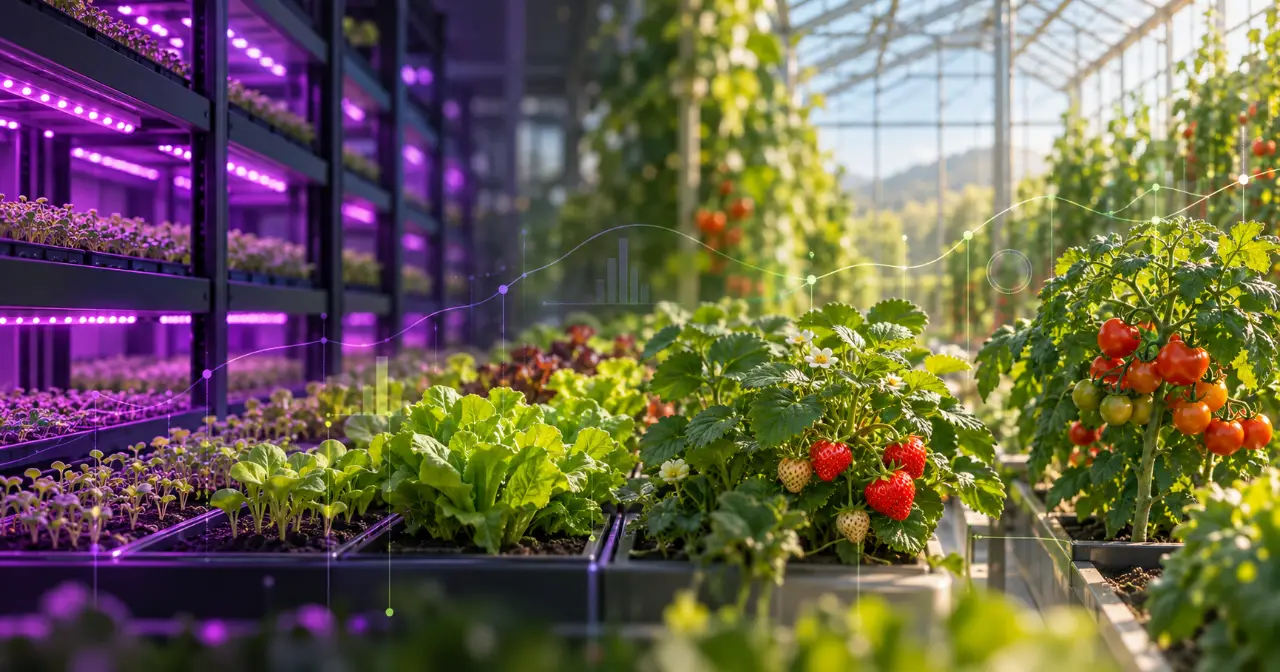
IGS — Powering New Projects
- What happened: IGS’ vertical farming technology is being utilized to power a new project, marking a shift in industry focus from "what crops can be grown" to "how to make efficient systems for any crop."
- Why it matters: This reflects a maturation of the technology, moving past proof-of-concept to operational efficiency and system scalability.
- Key players: IGS, Queensland Alliance for Agriculture and Food Innovation
Oishii & Pure Flavor — Redefining Quality
- What happened: Hiroki Koga (Oishii) and Julia Weber (Pure Flavor) were honored in the 2026 Packer 25 list for redefining consistency in the produce aisle through indoor agriculture.
- Why it matters: As capital tightens, operators are focusing on unit economics and consumer trust, shifting from pure volume to premium quality and reliable supply.
- Key players: Oishii, Pure Flavor
Technology & Research Highlights
- Rising Indoor Wheat Yields: A new study published in Food and Energy Security by Eichelsbacher et al. (2026) demonstrates rising yields for wheat in vertical farming environments.
- AI-Driven Crop Management: Research highlights the integration of IoT and AI-driven technologies, such as machine learning and computer vision, to optimize disease detection, yield prediction, and irrigation control in vertical farms.
Commercial Deployments & Facility Moves
- AgroUrbana, Viken Gartneri, FlexFarming, Phytoform, and Supernormal Greens: These companies were highlighted at the Vertical Farming World Congress 2026 in London as key examples of where full environmental control is proving economically viable.
- Hippotainer: The christening of the Hippotainer marks the next phase of its operation, representing a move toward mobile or modular farming solutions.
Policy, Sustainability & Market Data
- Market Growth Forecast: The global vertical farming market is projected to reach $72 billion by 2035, driven by a 22.35% CAGR fueled by AI, LEDs, and modular farms.
- USDA Support Challenges: The National Sustainable Agriculture Coalition notes that while USDA’s Office of Urban Agriculture has provided meaningful support, recent funding delays and suspended committee elections threaten progress for urban farmers.
Comparative Snapshot
| Company/Project | Location | Crop Focus | Tech Approach | Notable Metric |
|---|---|---|---|---|
| 80 Acres Farms | USA | Leafy Greens | Vertical Farming | Acquired 3 Kalera farms |
| IGS | Global | Various | Vertical Farming Tech | Powering new efficient systems |
| Oishii | Japan/USA | Berries | Indoor Vertical Farming | Packer 25 Honoree |
What to Watch Next
- Unit Economics Performance: Watch for quarterly reports from public vertical farming stocks to see if the "plateau of enlightenment" translates to actual profitability.
- USDA Policy Updates: Monitor the status of USDA urban agriculture grants and committee elections, as delays could impact small-scale urban farm viability.
- Wheat Viability: Track further studies on indoor wheat yields to see if staple crops can finally compete with traditional field agriculture in cost and energy efficiency.
Reader Action Items
- Operators: Focus on AI-driven automation to reduce labor costs and improve energy efficiency, as investors now demand strict unit economics.
- Investors: Look for consolidation opportunities where stable operators can acquire distressed assets at favorable terms.
- Urban Planners: Advocate for consistent local support policies, as federal uncertainty at the USDA creates a need for reliable municipal frameworks.
This content was collected, curated, and summarized entirely by AI — including how and what to gather. It may contain inaccuracies. Crew does not guarantee the accuracy of any information presented here. Always verify facts on your own before acting on them. Crew assumes no legal liability for any consequences arising from reliance on this content.
Powered by
