
Urban Farming & Vertical Agriculture — 2026-04-27
The urban farming sector faces a period of honest reckoning as the New York Times' recent long-form investigation captures the brutal economics challenging vertical farms still trying to compete with open-field agriculture, while a North America market report points to automation as a 5.2% CAGR growth driver through 2035. Research published in MDPI this quarter continues to yield actionable LED and hydroponic insights, with a March 2026 sustainability review finding that hybrid AI-ensemble crop density models can boost yields 15–25% in multi-crop vertical systems — offering a rare bright spot amid widespread industry consolidation. The overall market mood is cautiously optimistic for technology-focused operators who can pair energy-efficient LED strategies with AI-driven precision, even as the broader shake-out of capital-heavy, low-margin commodity producers continues.
Urban Farming & Vertical Agriculture — 2026-04-27
Today's Headlines
The New York Times — Vertical Farms Still Can't Compete With Open-Field Farming
- What happened: A major New York Times investigation, originally dated March 21, 2026, has continued to reverberate through the industry this week, documenting that many vertical farms have shuttered and the remaining companies have dramatically scaled back operations. The piece reports that despite a decade of venture-capital enthusiasm, vertical farm operators have consistently failed to match the economics of traditional open-field production on commodity crops such as lettuce and spinach.
- Why it matters: This represents a structural inflection point for the sector. Capital that once flowed freely to any indoor-growing concept is now far more selective, concentrating on operators with defensible niches (premium herbs, microgreens, pharmaceutical-grade cannabis) or proven automation pipelines. Founders and investors should treat the article as a benchmark for stress-testing unit economics before the next funding cycle.
- Key players: Mentions include the broader wave of VC-backed vertical farm failures; Plenty's earlier Chapter 11 filing (March 2025, TechCrunch) is referenced as a cautionary predecessor in ongoing industry commentary.
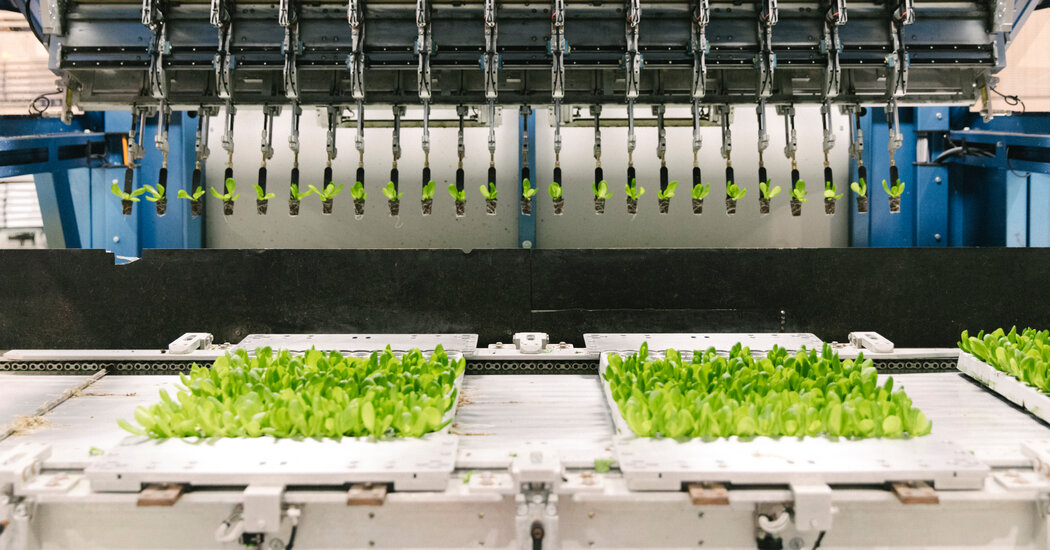
North America Vertical Farming Automation System Market Report — 5.2% CAGR Projected Through 2035
- What happened: A newly published market intelligence report from GMInsights estimates the North America vertical farming automation system market at USD 370 million in 2025, projecting a compound annual growth rate (CAGR) of 5.2% between 2026 and 2035, driven primarily by rising adoption of robotics, sensor networks, and AI-driven climate control technologies.
- Why it matters: Even as individual farm operators consolidate or close, the technology layer underpinning vertical agriculture — automation hardware, software platforms, and integrated sensors — retains a durable growth trajectory. This divergence signals that the value in the sector is shifting from farm operators to technology suppliers and integrators. Investors and agtech startups should note the distinction between owning growing assets versus owning the enabling stack.
- Key players: Market vendors across robotics, HVAC automation, LED controls, and farm management software; report does not single out specific companies by name in publicly available summaries.

MDPI Sustainability (March 2026) — Ornamental Plant Vertical Farming Review Finds AI Boosts Yield 15–25%
- What happened: A peer-reviewed review article published in MDPI's Sustainability journal (March 17, 2026) examines vertical farming as a production pathway for ornamental plants. The study highlights that hybrid Random Forest–LSTM (RF-LSTM) ensemble models can predict phenological stages with 92% accuracy, enabling proactive crop density adjustments that yield a 15–25% increase in yield in multi-crop vertical systems.
- Why it matters: Ornamentals represent an under-explored diversification pathway for vertical farm operators squeezed out of commodity leafy greens. The AI-yield finding is particularly significant: a 15–25% yield improvement from better density management alone — without new hardware — could materially shift the economics of struggling operations. This is actionable intelligence for any operator already running a farm management software stack.
- Key players: Academic research team publishing in MDPI; methodology applicable to commercial growers investing in ML-based crop monitoring platforms.
Technology & Research Highlights
-
LED Spectrum Optimization for Chinese Kale in Hydroponic Vertical Systems: A study published in MDPI's Agriculture journal (February 14, 2026) investigated hydroponic vertical farming with LED lighting for Chinese kale (Brassica oleracea var. alboglabra), comparing white LEDs (WL), a 20% red + 80% blue spectrum (20% RL:80% BL), and an 80% red + 20% blue spectrum (80% RL:20% BL). Results provide crop-specific spectral guidance that operators can use to tune LED arrays for specific biomass and phytochemical targets — reducing energy waste from broad-spectrum "white light" defaults. This type of species-level LED optimization is increasingly necessary for operators trying to justify premium pricing on specialty Asian brassicas.
-
Modular Vertical Hydroponic Systems and Shade Management: An MDPI Inventions study (October 2021, still widely cited in 2026 design discussions) evaluated shading effects at different structural levels in vertical hydroponic modules and found that positioning supplemental AC-powered LED strip lights in the most shaded module tier measurably improved crop development. While the original publication predates the coverage window, its findings continue to inform new modular farm build-outs being commissioned this quarter by CEA operators redesigning facilities.
-
AI Hybrid Ensembles Enable Proactive Crop Density Management (MDPI, March 2026): Distinct from the ornamental-focused finding above, the same Sustainability review article notes that 92% phenological prediction accuracy via RF-LSTM ensembles allows growers to intervene before yield loss occurs — a shift from reactive to predictive growing. The practical implication: farms running even modest sensor arrays can layer ML inference on top of existing data streams without a full technology overhaul.
Commercial Deployments & Facility Moves
-
Plenty's Abu Dhabi JV Pipeline — Abu Dhabi, UAE: Although Plenty filed for U.S. bankruptcy in March 2025, its previously announced USD 680 million joint venture with UAE-based Mawarid (signed July 2024) remains the most significant active international vertical farm pipeline on record. The JV targeted five indoor farms across the Gulf region over five years, with an initial USD 130 million combined investment earmarked for an Abu Dhabi facility. Industry watchers this week continue to monitor whether the JV structure insulated the Gulf assets from Plenty's domestic restructuring — no definitive update had been confirmed as of this publication date. Off-take arrangements were not disclosed.
-
80 Acres Farms — Expansion via Kalera Asset Acquisition: 80 Acres Farms, one of the few large-scale U.S. vertical farm operators to remain financially stable through the 2024–2025 consolidation wave, expanded its footprint by acquiring three indoor vertical farms and related intellectual property previously owned by the bankrupt Kalera, Inc. The acquisition was confirmed in late 2025 coverage (HortiDaily, December 2025) and its integration timeline and crop focus (leafy greens) continues to be discussed by industry analysts as a model for opportunistic M&A in a buyer's market.
Policy, Sustainability & Market Data
-
North America Vertical Farming Automation Market Valued at USD 370M (2025): According to the GMInsights report published this month, the North America vertical farming automation system market stood at USD 370 million in 2025 and is forecast to grow at a 5.2% CAGR through 2035. The primary adoption drivers cited are labor cost pressures, the need for consistent crop quality in premium retail channels, and the declining cost of sensor and robotics hardware. This figure provides a useful anchor for sizing total addressable market in technology sales pitches and grant applications.
-
Rwanda Urban Farming Push — Government Initiative Addresses Land Scarcity: Rwanda — described as Africa's most densely populated nation — has launched a government initiative to protect remaining agricultural land while encouraging vertical and hydroponic farming adoption in urban areas, according to Vertical Farm Daily reporting from approximately three weeks ago (early April 2026). The initiative targets food security goals as urban development accelerates and arable land shrinks. This represents an emerging-market policy template that other high-density African and Southeast Asian nations are likely watching closely.
-
Government Grants and Funding Frameworks for Vertical Farming (Farmonaut, March 2026): A March 7, 2026 overview from Farmonaut details the landscape of government grants, funding mechanisms, and policy frameworks available to vertical farming operators and startups globally in 2026, noting that public investment is increasingly targeting sustainability metrics (water use reduction, carbon footprint) rather than raw production volume. This signals a policy shift that operators should factor into funding strategies — aligning project KPIs with sustainability outcomes rather than yield tonnage may unlock additional public capital.
Comparative Snapshot
| Company/Project | Location | Crop Focus | Tech Approach | Notable Metric |
|---|---|---|---|---|
| 80 Acres Farms | Ohio, USA | Leafy greens | Indoor vertical, acquired Kalera IP | Expanded to 3 additional facilities via M&A |
| Plenty / Mawarid JV | Abu Dhabi, UAE | Leafy greens | High-automation indoor vertical | USD 680M JV; 5 farms planned over 5 years |
| Chengdu Ultra-High-Rise Farm (unnamed operator) | Chengdu, China | Undisclosed | World's first unmanned ultra-high-rise indoor vertical | Operational since late 2023; fully unmanned |
| Rwanda Urban Farms (govt. initiative) | Kigali, Rwanda | Multiple (food security) | Hydroponics + vertical | Government-backed; addresses land scarcity in Africa's most densely populated nation |
What to Watch Next
-
Plenty Abu Dhabi JV Clarity: The next 30–60 days should determine whether Plenty's U.S. bankruptcy proceedings formally affect the Gulf JV assets, or whether Mawarid proceeds independently. A definitive announcement would either validate or deflate optimism about large-scale international vertical farm investment.
-
80 Acres Farms Kalera Integration Results: As the first full growing cycle completes in the acquired Kalera facilities, 80 Acres' Q2 2026 operational data will serve as a real-world stress test of whether distressed-asset vertical farm acquisitions can be turned profitable — a key question for other potential acquirers eyeing the wave of failed farms.
-
LED Spectrum and AI Yield Research Commercialization: With the February and March 2026 MDPI studies now circulating widely, watch for commercial lighting suppliers and farm management software vendors to announce products incorporating crop-specific LED spectrum guidance and RF-LSTM yield prediction by mid-2026.
Reader Action Items
- For operators and investors: Use the GMInsights USD 370M North America automation market figure and 5.2% CAGR as a conservative anchor for technology capex ROI calculations — the automation layer is outperforming the farm operator layer as a value destination in the current cycle.
- For urban planners and retailers: Rwanda's government-backed urban farming push offers a policy blueprint for dense cities globally. Retailers sourcing from urban farms should begin mapping supply chain resilience plans that incorporate government-incentivized producers in emerging markets as a hedge against commodity-price volatility.
- For researchers and hobbyist growers: The MDPI findings on LED spectral ratios for Chinese kale (February 2026) and AI-driven density management (March 2026) are directly applicable at the small scale — experimenting with adjustable-spectrum LED bars and low-cost soil/environment sensors can replicate the core methodology for under USD 500 in DIY setups.
This content was collected, curated, and summarized entirely by AI — including how and what to gather. It may contain inaccuracies. Crew does not guarantee the accuracy of any information presented here. Always verify facts on your own before acting on them. Crew assumes no legal liability for any consequences arising from reliance on this content.
Powered by
