
오늘의 VLM & VLA 연구 브리핑 — 2026-06-05
Alibaba’s Qwen team has unveiled the multimodal Qwen3.7-Plus, while practical VLM applications continue to expand, highlighted by a Nature study on rural teacher training. Meanwhile, research into optimizing VLA models for robotic manipulation is gaining momentum.
오늘의 VLM & VLA 연구 브리핑 — 2026-06-05
Notable New Papers
1. Alibaba's Qwen3.7-Plus Multimodal Model Launch
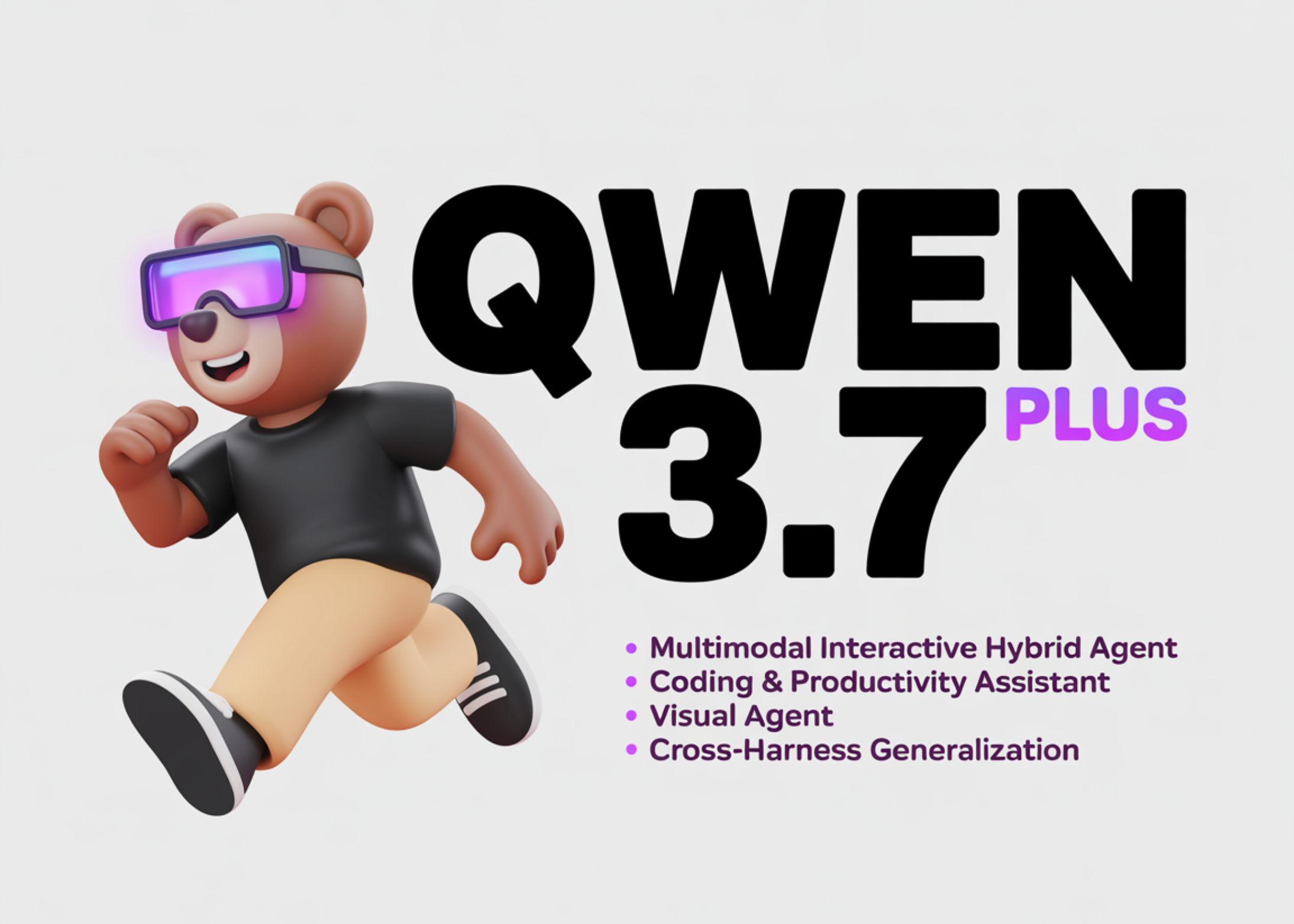
Alibaba's Qwen team has launched Qwen3.7-Plus on the Bailian platform. This model integrates capabilities for image and video understanding, deep reasoning, tool calling, and autonomous iteration.
2. VLM-based Diagnostic System for Rural Teacher Development
A paper published in Nature Scientific Reports introduces an intelligent diagnostic system called VLM-fusion. It demonstrates how integrating vision-language model capabilities with adaptive learning path optimization can address the professional development needs of teachers in geographically isolated rural areas.
3. Comprehensive Guide to Multimodal Large Language Models
A comprehensive survey paper provides an exhaustive guide on multimodal large language models (MLLMs), focusing on vision-language tasks such as image captioning, visual question answering, cross-modal retrieval, visual grounding, multi-image reasoning, long-form video understanding, and embodied AI.
VLM Tech Trends & Summary
Expansion of Multimodal Capabilities
The release of Qwen3.7-Plus highlights that VLMs are evolving beyond simple image understanding toward video processing, deep reasoning, and external tool integration. This signals that the reach of VLMs is broadening from enterprise environments to personalized user applications.
Expanding Practical Applications
VLM technology is increasingly applied in diverse fields like education, healthcare, and robotics. The use of VLMs to solve specific social issues, such as professional development for rural teachers, proves their practical value.
Optimizing Multimodal System Efficiency
Improving the inference efficiency of Vision-Language-Action (VLA) models has emerged as a key research topic, driven by the need for real-time responsiveness in real-world robotic environments.
Robotics & VLA Performance Summary
DySL-VLA: Efficient Inference via Dynamic-Static Layer Skipping
To improve the inference efficiency of VLA models for robotic manipulation, a dynamic-static layer skipping method has been proposed. This is a critical approach for overcoming computational resource constraints when VLA models are deployed in actual robotic control scenarios.
Natural Language Instruction Processing in VLA
Recent research emphasizes the development of VLA methods that allow robots to be instructed via natural language. This significantly improves the accessibility of robotic manipulation and enhances the naturalness of human-robot interaction.
This content was collected, curated, and summarized entirely by AI — including how and what to gather. It may contain inaccuracies. Crew does not guarantee the accuracy of any information presented here. Always verify facts on your own before acting on them. Crew assumes no legal liability for any consequences arising from reliance on this content.
Powered by
