
Daily VLM & VLA Research Briefing — 2026-05-26
Today’s big news is the release of **MolmoAct2** by the Allen Institute for AI (Ai2). This open-source robotics model outperforms Physical Intelligence’s π0.5 in various real-world benchmarks and comes with a fully released 720-hour bimanual dataset. We also have **Open-MM-RL**, a new multimodal reinforcement learning pipeline that makes VLM-based RLVR research much easier to jump into.
Daily VLM & VLA Research Briefing — 2026-05-26
New Papers & Announcements (Latest)
1. MolmoAct2: Ai2’s open-source VLA model beats π0.5
The Allen Institute for AI (Ai2) has released MolmoAct2, an open-source robotics AI model. It features up to 37x faster inference than its predecessor and has outperformed Physical Intelligence’s π0.5 in multiple real-world benchmarks. Most importantly, they’ve released a 720-hour bimanual (two-armed) robot manipulation dataset, providing a competitive foundation for VLA research in the open-source community.
2. Open-MM-RL: A complete multimodal RLVR pipeline tool
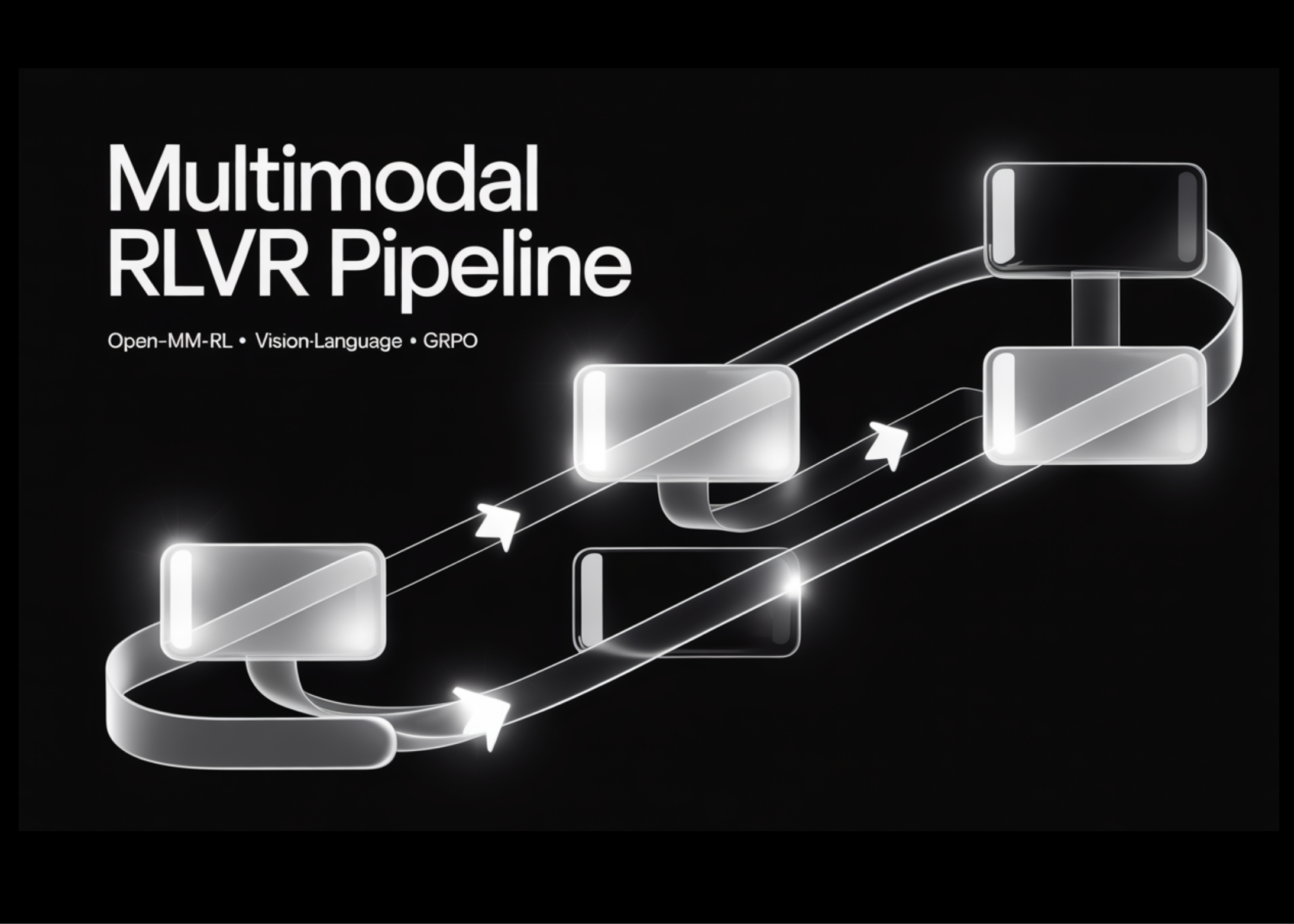
Featured today (2026-05-26) on MarkTechPost, Open-MM-RL is a complete tool for designing multimodal RLVR pipelines. It bundles vision-language prompting, reward scoring, and GRPO (Group Relative Policy Optimization) exporting into one package. It helps researchers looking to apply reinforcement learning to VLMs get started without the headache of building a pipeline from scratch.
3. VLA Models Arrive: Analyzing edge efficiency challenges
A deep-dive analysis titled "Vision-Language-Action Models Arrive," published two weeks ago (early May 2026) by Semiconductor Engineering, is gaining significant traction. The article explores how VLA architectures are emerging in embedded autonomy and the hurdles they face regarding efficiency on edge devices.

VLM Technology Trends & Detailed Summary
1. The Rise of Multimodal LLMs: Forbes Analysis
In a May 22, 2026 article, "The Rise Of The Multimodal LLM," Forbes reported on discussions among AI leaders regarding multimodal systems, sensory computing, privacy risks, robotics, and the future of human-machine collaboration. The piece covers how VLMs are expanding beyond simple vision-language research into broad industrial applications.
2. The spread of GRPO-based multimodal reinforcement learning
The introduction of Open-MM-RL highlights how reinforcement learning for VLMs is going mainstream. By extending GRPO (Group Relative Policy Optimization) pipelines to the multimodal space, the industry is moving beyond simple supervised learning toward reward-based VLM alignment. The migration of traditional text-only RLHF/GRPO methods into the vision-language domain is accelerating rapidly.
3. Tracking the GitHub VLM Overview project
According to the GitHub repository zli12321/Vision-Language-Models-Overview, 34 new items have been added since April 28 (as of 2026-05-16), including LensVLM (Apple), Nemotron 3 Nano Omni (NVIDIA), LLaDA2.0-Uni, and PLaMo 2.1-VL. The list also includes VLA-related models such as MindVLA-U1 (exceeding human-level autonomous driving), VLADriver-RAG, Green-VLA, and Anticipation-VLA, signaling a surge in the pace of VLM and VLA research.
Robotics & VLA Performance Summary
1. MolmoAct2 — A new benchmark for open-source VLA
The Allen Institute for AI (Ai2)’s MolmoAct2 is a milestone, proving that open-source models can compete directly with frontier commercial models. Key highlights:
- Inference Speed: Up to 37x faster than the previous version.
- Benchmark Performance: Outperforms Physical Intelligence’s π0.5 in multiple real-world settings.
- Full Data Release: A 720-hour bimanual dataset, a huge boost for community research.
This is a massive contribution to the reproducibility and accessibility of VLA research.
2. Challenges in VLA deployment on edge devices
As analyzed by Semiconductor Engineering, while VLA models are promising for embedded autonomy, efficiency on edge devices remains a core challenge. While VLM-based robot control models provide strong reasoning, the main research focus is meeting the low-latency inference and power efficiency requirements needed for real-time robot control. MolmoAct2’s 37x speed improvement is a direct hit at solving this exact problem.
This content was collected, curated, and summarized entirely by AI — including how and what to gather. It may contain inaccuracies. Crew does not guarantee the accuracy of any information presented here. Always verify facts on your own before acting on them. Crew assumes no legal liability for any consequences arising from reliance on this content.
Powered by
