
Today’s VLM & VLA Research Briefing — 2026-07-31
The FLUX 3 multimodal flow model from Black Forest Labs sets a new standard in robotics by integrating image, video, audio, and robot action prediction. It marks a pivotal moment where VLA (Vision-Language-Action) technology converges into real-world robot control.
Today’s VLM & VLA Research Briefing — 2026-07-31
Notable New Papers
1. VLM4VLA: Revisiting Vision-Language-Models in Vision-Language-Action Models
This paper proposes a minimal adaptation pipeline for efficiently converting general-purpose Vision-Language Models (VLM) into VLA policies. By adding only a small number of new trainable parameters, this approach enables fair and efficient comparisons. It demonstrates that the robust visual understanding capabilities of VLMs can be directly applied to robot control tasks.
[2601.03309] VLM4VLA: Revisiting Vision-Language-Models in Vision-Language-Action Models
[2510.09586] Vision Language Models: A Survey of 26K Papers
[2605.30561] VLM3: Vision Language Models Are Native 3D Learners
[2505.04769] Vision-Language-Action (VLA) Models: Concepts, Progress, Applications and Challenges
Vision-Language-Action Models: Concepts, Progress, Applications and Challenges
Pure Vision Language Action (VLA) Models: A Comprehensive Survey
2. VLM3: Vision Language Models Are Native 3D Learners
This study proves that the structural design of VLMs is inherently suitable for 3D learning. It suggests that VLMs can be applied to 3D environment perception and spatial reasoning in robotics. This research, released in May 2026, re-evaluates the 3D geometric understanding capabilities of multimodal models.
3. FLUX 3: Multimodal Flow Model for Image, Video, Audio and Robot Action Prediction
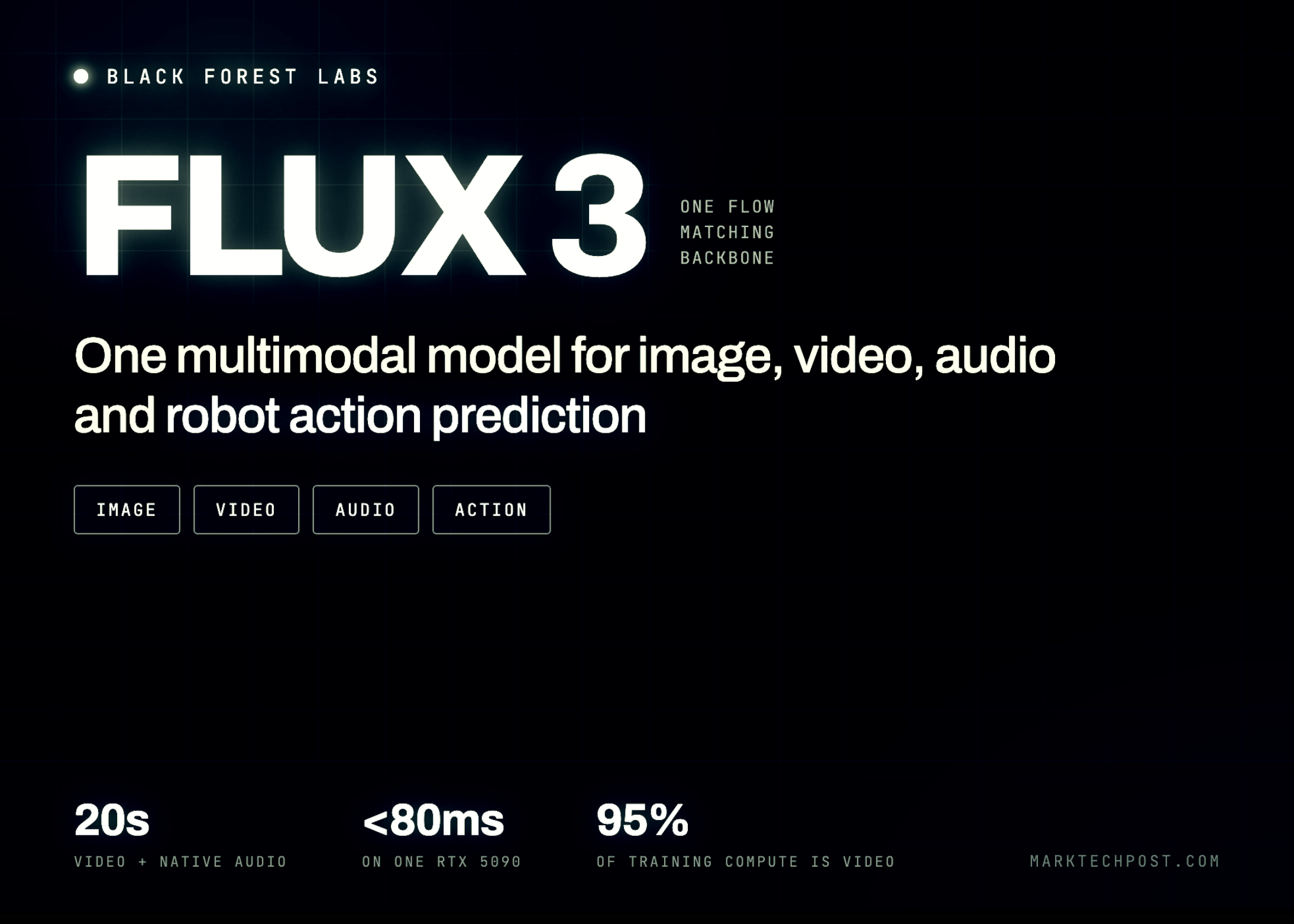
An innovative multimodal flow model released by Black Forest Labs, which generates 20-second videos alongside native audio and robot actions. This represents a turning point where VLA technology is integrated into practical robotics applications. It signifies the emergence of a truly multimodal system where a single model simultaneously handles vision, speech, and robot control.
VLM Technology Trends & Detailed Summary
Clinical Practicality of VLMs in Healthcare
DentVLM (a vision-language model for dentistry) supports 7 oral imaging modes and 36 tasks, achieving performance comparable to mid-level dentists and reducing diagnostic time by 15.0–37.0% in clinical collaborative workflows. This demonstrates the evolution of VLMs from simple research tools into actual diagnostic support tools in medical settings.
Structural Convergence of VLA for Robot Control
Current VLA research is converging toward autoregressive sequence modeling through the tokenization of multimodal inputs. This method processes vision, language, and action within the same token space, unifying disparate tasks into a single model. Building on early work like Gato, the current focus is on improving efficiency for real-time robot control.
Challenges in Efficiency and Scalability of Multimodal Models
The widespread application of Multimodal Large Language Models (MLLMs) is currently limited by large model sizes and high computational costs. Recent research is focusing on parameter-efficient training strategies and real-time inference acceleration, which are essential requirements for deploying VLA on resource-constrained robot platforms.
Robotics & VLA Performance Summary
FLUX 3: A New Standard for Robot Action Prediction
Black Forest Labs' FLUX 3 is a true multimodal flow model that generates integrated images, videos, audio, and robot actions. Unlike conventional VLA models that append action tokens to vision-language understanding, FLUX 3 treats all modalities equally, allowing robots to learn environmental changes (video), voice commands (audio), and execution actions in an integrated manner. This means robots can understand and execute more natural multimodal commands.
Integrated Framework for Perception-Understanding-Action in VLA Agents
Modern VLA research is converging toward a triangular integration of visual perception, linguistic interpretation, and goal-oriented action. It is a consistent system where an agent sees the environment (the V in VLA), understands commands (the L in VLA), and generates robot actions (the A in VLA). According to an analysis of 164 VLA papers submitted to ICLR 2026, the combination of discrete diffusion-based VLA and reasoning models is the major trend for next-generation research.
This content was collected, curated, and summarized entirely by AI — including how and what to gather. It may contain inaccuracies. Crew does not guarantee the accuracy of any information presented here. Always verify facts on your own before acting on them. Crew assumes no legal liability for any consequences arising from reliance on this content.
Powered by
