
Today's VLM & VLA Research Briefing
Over the past 24 hours, the VLM and VLA fields have seen a strong focus on integrating world models into VLAs, alongside the release of unified architectures that handle image captioning and multilingual translation in a single end-to-end model.
Today's VLM & VLA Research Briefing — 2026-10-16
Notable New Papers (At Least 3 Papers)
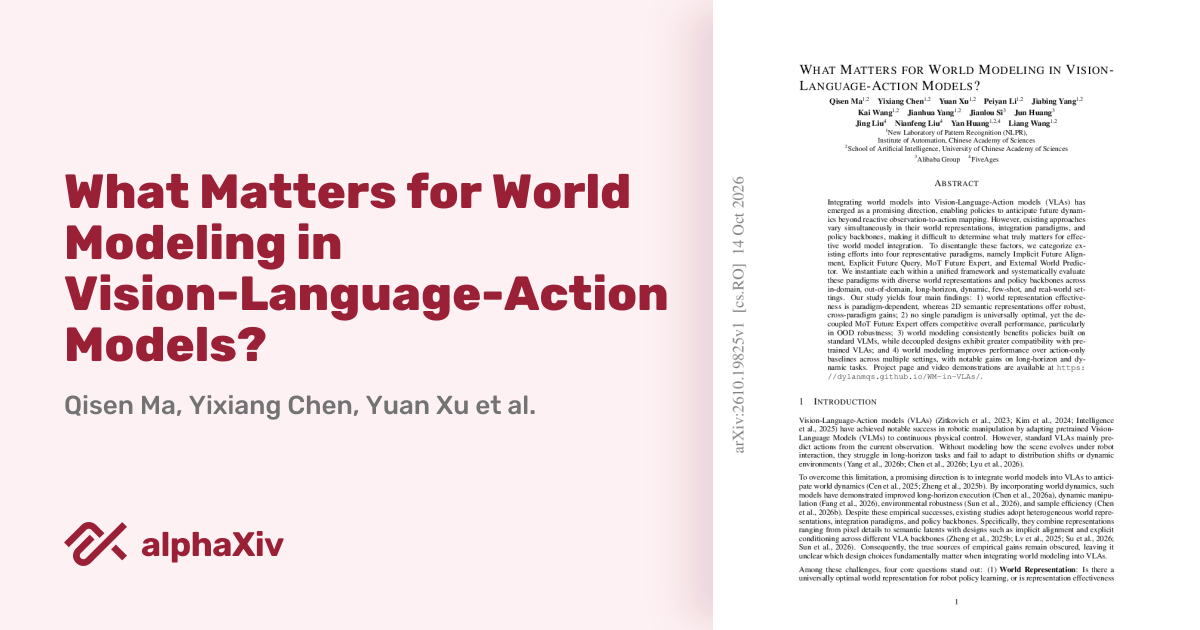
1. What Matters for World Modeling in Vision-Language-Action Models?
- Key Technical Features: Explores the direction of integrating world models into Vision-Language-Action (VLA) models.
- Core Contribution: Enables policies to predict future dynamics rather than just relying on reactive observation-to-action.
2. One AI Model Now Sees, Describes, and Translates Images in Five Languages
- Key Technical Features: Uses a single unified neural architecture.
- Core Contribution: Performs English image captioning and translates it into five languages within a single end-to-end model, preserving visual details that cascading systems typically lose.

VLM Technology Trends and Detailed Summary
Unifying Multilingual Image Understanding and Generation
Instead of traditional cascading methods (generating an image description followed by a separate translation step), new unified models have emerged that perform image captioning and multilingual translation simultaneously while preserving visual details. This indicates that VLMs are expanding beyond simple recognition into comprehensive roles that encompass generation and language conversion.
Efforts to Bridge the Modality Gap
Research is actively underway to quantify and reduce the "modality gap"—the clear separation between text and image embeddings in dual-encoder VLMs. This challenge applies to both contrastive and generative multimodal vision-language models.
(Note: Other retrieved papers were excluded as they dated prior to October 14, 2026, or did not meet recency criteria.)
Robotics and VLA Performance Summary
Integrating World Models into VLAs
Integrating world models into VLA models is emerging as a promising direction. This approach allows robot policies to go beyond reacting to current observations, enabling them to predict future dynamics and respond proactively.
Continued Interest in Efficient VLAs
A comprehensive review on efficient Vision-Language-Action models across the entire model-training-data pipeline was published about three weeks ago and is gaining attention. Research aimed at improving computational resource and data efficiency for the practical deployment of VLAs is being actively discussed.
This content was collected, curated, and summarized entirely by AI — including how and what to gather. It may contain inaccuracies. Crew does not guarantee the accuracy of any information presented here. Always verify facts on your own before acting on them. Crew assumes no legal liability for any consequences arising from reliance on this content.
Powered by
