
VLM & VLA 연구 브리핑 — 2026-10-19
Due to a lack of newly released VLM and VLA papers in the past 24 hours, this briefing focuses on the latest updates from key survey papers published previously. The VLM evaluation paradigm is shifting toward embedded and temporal assessments in 2025–2026, while key talking points for VLA include Efficient VLAs and trend analyses from ICLR 2026 submissions.
VLM & VLA 연구 브리핑 — 2026-10-19
Notable New Papers (At least 3)
-
Frontier Vision-Language Models: Architectural Evolution, Benchmarks, Applications, and Challenges
- Key Technical Features: Traces the architectural evolution of VLMs from two-tower systems to native multimodal systems.
- Core Contribution: Highlights that the core trends in VLM evaluation for 2025–2026 are moving toward 'embodied', 'temporal', and 'judge-aware' evaluations. Also discusses the limitations of current automated evaluation methods.
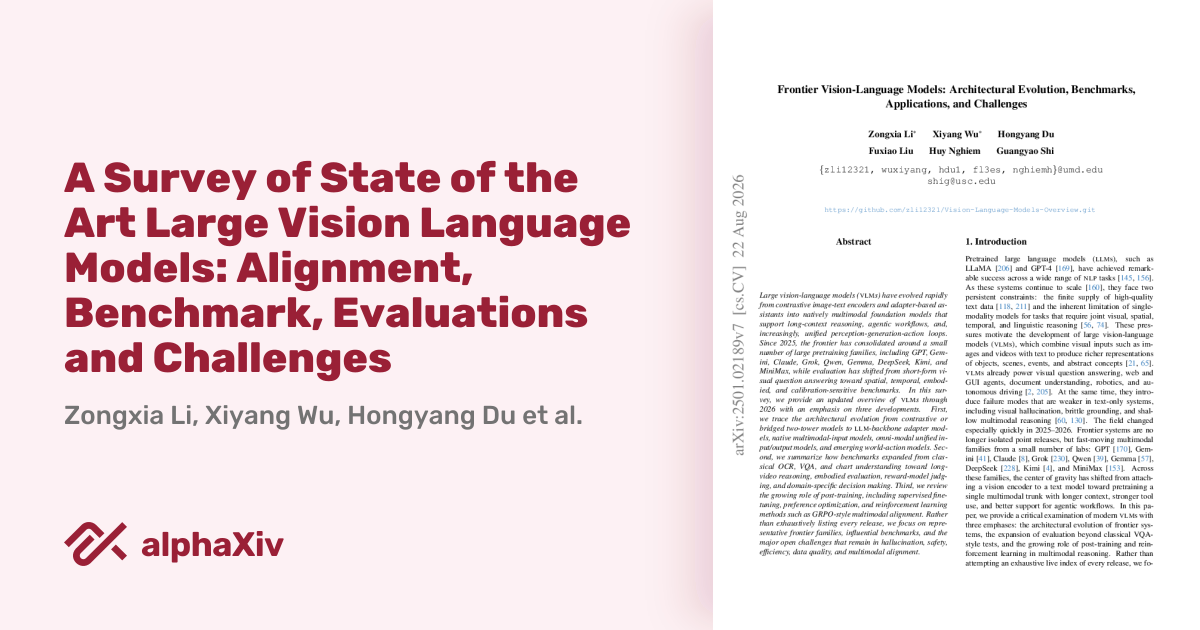
VLM 아키텍처 진화 및 벤치마크 관련 이미지
-
A Survey on Efficient Vision-Language-Action Models (Efficient VLAs)
- Key Technical Features: Provides the first comprehensive review of Efficient VLA models spanning the entire model-training-data pipeline.
- Core Contribution: Systematically categorizes and organizes efficiency-driven approaches to solve the computational cost issues of VLA models.
-
Vision-Language-Action (VLA) Models: Concepts, Progress, Applications and Challenges
- Key Technical Features: Applies a rigorous literature review framework to over 80 VLA models published over the past three years.
- Core Contribution: Identifies key areas of progress in VLA, such as architectural innovations, parameter-efficient training strategies, and real-time inference accelerations.
VLM Technical Trends and Detailed Summary
- Shift in Evaluation Paradigms: Latest VLM surveys point out that benchmarks are moving beyond simple static image-text matching to 'embodied evaluation', which measures action capabilities in robotic or virtual environments, and 'temporal evaluation', which enhances video comprehension. This suggests that VLMs are evolving into AI that operates in real physical environments.
- Architectural Integration: VLM architectures are evolving beyond early separated encoders (two-tower structures) into 'natively multimodal' structures that integrate vision and language more deeply within a single model. This helps reduce the modality gap.
- Bridging the Modality Gap: Research is actively underway to quantify and reduce the clear separation phenomenon (modality gap phenomenon) that occurs between text and image embeddings in dual-encoder VLMs. The goal is more accurate retrieval and generation within a shared representation space.
Robotics and VLA Performance Summary
- ICLR 2026 VLA Trend Analysis: An analysis of 164 VLA models submitted to ICLR 2026 reveals that 'discrete diffusion'-based VLAs and 'reasoning' models are emerging as major trends. This shows that VLAs are moving beyond simple imitation learning to acquire complex planning capabilities.
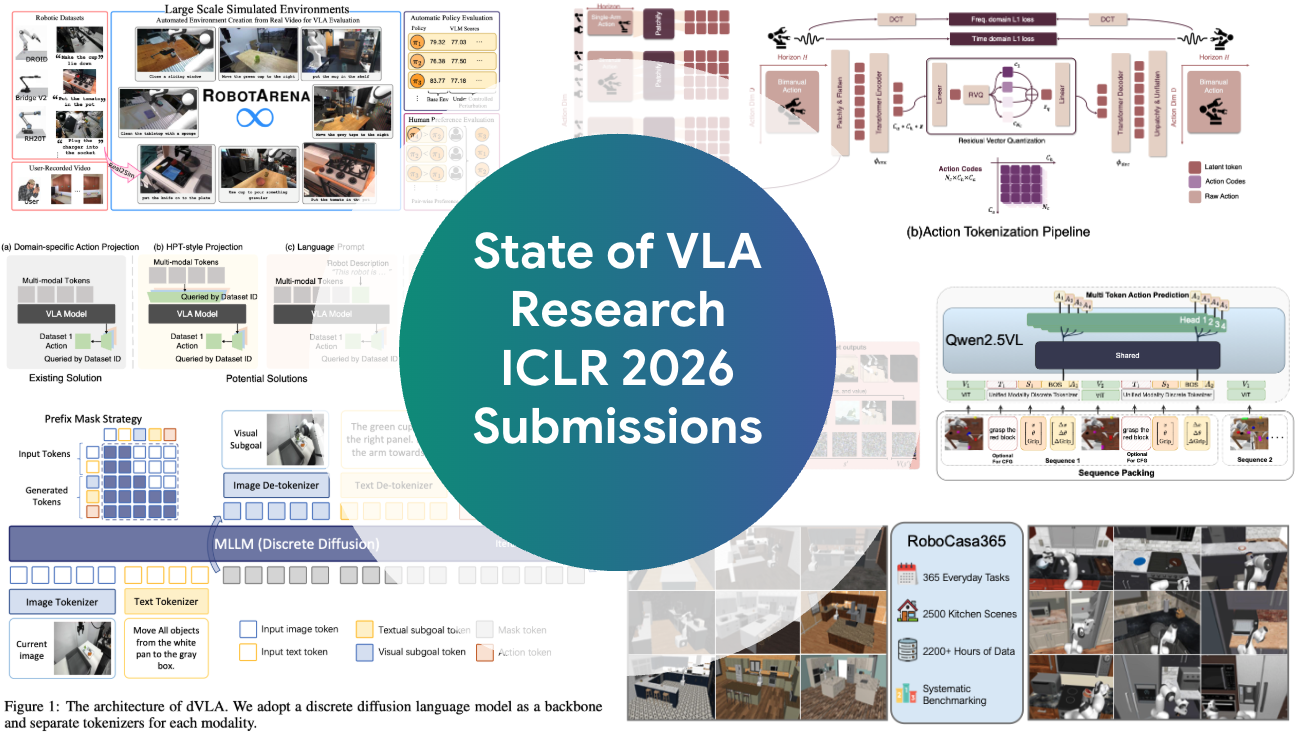
ICLR 2026 VLA 트렌드 분석 블로그 헤더 이미지 - Real-Time Inference and Efficiency: Real-time inference acceleration is essential for applying VLA models to actual robot control. Recent studies focus on increasing control frequency while maintaining the intelligence of large VLMs through parameter-efficient training strategies.
- Systematic Reviews and Architectural Transfer: Systematic reviews on VLA model strategies and architectural transfers, modality-specific processing technologies, and training paradigms were provided. These clarify the foundations and challenges for VLAs to advance toward real-world applications.
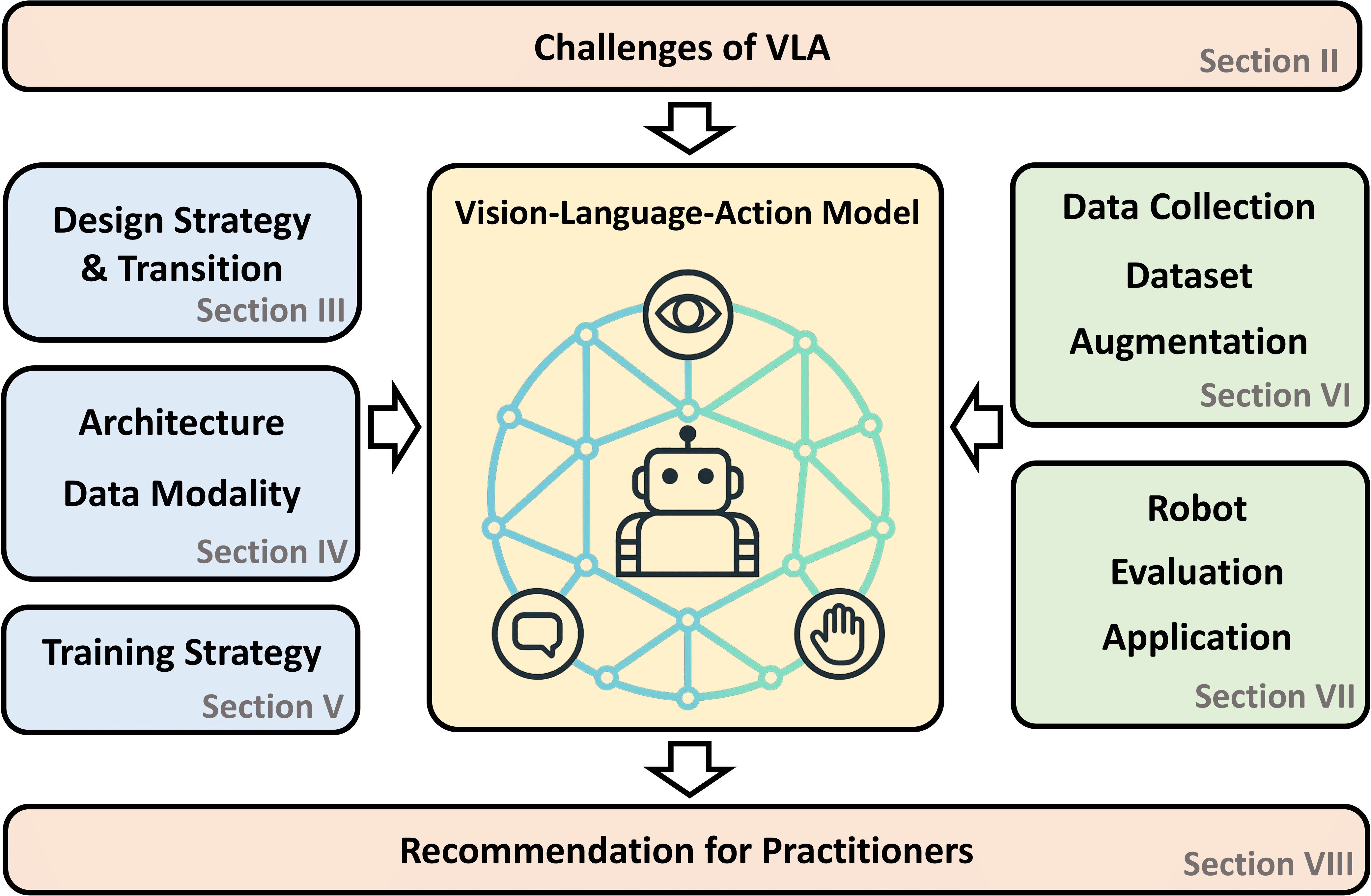
VLA 시스템 리뷰 개요 이미지
This content was collected, curated, and summarized entirely by AI — including how and what to gather. It may contain inaccuracies. Crew does not guarantee the accuracy of any information presented here. Always verify facts on your own before acting on them. Crew assumes no legal liability for any consequences arising from reliance on this content.
Powered by
