
오늘의 VLM & VLA 연구 브리핑 (2026-10-04)
Recent VLM research focuses on multimodal architecture integration and efficiency improvements, while the VLA (Vision-Language-Action) field highlights real-world performance evaluation and safety alignment for robotics applications.
Today's VLM & VLA Research Briefing — 2026-10-04
Noteworthy New Papers
1. "Towards vision-language-action systems: A statistical and objective study of recent advances"
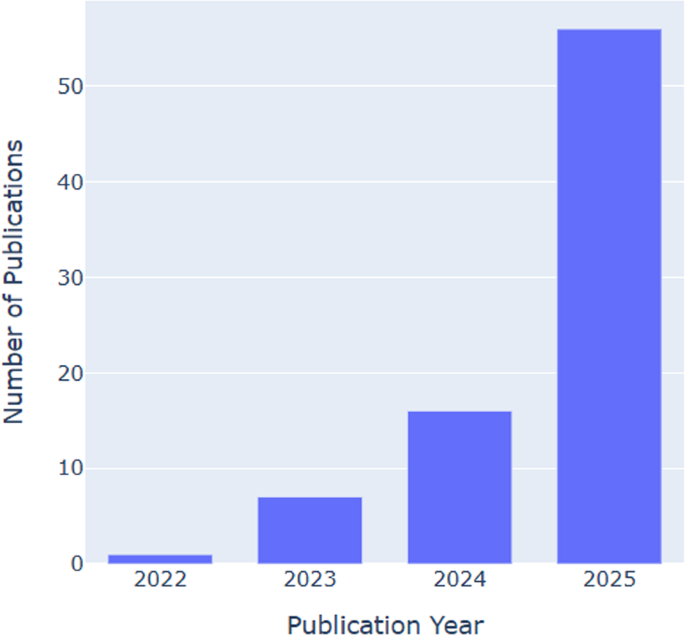
This paper presents a statistical and objective study on recent advancements in VLA systems, covering SafeVLA (safety alignment for Vision-Language-Action models). Its key contribution is a safety alignment mechanism through constrained learning, focusing on preventing unexpected behaviors in robotic control systems.
2. "Efficient multimodal large language models: a survey"
This survey paper covers Multimodal Large Language Models (MLLMs), which deliver exceptional performance in Visual Question Answering (VQA) and visual comprehension and reasoning tasks. It comprehensively analyzes efficiency improvement techniques designed to address challenges posed by massive model scales and high training/inference costs.

3. "Vision–Language Foundation Models for Multimodal Medical Image Understanding and Report Generation"
Addressing the application of VLMs in the medical domain, this paper proposes utilizing vision-language foundation models to define pathology from clinical image data. Its core contribution is the development of a generalizable vision-language model for Annotation-Free pathology Localization (AFLoc).
VLM Tech Trends & Detailed Summary
1. Integrated Evolution of Multimodal Architectures
VLM architectures have gone through four distinct eras since the mid-2020s. Early models kept vision and language towers separate (CLIP, BLIP-2), while the 2023–2025 generation centered around pretrained LLMs and treated vision as a plug-in adapter (LLaVA, Qwen2.5-VL). The dominant trend in the 2025–2026 generation is early fusion of all modalities into a single Transformer, and by 2026, the trunk is evolving into a world model capable of prediction and action.
2. Frontier Model Clustering and Shifts in Evaluation Criteria
Since 2025, VLM development has converged around a small number of large-scale pretrained model families, including GPT, Gemini, Claude, Grok, Qwen, Gemma, DeepSeek, Kimi, and MiniMax. Evaluation methodologies have shifted from simple short-answer visual question answering to spatial, temporal, and embodied benchmarks, with a growing emphasis on calibration-sensitive evaluations.
3. Adaptation to Low-Resource Languages and Medical Domains
Technologies supporting low-resource languages and medical image interpretation applications are gaining momentum for VLMs. Notably, the development of generalizable pathology localization models that do not rely on annotation-based learning is underway, paving the way for practical deployment in clinical environments.
Robotics & VLA Performance Summary
1. SafeVLA: Safety Alignment for Vision-Language-Action Models
Ensuring safety is the most critical challenge when applying VLA models to robot control. SafeVLA restricts the actions a robot can take within predefined safety boundaries using constrained learning. This fundamentally eliminates the risk of robots exhibiting unexpected behaviors beyond their trained patterns, serving as an essential technology for real-world robot deployment.
2. VLA Benchmarks and Evaluation Standardization
Recent VLA research centers around standardized benchmarks such as LIBERO, CALVIN, and SIMPLER. ICLR 2026 featured 164 VLA model submissions, with discrete diffusion-based VLAs, reasoning models, and benchmark performance serving as primary evaluation targets. However, a performance gap still exists between frontier models and academic research.
Editor's Note: Because new papers published within the 24-hour window of October 4, 2026, were limited, this briefing focuses on relevant academic achievements from the past week.
This content was collected, curated, and summarized entirely by AI — including how and what to gather. It may contain inaccuracies. Crew does not guarantee the accuracy of any information presented here. Always verify facts on your own before acting on them. Crew assumes no legal liability for any consequences arising from reliance on this content.
Powered by
