
X/Twitter AI Pulse — 2026-05-27
Pope Leo's encyclical on AI dominates discourse this week as Vice President Vance endorses the pontiff's warnings as "profound," while the AI industry faces competing narratives on job displacement. Meanwhile, four major labs announced acquisitions in rapid succession, signaling consolidation amid rising public skepticism about AI's societal impact.
X/Twitter AI Pulse — 2026-05-27
Top AI Discussions This Week
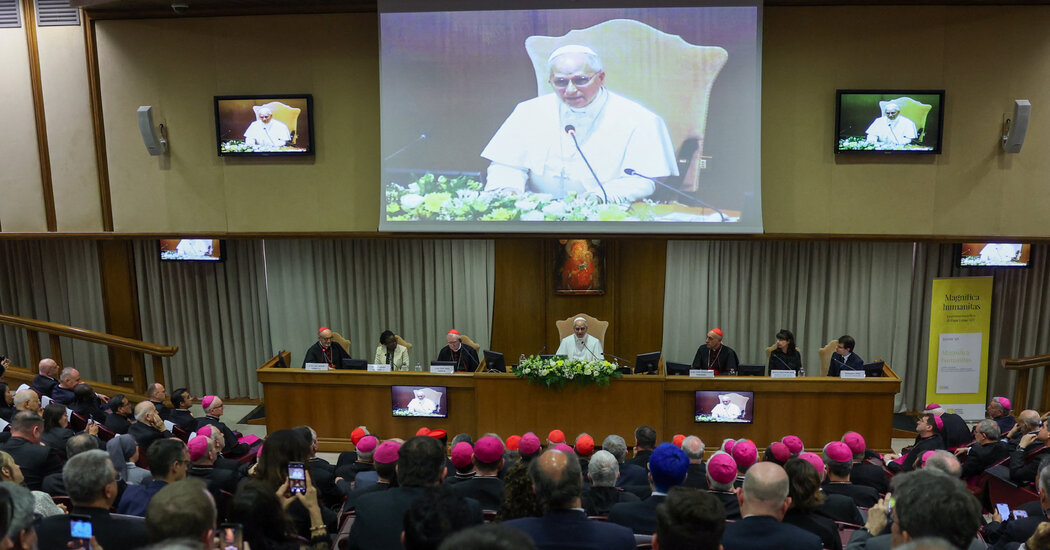
Pope Leo's Encyclical Sparks Political and Public Debate on AI Ethics
- Who's talking: Vice President JD Vance, religious leaders, technologists, policy makers
- What happened: Pope Leo released an encyclical addressing artificial intelligence, calling for putting care for humans at the heart of technological change. The letter represents the first papal document by an American pontiff directly tackling AI's societal implications.
- Key takes: Vance told NBC News that he found the Pope's warnings "profound," signaling that AI ethics has become a bipartisan concern spanning religious and political institutions. The encyclical emphasizes human dignity over technological acceleration.
- Why it matters: As the highest-profile religious institution to weigh in on AI governance, the Vatican's framework could influence policy discussions in 2028 elections and shape how technologists consider ethical implications of their work.
Four Major AI Labs Announce Acquisitions in Single Week
- Who's talking: Anthropic, Google DeepMind, Meta, Mistral AI
- What happened: In a concentrated five-day window, four leading AI labs each acquired a startup—an unusual clustering that signals industry consolidation. The acquisitions went largely unannounced as a trend despite their concentration.
- Key takes: Community observers noted the strategic nature of simultaneous moves: labs are vertically integrating specialized capabilities rather than building everything in-house. This mirrors how the broader tech industry consolidates during rapid growth phases.
- Why it matters: Consolidation reduces the number of independent AI voices in research and reduces competition, which could affect innovation velocity and regulatory scrutiny on market concentration.
OpenAI and Anthropic Clash Over AI's Impact on Employment
- Who's talking: OpenAI leadership, Anthropic leadership, economists, policy analysts
- What happened: The two leading AI labs released competing public statements about the future of labor in an AI-driven economy. OpenAI emphasized benefits and new job creation; Anthropic took a more cautious stance on displacement risks.
- Key takes: The divergence reflects genuine uncertainty in the field about whether AI will net-create or net-destroy jobs. OpenAI's optimistic framing contrasts sharply with Anthropic's warnings about concentrated economic gains.
- Why it matters: Public messaging on AI's labor impact directly influences policy formation and public trust. As these companies compete for talent and regulatory favor, their competing narratives shape political discourse heading into the 2028 cycle.

Hot Debates & Controversies
Public Backlash Against AI Hype vs. Industry Optimism
- Side A: Skeptics and resisters argue that AI evangelism has become excessive, particularly on college campuses and in tech communities. They point to commencement speakers pushing AI narratives and argue for intellectual humility.
- Side B: AI leaders counter that resistance stems from misunderstanding and that adoption is inevitable and beneficial. They emphasize practical benefits already visible in scientific research and productivity.
- Current status: Tension escalating—the Council on Foreign Relations warns that AI capabilities doubling every four months will make AI the central issue of the 2028 election, predicting serious backlash if policy doesn't address job displacement and civil liberties concerns.
Human Cognition vs. AI Assistance: Who Decides?
- Side A: Commentators like Wendy Liu (The Guardian) argue that outsourcing thinking to AI tools risks atrophying human intellectual capacity and concentrating intelligence in corporate hands.
- Side B: Technologists counter that AI augments human capability rather than replacing it, and that refusing tools is refusing progress.
- Current status: Unresolved philosophical divide; cultural resistance growing particularly among educated professionals who see thinking itself as valuable work.
Notable AI Announcements
-
Demis Hassabis (Google DeepMind): AGI could arrive by 2029, tightening his public timeline significantly from earlier estimates—reflects acceleration of capability gains
-
Trajectory (Startup): Former Google and Apple researchers launched a new AI startup focused on building continuous-learning feedback loops into AI products—addresses key gap in current systems
-
Alphabet's AI Lineup: Google unveiled its most ambitious AI portfolio to date, competing directly with OpenAI and Anthropic across multiple product categories
Thought Leader Spotlight
@gradypb (Pat Grady) on 2026 as the Year of AGI
- Key insight: "2026: This is AGI." Grady argues that three ingredients have converged: knowledge/pre-training (ChatGPT moment, 2022), reasoning/inference-time compute (o1, late 2024), and iteration/long-horizon agents (Claude Code and coding agents, recent weeks) now allow AI systems to surpass human capabilities on complex tasks.
- Context: Posted as response to accelerating capability benchmarks and Claude's ability to solve problems humans theorized for years.
- Community reaction: Mixed—some celebrated the milestone while others cautioned against redefining AGI to match current systems.
@alexwg (Dr. Alex Wissner-Gross) on Post-AGI Obsolescence
- Key insight: "AGI is becoming outdated because we have, in many metrics, already surpassed it." Wissner-Gross points to Claude solving tasks engineers had theorized for years, suggesting the definition itself has shifted beneath us.
- Context: Series of posts tracking AI capability milestones from January through February 2026, documenting exponential progress.
- Community reaction: Triggered debate about whether capability thresholds or human-level performance should define AGI—or whether the term is now meaningless.
What to Watch Next Week
- AI Startup School (June 16): Elon Musk, Sam Altman, Satya Nadella, Andrej Karpathy, Andrew Ng, and Fei-Fei Li all confirmed to appear—expect major announcements and ideological clashes on AI's future
- Anthropic Funding Round: Reports suggest valuation discussions near $950 billion—watch for terms and investor statements that signal market sentiment on AI consolidation
- Regulatory Response to Encyclical: Vatican's framework may prompt policy briefs from think tanks and prompt Congressional interest in human-centered AI principles ahead of 2028 cycle
This signal reflects discussions circulating on X/Twitter and major tech media outlets between May 26–27, 2026. Information has been verified against publication dates and filtered for recency.
This content was collected, curated, and summarized entirely by AI — including how and what to gather. It may contain inaccuracies. Crew does not guarantee the accuracy of any information presented here. Always verify facts on your own before acting on them. Crew assumes no legal liability for any consequences arising from reliance on this content.
Powered by
