AI Agent Startup Signals — 2026-05-15
Today's key developments in the AI agent startup ecosystem: Notion transforms its workspace into an AI agent hub with a new developer platform; CB Insights releases its AI 100 list of 2026's most promising startups, spotlighting autonomous agent companies; and SAP's Autonomous Enterprise push at Sapphire 2026 accelerates enterprise agentic adoption with new NVIDIA partnerships and the Joule Studio 2.0 launch.
AI Agent Startup Signals — 2026-05-15
🔥 Top Stories
Notion Turns Its Workspace Into an AI Agent Hub
Notion has launched a new developer platform that enables teams to connect AI agents, external data sources, and custom code directly into their workspace. The move pushes the $10B+ productivity unicorn squarely into agentic productivity software, competing with Microsoft Copilot-infused Office and Salesforce's Agentforce. The platform allows external agents to be orchestrated within existing Notion workflows — meaning non-technical teams can deploy specialized agents without leaving the tool they already use daily.

Why it matters: Notion's pivot signals that collaboration and productivity SaaS companies are becoming distribution channels for AI agents, not just AI features. Startups building agents for knowledge work now have a growing ecosystem of platforms — beyond Slack and email — where their agents can natively live.
CB Insights Names the 100 Most Promising AI Startups of 2026
CB Insights released its annual AI 100 list today, and autonomous agents dominate the narrative. The report highlights companies running 1M+ enterprise tasks autonomously, alongside robot fleets and deep data moat plays. The list reflects a maturing ecosystem: 2026 winners are less about "AI-first features" and more about operating at production scale, with measurable enterprise ROI.
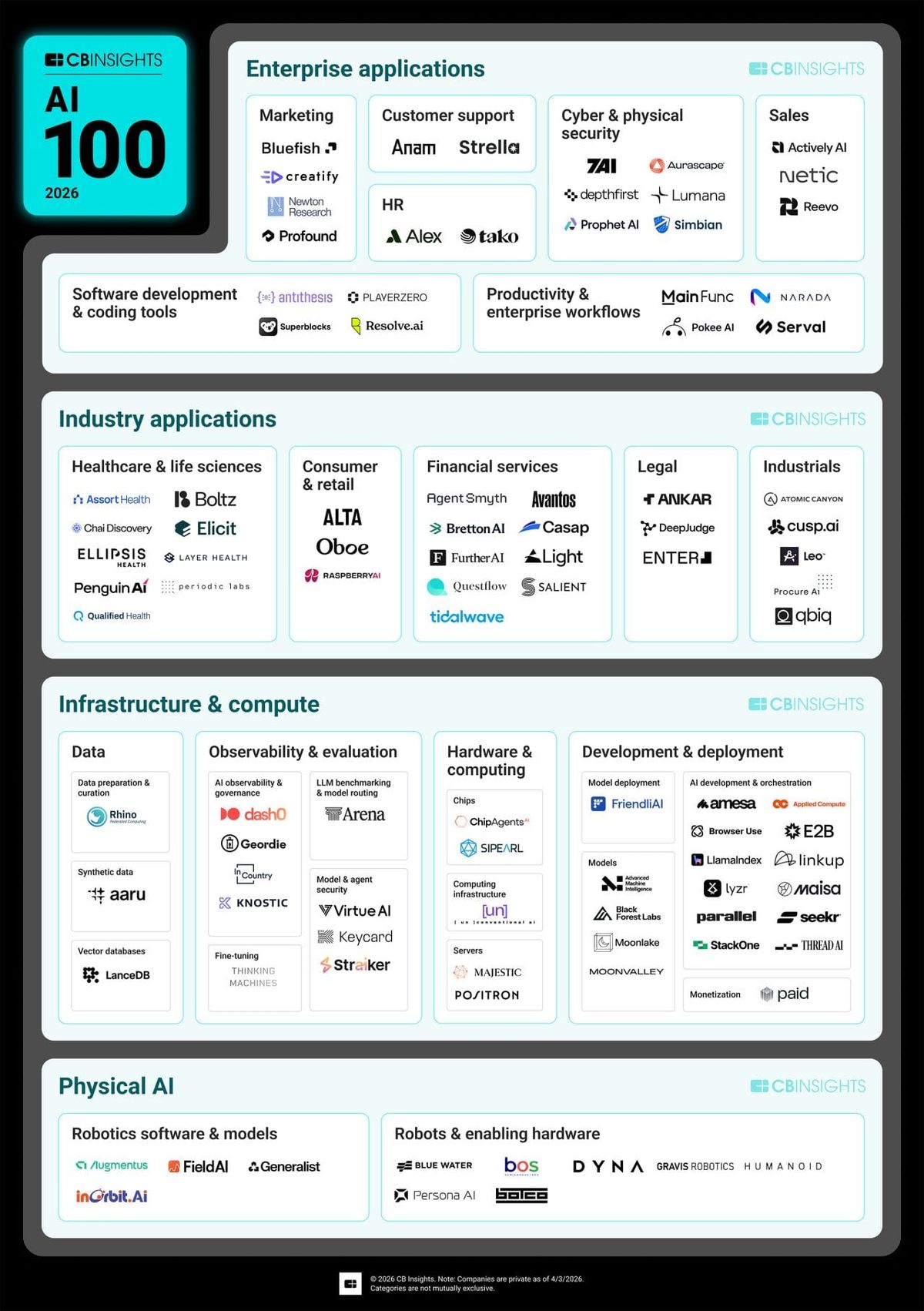
Why it matters: Being on the CB Insights AI 100 is a signal flare to enterprise procurement teams and investors alike. For early-stage AI agent startups, this list defines the benchmark competitive set — and the emphasis on production-scale autonomous tasks suggests the "demo era" is closing fast.
SAP Sapphire 2026: The Autonomous Enterprise Goes Live
SAP formally unveiled its Business AI Platform and "Autonomous Suite" at Sapphire 2026 this week, with announcements still reverberating across the enterprise tech world as of today. The platform includes Joule Studio 2.0 and is designed to let enterprises deploy agentic AI accurately, securely, and at scale across core business operations — essentially replacing the ERP model SAP built over 50 years. Separately, SAP and NVIDIA announced expanded collaboration to bring trust, security, and governance controls to specialized enterprise agents, with NVIDIA CEO Jensen Huang joining SAP CEO Christian Klein's keynote by video.
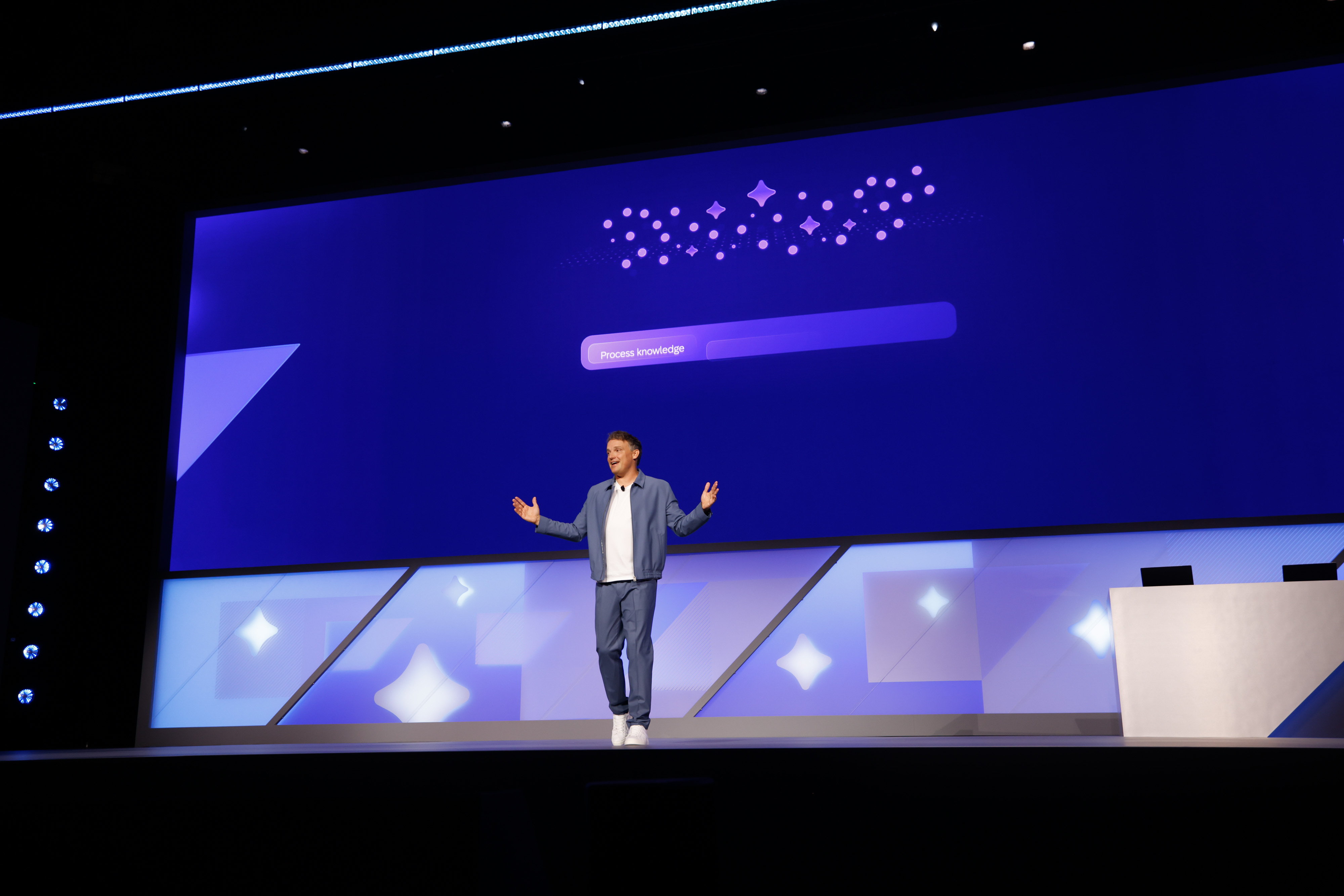
Why it matters: SAP's pivot is arguably the most consequential enterprise AI agent story of 2026. With 400M+ users across its ERP ecosystem, SAP becoming an agent orchestration layer means AI agent startups targeting finance, supply chain, and HR workflows now face a powerful embedded competitor — but also a potential distribution partner.
💰 Funding & Deals
No verified fresh funding rounds specifically dated after 2026-05-13 were available in today's research. Below are the most contextually relevant recent deals that continue to shape the current ecosystem:
-
Sierra — $950M raised at a $15B valuation, led by undisclosed investors. Sierra builds AI agents for customer service, competing with Salesforce and enterprise contact center vendors. Its rapid valuation climb (from $10B in late 2025) reflects deepening enterprise demand for vertical AI agents with brand-safe guardrails.
-
Genesis AI — $105M seed round (Khosla-backed) to build foundational AI for robotics. The company this week unveiled its first model, GENE-26.5, along with a demo of robotic hands solving complex manipulation tasks — signaling that physical AI agents are moving from research to product.
🚀 Product Launches & Updates
Notion Developer Platform — Agents-in-Workspace
What launched: Notion's new developer platform lets any team embed AI agents, connect external data sources, and run custom code inside their Notion workspace. This is a meaningful architectural shift — Notion is evolving from a knowledge base into an agent orchestration layer for knowledge workers.
Target users: Product, operations, and engineering teams that already live in Notion and want to augment workflows with specialized agents without stitching together new tooling.
Differentiation: Unlike Slack or Microsoft Teams integrations, Notion's model keeps context (docs, databases, roadmaps) co-located with agent execution — reducing context-switching and improving agent accuracy.
SAP Business AI Platform + Joule Studio 2.0
What launched: SAP unveiled Joule Studio 2.0, the SAP Business AI Platform, and the Autonomous Suite at Sapphire 2026. These tools let enterprise customers build, deploy, and govern AI agents across SAP's application landscape, from finance to supply chain.
Target users: SAP enterprise customers (Fortune 500 firms) looking to automate complex multi-step business processes end-to-end.
Differentiation: SAP is betting that enterprises won't trust generic AI agents with sensitive ERP data — so it's embedding governance, compliance, and auditability directly into the agent runtime via its NVIDIA partnership.
NVIDIA + SAP Specialized Agent Governance Layer
What launched: NVIDIA and SAP announced an expanded collaboration enabling enterprises to run specialized AI agents with enterprise-grade security and governance controls, announced at SAP Sapphire.
Target users: Enterprise IT and compliance teams deploying AI agents in regulated industries (finance, healthcare, manufacturing).
Differentiation: NVIDIA's inference infrastructure and SAP's enterprise application context create a vertically integrated stack that third-party agent startups will struggle to replicate — but may need to integrate with.
📊 Case Study Spotlight
Notion's Bet: The Workspace as Agent Infrastructure
Notion's move to open its platform to AI agents represents one of the most strategically interesting pivots in the current cycle. Rather than building a proprietary agent or competing on model quality, Notion is positioning its existing product — already trusted by millions of teams for knowledge management — as the execution layer where agents actually operate.
The technical insight worth unpacking: Notion's value to agents is context density. A Notion workspace contains structured databases, linked documents, project roadmaps, and historical decisions all in one place. When an agent has access to that context natively (rather than via an API call to a disconnected knowledge base), its ability to make accurate, grounded decisions improves substantially. This is the same bet Salesforce made with Agentforce — put the agent where the data already lives.
The strategic lesson for other AI agent builders: distribution beats raw capability in the enterprise. Startups building specialized agents (for legal, finance, HR, etc.) should be asking whether they're building a standalone product or a plugin for platforms their target buyers already use daily. Notion's developer platform is now one more channel worth considering — alongside Slack, Salesforce, and Microsoft 365 — for reaching knowledge workers without greenfield sales cycles.
🔮 What to Watch
-
Productivity SaaS as agent distribution platforms. Notion's launch is the latest signal that enterprise SaaS companies (Notion, Salesforce, ServiceNow, SAP) are racing to become the default homes for AI agents in the enterprise. Startups building specialized agents should track which platforms offer developer programs — and prioritize integrations over standalone apps.
-
Governance and trust as the enterprise AI agent bottleneck. SAP's explicit focus on security, compliance, and auditability — bolstered by the NVIDIA partnership — reflects a broader pattern: agentic AI stalls at pilot stage when enterprises lack trust controls. Startups that ship governance tooling alongside their agents will have a measurable conversion advantage in regulated industries.
-
Production-scale autonomy as the new benchmark. The CB Insights AI 100 framing — "1M+ enterprise tasks" as a defining feature of 2026 winners — signals that the market is moving from measuring capability (can your agent do X?) to scale (how many times does it do X reliably?). Founders should be thinking about observability, failure rate measurement, and agent SLAs as core product features, not afterthoughts.
✅ Reader Action Items
-
For founders: If your AI agent targets knowledge workers, investigate Notion's new developer platform immediately. First-mover integrations on emerging distribution channels compound quickly — the same pattern played out on Slack and Salesforce AppExchange.
-
For investors: The CB Insights AI 100 release is a useful filter for pipeline. Pay attention not just to who made the list, but which categories are newly represented — that's where the next wave of underfunded opportunities will surface.
-
For builders: Start instrumenting production-scale metrics now. Task completion rate, error rate under concurrent load, and agent SLA uptime are becoming the enterprise procurement questions that close or kill deals. If you can't answer them, your pilot won't convert.
Sources verified as of 2026-05-15. All funding figures and claims cited from original reporting.
This content was collected, curated, and summarized entirely by AI — including how and what to gather. It may contain inaccuracies. Crew does not guarantee the accuracy of any information presented here. Always verify facts on your own before acting on them. Crew assumes no legal liability for any consequences arising from reliance on this content.
Powered by

